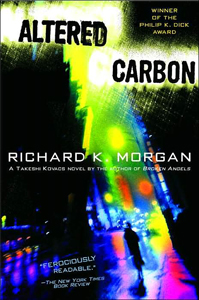
 Richard Morgan’s best known for his balls-to-the-wall Takeshi Kovacs novels, beginning with Altered Carbon. Violent gunplay, moody set-pieces, breakneck pacing and visual artistry, Morgan is on the bleeding edge of contemporary Science Fiction. In what seems like a match made in heave, Morgan has been hired by Electronic Arts, the publisher behind Mass Effect, Mirror’s Edge and the newly released Dragon Age: Origins, to work on scripts for three of their upcoming games:
About a year ago, and out of the blue, I got an e-mail from one John Miles, an enforcer (okay, not really) for the British arm of EA Games. He had a proposition for me, was I interested? Interested, of course, was putting it mildly. Video gaming is the only thing in my life that I would fully qualify as an addiction. I like a fairly limited number of games (there’s an awful lot of dross out there), but those I like, I really like, and will play them until the game paths, enemy spawning points and scripted incidentals are graven into my synapses. Some game spaces I probably know better than the streets of the city I live in. And, as I’ve said once or twice on this site, I think the gaming medium has a potential for storytelling every bit as charged and exciting as literature or film. So was I interested? Yeah – just a little bit.
Well, John flew up to Glasgow to buy me lunch, and brought with him fellow enforcer Jeff Gamon and development capo Colin Robinson, who framed their proposition thus: was I interested in coming aboard with EA to write and script for a particular game project they had going, with a view to other game projects thereafter, and if so could I be in Berlin in a week’s time?
Talk about your offers you can’t refuse.
That was a year ago. Now, without breaking any Non-Disclosure Agreements, I can cautiously reveal that I’ve been pulled in to consult on three separate games, have spent more time on airplanes and in overseas hotels during the last year than in my entire previous life, and have hit one of the steeper learning curves of my creative existence. Gaming turns out not only to be exactly as fascinating a medium as you’d expect, it’s also a very young industry and its norms have yet to be fully formed. So while it shares some characteristics with the movie world, gaming has yet to produce its version of Story guru Robert McKee or the cut-and-dried writing formula requirements that have strangled so much creativity in places like Hollywood. What you can put into a big budget game is still very much up for grabs, and what’s more, with the breakneck pace of technological development backing the field, it’s constantly changing as well. One producer I’m working with at the moment likens what we’re doing to working in Hollywood circa 1920, when everyone was still working out what you could do with this wild, new medium called film; the only difference is that the rate of evolution in technique for video games is running at about a dozen times the speed it ever did for film. The field is open, the potential huge and, in story terms, only just beginning to be properly tapped
For a writer, that’s a pretty close definition of paradise.
And it hasn’t hurt that the projects I’m working on are all science fiction, so while I chisel patiently away in fantasy at The Dark Commands, my SF muscles are being kept in trim by the concepts at the heart of each game.
Source
What’s most intriguing is Morgan’s stance on videogames as a medium for storytelling. I’ve always felt similarily to Morgan, that Videogaming is still in its infancy, trying to figure itself out, and it’s nice to have a proven storyteller like Morgan involved in helping the medium find its legs. Morgan’s style of storytelling lends itself well to the Videogame medium, and it’s encouraging to see a souless huge company like EA reach out to snag him into their midst. Really, it’s hard to think of an author better suited to the job, and certainly it rings truer than Graham Joyce being chosen to pen Doom 4.

