From Ahmed’s blog:
The Crescent Moon Kingdoms, land of djenn and ghuls, holy warriors and heretics, Khalifs and killers, is at the boiling point of a power struggle between the iron-fisted Khalif and the mysterious master thief known as the Falcon Prince. In the midst of this brewing rebellion a series of brutal supernatural murders strikes at the heart of the Kingdoms.
Doctor Adoulla Makhslood, the last real ghul hunter in the great city of Dhamsawaat, just wants a quiet cup of tea. A fat old man who has grown weary of hunting monsters and saving lives, he’s more than ready to retire from his dangerous vocation. But when an old flame’s family is murdered, Adoulla is drawn back to the hunter’s path.
Adoulla’s young assistant Raseed, a hidebound holy warrior whose prowess is matched only by his piety, is eager to deliver God’s justice. But even as Raseed’s sword is tested by ghuls and manjackals, his soul is tested when he and Adoulla cross paths with the tribeswoman Zamia.
Zamia Badawi, Protector of the Band, has been gifted with the power of the Lion-Shape, but shunned by her people for daring to take up a man’s title. She lives only to avenge her father’s death. Until she learns that Adoulla and his allies also hunt her father’s killer. Until she meets Raseed.
When they learn that the murders and the Falcon Prince’s brewing revolution are connected, the companions must race against time – and struggle against their own misgivings – to save the life of a vicious despot. In so doing they discover a plot for the Throne of the Crescent Moon that threatens to turn Dhamsawaat, and the world itself, into a blood-soaked ruin.
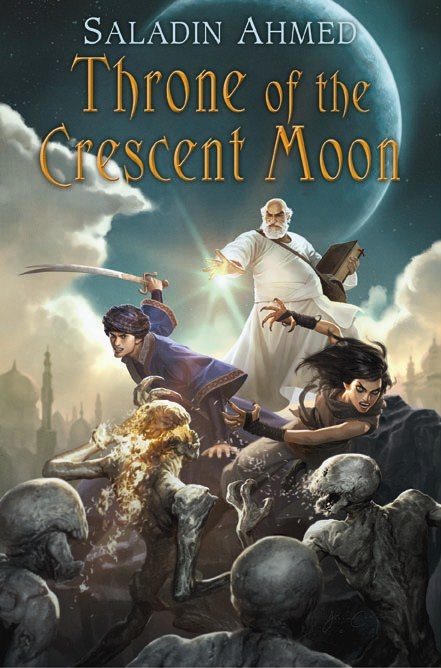
I written before about Jason Chan and his artwork. I appreciate how he’s able to straddle that thin line between fun/serious without falling into looking like a cheap comic book. I like this, though Doctor Adoulla Makhslood (who I’ve enjoyed since first discovering Ahmed’s short fiction), doesn’t look nearly as down-in-the-gutter ragged and imposing as I always pictured him. It’s fun and reminds me of old Sword & Sorcery novels from Lieber, Howard and their ilk (which, from what I can tell, is accurate of the novel, too). It’s also nice to see DAW embracing the Middle Eastern roots, rather than painting it with a more ambiguous image (as we’ve too often seen).