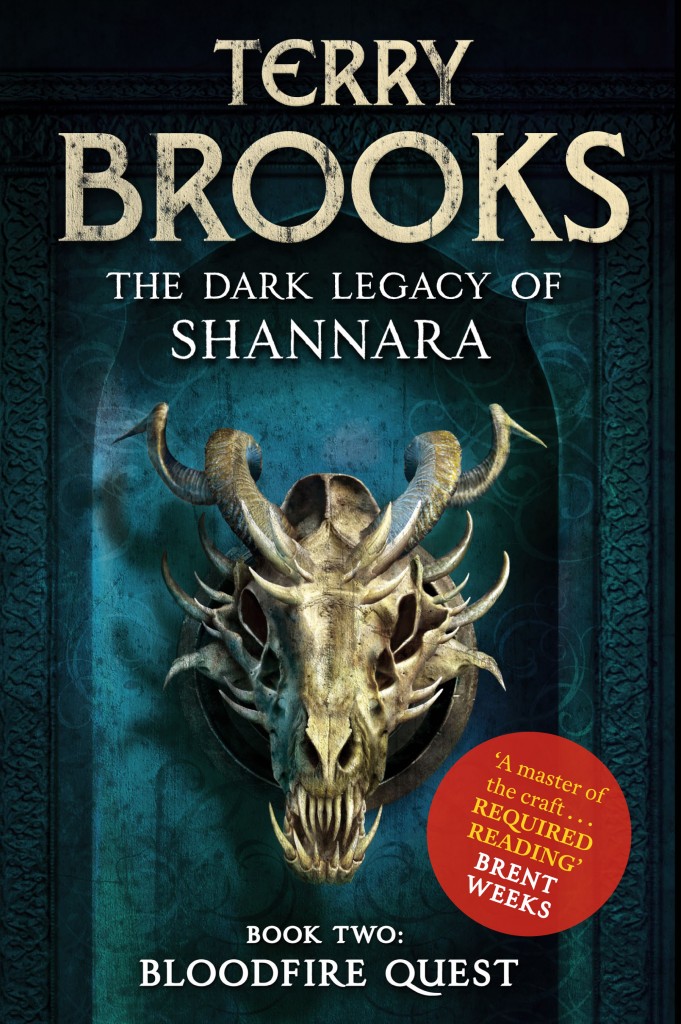
It’s a nice new direction for Terry Brooks, and an improvement on his North American covers, even though I like the new ones well enough, but it won’t blow anyone out of the water. And, man, that big red circle is an eyesore.
It’s a nice new direction for Terry Brooks, and an improvement on his North American covers, even though I like the new ones well enough, but it won’t blow anyone out of the water. And, man, that big red circle is an eyesore.
 One of my favourite weekly features in the blogosphere in Mieneke Van Der Salm’s Blogger Query interviews. Every Wednesday, she pulls one blogger or reviewer and puts them to question. It’s a fun way to get to know some of the personalities in SFF fandom. And, well, this week was my turn.
A little snippet:
You’ve been quite outspoken about the lack of regard for blogs as fan publications and bloggers as fan writers, mostly in regard to the Hugos. Do you think regard for blogs as fan publications from awards and the way the publishing industry regards blogs are intertwined? Would increased respect from the publishing industry also increase respect for blogs and bloggers from awards committees or are awards too insular for such cross-pollination?
Yeah, I’ve raised a stink or two, and been successful at opening at least a small dialogue about the matter between the incumbent fan publications (fanzines) and the up-and-coming ones (blogs). It’s something I feel very strongly about.
To be honest, I wouldn’t be so quick to link the perception of blogs and online fan writers by the publishing industry to the struggles they’ve had in being recognized by the award committees and voters. Conversely, I’d say that publishers, large and small, pay a heck of a lot more attention to blogs and the online space than they do to the traditionally published fanzines. This is keeping in the tradition and origins of fanzines, which by their nature are independent and often focus more on exploring the natures and issues of fandom, than in being a part of the PR circle that runs the publishing industry, a pitfall that blogs have to be sure to avoid. Instead, you have a new generation of writers, many of them a bit younger, in their mid-twenties to late-thirties, that is trying to break into an area that is often run and heavily influenced by an older generation that has long been entrenched in their ideals and tendencies.
Whether they’re older men or not (and, in the case of the Hugo Awards, there are over a 1,000 eligible voters, so they’re not all old men, of course), old ideas and habits still exist. It’s always been a challenge for the young whipper-snappers to push against the older generation, trying to promote new ideas and the fast-moving world that has grown up around the original foundations of awards like the traditional awards. Right now, bloggers are those young whipper-snappers, and we just need to make enough noise to ensure that, when the time comes, voters take us as seriously as we deserve.
With all that said, I think the addition of SF Signal, which I’ve contributed to on occasion, on the recent Hugo ballot is a huge step for online fan writing and blogs in general. I hope to see a continued drive in that direction. Not at the expense of great fanzines and fan writers working in more traditional mediums, but as a joining of the two, recognizing the best writing, period.
If you want to hear a bit about my thoughts on reading, writing, the Hugos and blogging, I encourage you to read the whole interview.


In a bubble, I don’t mind them. They match up somewhat well stylistically with the original cover for Boneshaker (which is used in both North America and the United Kingdom), even if the technique is a different and not nearly as appealing. I also appreciate that they feature strong heroines that haven’t been over-sexualized. But, compared against the covers for the North American editions, including the fourth volume, The Inexplicables, Dreadnought and Ganymede can’t hold a candle. Another case of the pendulum swinging slowly in favour of North America when it comes to covers.

by Terry Brooks
Hardcover
Pages: 384 pages
Publisher: Del Rey
Release Date: August 21, 2012
ISBN-10: 0345523474
Buy: Book/eBook
In the interest of full disclosure, I’m a moderator at the Official Terry Brooks Forums, a role which I take seriously and indicates my level of fandom for Brooks, but which has not coloured the following review.
In my review of Bearers of the Black Staff, the first volume of Brooks’ The Legends of Shannara duology, his most recent published work, I wrote:
[T]he real meat of Bearers of the Black Staff is in the familiar elements that begin to rear their heads. The Trolls, a race that’s played a maligned roll in many of Brooks other novels, are the stars of the show here, and much of their history is revealed to the reader, for the first time in the series. Their origin story, involving characters from The Genesis of Shannara is heavy-handed and would have been better left hinted at, but this is something Brooks fans should be used to by now. Astute readers will also begin piecing together hints of the Knights of the Word and their eventual transformation into the Druids that manipulate the world in later Shannara novels.
Ultimately, though, these familiar elements are also the novel’s (and Brooks’) weakest link. Terry Brooks has a vocabulary that he’s built up through his career. Not a vocabulary in the sense that you’d find it in a dictionary (though his prose isn’t exactly a bastion of variety, it’s serviceable and easy to read), but rather in elements, archetypes and plot devices that he uses to construct his stories. There’s next to nothing in Bearers of the Black Staff that we haven’t seen before in any of Brooks’ previous novel.
This dissatisfaction extended into the sequel, The Measure of Magic, and grew, leaving me with a bitter taste in my mouth as a longtime Shannara fan. I didn’t review The Measure of Magic, for fear of just repeating the exact same points I made in the first, with only a small measure of irony. Fast forward a year and I approached the release of Wards of Faerie with no little amount of trepidation. Since Brooks concluded The Voyage of the Jerle Shannara 10 years ago, with the exception of Armageddon’s Children, I felt disappointment with each of his novels, from mild to severe. Where was the Brooks I fell in love with as a boy, first discovering Fantasy? Was he gone? Or was I simply grown up, better read and unable to appreciate the type of fiction that Brooks writes? Read More »
The Great Reawakening did not come quietly. Across the country and in every nation, people began to develop terrifying powers—summoning storms, raising the dead, and setting everything they touch ablaze. Overnight the rules changed… but not for everyone.
Colonel Alan Bookbinder is an army bureaucrat whose worst war wound is a paper-cut. But after he develops magical powers, he is torn from everything he knows and thrown onto the front-lines.
Drafted into the Supernatural Operations Corps in a new and dangerous world, Bookbinder finds himself in command of Forward Operating Base Frontier—cut off, surrounded by monsters, and on the brink of being overrun.
Now, he must find the will to lead the people of FOB Frontier out of hell, even if the one hope of salvation lies in teaming up with the man whose own magical powers put the base in such grave danger in the first place—Oscar Britton, public enemy number one…
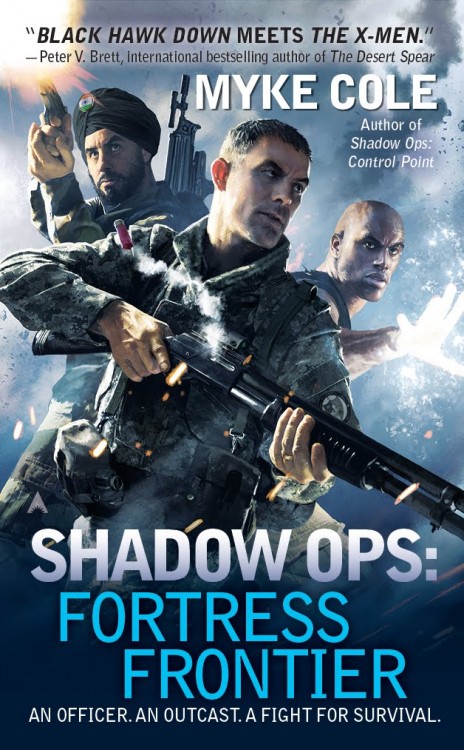
I still haven’t read Cole’s work, despite hearing great things about it from many readers, but I like this cover, so I wanted to post it anyway. Sure, it’s cheezy and overloaded with testosterone, but it’s great to see Ace Books not shy away from the ethnic diversity in Cole’s novels. Are genre marketing departments finally starting to wake up? Let’s hope so.
