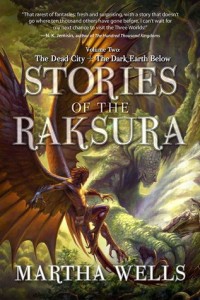
Stories of the Raksura: Volume Two: The Dead City & The Dark Earth Below by Martha Wells
Publisher: Night Shade Books -
Pages: 232 -
Buy: Book/eBook
When the first book in Martha Wells’s Raksura series, The Cloud Roads, was released in 2011, I was wary of it despite the many positive reviews I saw from people I trusted. This wariness had nothing to do with disliking the premise, wherein a dragonesque shapeshifter, Moon, raised without any knowledge of his species in a world abounding with sentient peoples, suddenly discovers his heritage and must struggle to make a place for himself, but rather stemmed from the opposite concern. The Cloud Roads sounded like everything I’d ever wanted in a fantasy novel but had never seen done properly, and I was nervous about getting my hopes up.
To provide some personal context, I spent a not inconsiderable portion of my early internetting years on a still-extant SFF site called Elfwood, which serves as a repository for fantasy-themed artwork and stories, both original and fan-made. On this site, there were multiple stories by the same author about sentient dragons that focussed purely on the romance and politics of their lives, and at a point in time where dragons were basically my favourite thing in the world, they made an indelible impression. There were other stories I loved in a similar vein, often about girls who could shapeshift from human to dragon – I suspect, at the time, a lot of young writers were equally inspired by Anne McCaffrey’s Pern books – or sentient wolves, or other non-human creatures, and it says something about their collective impact that, almost twenty years later, I still think about them fondly. Read More »
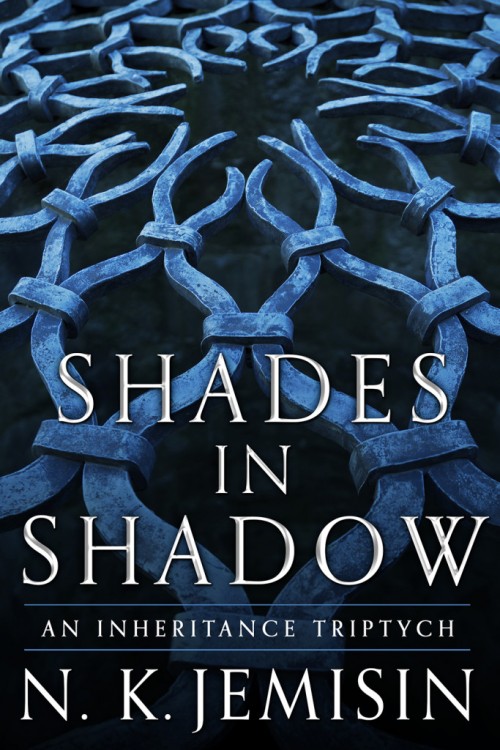
Yesterday, Orbit Books announced Shades in Shadow a collection of three short stories from N.K. Jemisin. Each of the three stories in the collection is set in the same world as Jemisin’s Hugo Award-nominated Inheritance Trilogy.
From the shadows of the greater stories, away from the bright light of Sky and wending ’round the sagas of the Arameri, come three quieter tales. A newborn god with an old, old soul struggles to find a reason to live. A powerful demon searches for her father, and answers. And in a prequel to the Inheritance Trilogy, a newly-enslaved Nahadoth forges a dark alliance with a mortal, for survival… and revenge.
The fantasy world can never have too many stories from Jemisin, who’s one of the brightest and most talented writers in the genre, and returning to the world of the Inheritance trilogy is just icing on the cake. Can’t wait to get my hands on this.
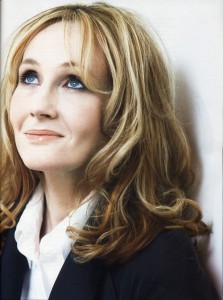
On the 18th anniversary of the publication of Harry Potter and the Sorcerer’s Stone, J.K. Rowling announced the next installment of the immensely popular fantasy series: Harry Potter and the Cursed Child. But, hold onto your britches… it’s not a novel. It’s actually the long talked-about theatrical production that Rowling first revealed in 2013. Sonia Friedman and Colin Callender will produce, and the score will be provided by Imogen Heap (!!).
According to its producers, will “tell the ‘untold part’ of the boy wizard’s story, including the story of the lives of his murdered parents.” This, however, contradicts Rowling’s statement on Twitter that the play “is not a prequel!” Perhaps the narrative of Harry’s childhood and his parents’ lives are wrapped around storytelling motif featuring an older Harry Potter and his children?
Friedman and Callender also revealed that the play will feature many popular characters from the series, and “will offer a unique insight into the heart and mind of the now legendary young wizard”
Why not a novel? “I am confident that when audiences see the play they will agree that it was the only proper medium for the story,” Rowling teased.
The first run of Harry Potter and the Cursed Child will run at the Palace Theatre in London during the summer of 2016.
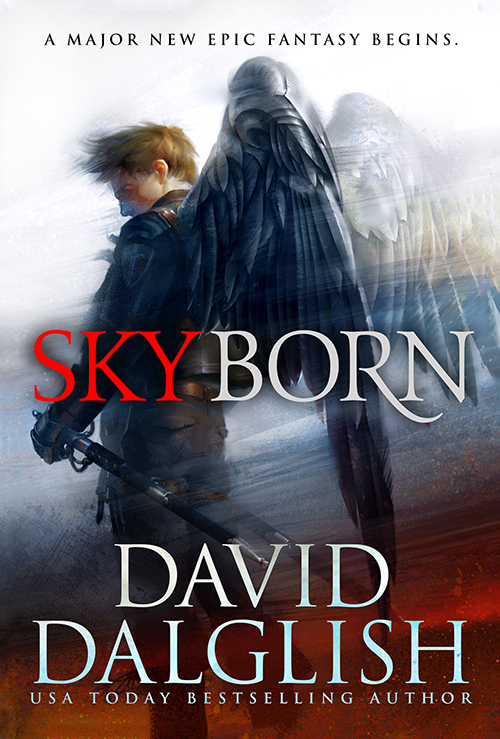
I adore this cover. For being bold, and putting focus on what makes the character interesting (his wings), rather than trying to create a clear image of the character himself. Lovely, simple typography (including the stylized R), and Arnold’s soft, impressionistic style are perfect for bringing together a cover you just can’t ignore.
“Skyborn is about the Seraphim, an elite military force protecting a floating island of Weshern,” said Kirk Benshoff, Art Director at Orbit Books. “The Seraphim guard the remnants of mankind, defying gravity using ancient wings and mastering powerful elements to wage war in the skies.” Starring militarized sword-wielding soldiers with huge metal wings, Skyborn begs for a cover that shows off Daglish’s unique denizens of Weshern. Artist Tommy Arnold was the perfect fit, says Benshoff.
“In what I would call serendipitous timing, the work of Tommy Arnold came across my desk as we were discussing the covers,” he said. “His style just hit the nail on the head for this project. His ability to illustrate characters was spot on. He could also handle textures beautifully: fabrics, metals, flames, etc. And most importantly, his illustrations really pull the viewer in and engage you. It was a no brainer in reaching out to get Tommy on board.”
This book just landed pretty high atop my fall “to-read” pile. Skyborn will be released by Orbit Books in November, 2015.
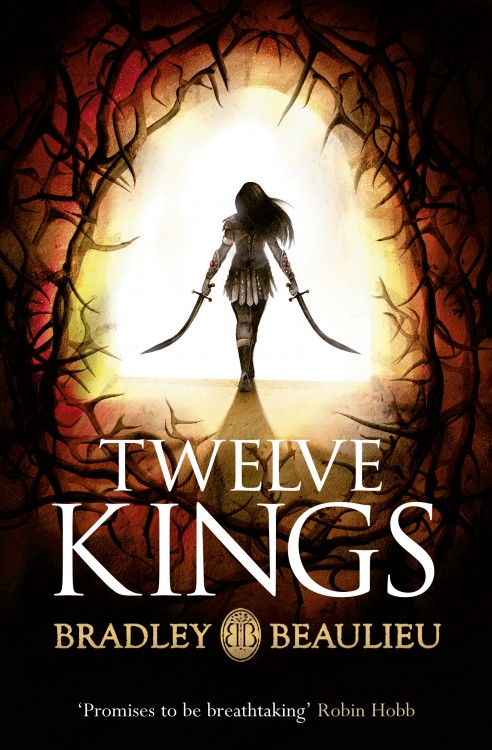
Today, Gollancz revealed the cover art for the UK edition of Bradley P. Beaulieu’s Twelve Kings, the first volume of the Songs of the Shattered Sands trilogy. I had a chance to read some early drafts of the novel, and readers are in for a treat. I also had the opportunity to see a few early sketches of this cover, and it’s fun to see Gollancz take a lot of the early feedback and create a cover with a lot of impact. I’m particularly impressed by the way they’ve focused on Ceda, the novel’s protagonist, making her identifiably badass and female (without over-sexualizing her, or falling back on the usual cover tropes applied to female characters.) It’s a nice compliment to the US cover.
Note, the title of the novel in the UK is Twelve Kings, versus the US title, Twelve Kings in Sharakhai. They both have their strengths, but I think I prefer the US version. There’s something about made-up fantasy names that resonates with the 16 year old in me.