Yearly Archives: 2010

The Heroes by Joe Abercrombie

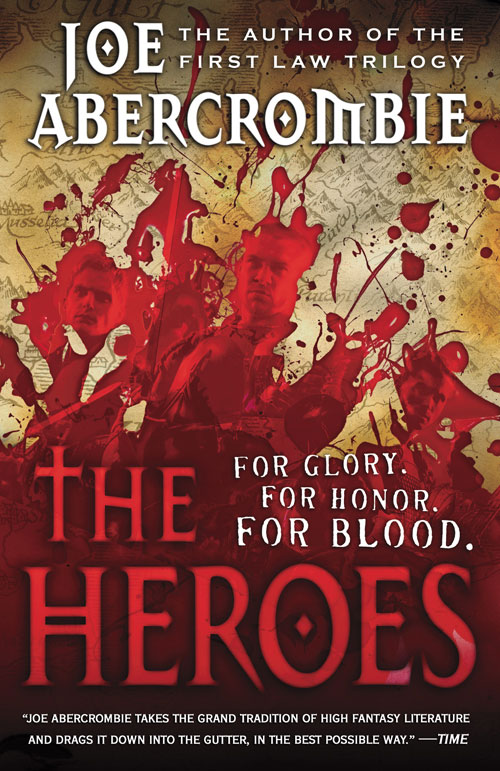
As they are wont to do, Orbit Books have done a fancy ‘Cover Launch’ for Joe Abercrombie‘s upcoming novel, The Heroes. Despite my reservations for Best Served Cold, this is is one of my most anticipated novels of next year.

Still a little too obvious and gratuitous for me, but certainly a better realization of the concept first attempted with Orbit’s release of Best Served Cold. It’s reminiscent of Dragon Age: Origins. The art in the, uhh… blood, is by Steve Stone.

You might notice the map is that of Styria, from Best Served Cold, which will be changing to a map of the North once the art is done.

War: where the blood and dirt of the battlefield hide the dark deeds committed in the name of glory. THE HEROES is about violence and ambition, gruesome deaths and betrayals; and the brutal truth that no plan survives contact with enemy. The characters are the stars, as ever, and the message is dark: when it comes to war, there are no heroes…

Meet THE HEROES.

Curnden Craw: a ruthless fighter who wants nothing more than to see his crew survive.

Prince Calder: a liar and a coward, he will regain his crown by any means necessary.

Bremer dan Gorst: a master swordsman, a failed bodyguard, his honor will be restored—in the blood of his enemies.

Over three days, their fates will be sealed.

An Abercrombie, in a comment on a recent blog post, reveals a bevvy of returning characters:

Lots of familiar faces. More so than last time, in fact. Among the central cast are Bremer dan Gorst and Prince Calder. In significant roles are Caul Shivers, Black Dow, Kroy, Jalenhorm, and Bayaz. Plus a galaxy of more minor returning players.

I’m glad to see Shivers back, as his character arc in Best Served Cold left me with a bitter taste in my mouth. More Bayaz is curious, making me wonder whether it’ll tie into the overall mythos of Abercrombie’s world a little more solidly than Best Served Cold.

Joe also updates us on the status of the novel:

I’ve just started the final part of five, and hope to have the whole first draft finished by the end of April or thereabouts. There’ll then be a period of heavy cutting down and revision in which I’ll bring the earlier parts of the book into line with how my sense of it has developed as I’ve gone along. Part of the charm of writing standalone books is that you can revise the whole thing in one go, and you’re therefore free to plunge ahead to the end, and see where you stand without worrying too much about the start. The downside, of course, is that the start then needs to be whipped into line in quite a big way. Certain themes have emerged as important and need more emphasis in the earlier sections. Certain characters have proved important and need to be fleshed out earlier on. Others have proved unimportant and need to be cut, particularly since it’s an epic kind of affair with a whole lot of characters, and a bit of simplification wouldn’t hurt. The personalities of the central cast and the methods for their writing have developed over time, and so they need to be brought into line and made consistent. The secondary characters need to be given more focused personalities, styles of expression, physical characteristics that can quickly distinguish them and lodge them in the reader’s head – particularly important when there are so many to keep track of.

This is the bit of the process I most enjoy, in fact. Taking something that’s a bit of a mess and sharpening it up, cutting it down, refining and improving it, drawing out the central points and cutting away the superfluous ones (hopefully). Taking the uncut gemstone and polishing it to a brilliant diamond, you might say. Or at any rate a flashy zirconium. Overall, I’m pretty pleased with the way it’s going. A few months ago I was concerned that it would end up really long – quite possibly my longest book yet. It’s drawn together a bit towards the end, though, and I’m intent on pruning it down as much as I possibly can in the editing, hoping to bring it in somewhere around the 210,000 mark. Still considerable, but not quite up to Best Served Cold or Last Argument of Kings, which were both around the 230,000.

Encouraging news. Every writer’s different. As someone who’s just moving on to the revising stage on my own work-in-progress, it’s encouraging to know that writer’s like Abercrombie refine their novels so heavily after the first drafts. There’s certainly a level of polish in Abercrombie’s novels that hints towards a very serious level of polishing and revising. Though his characters might hate to hear it, those novels are a labour of love, from the sounds of it!
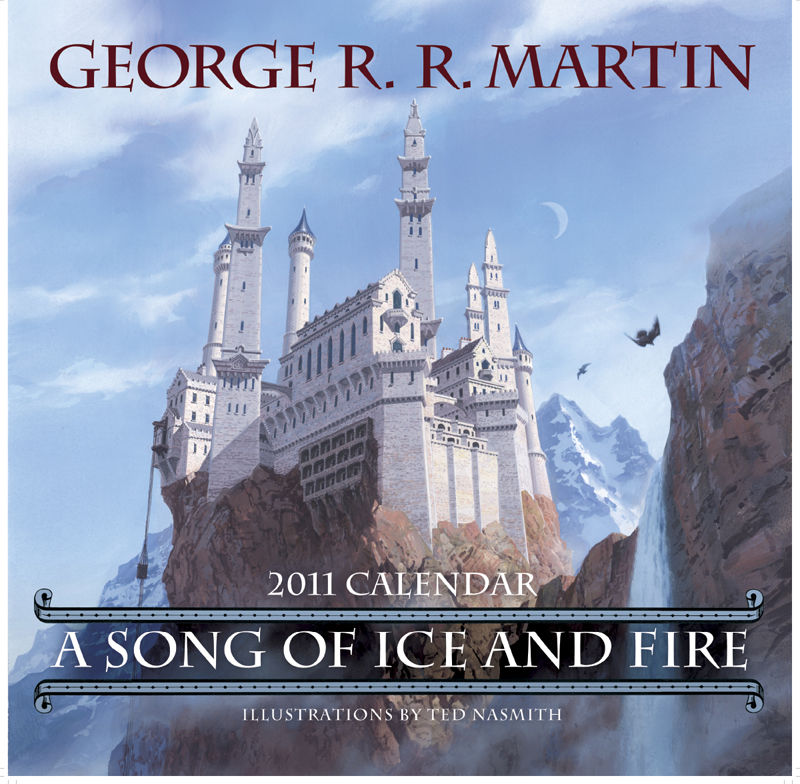
The cover of the 2011 A Song of Ice and Fire calendar

Click for bigger

Ted Nasmith (along with Alan Lee) defined Middle Earth for me. The images he crafted had as much an impact on my young self as Tolkien’s words, and helped to utterly immerse me in a Fantasy land like few other books have achieved. To say my love for Middle Earth extends beyond the man who wrote the books would be an understatement.

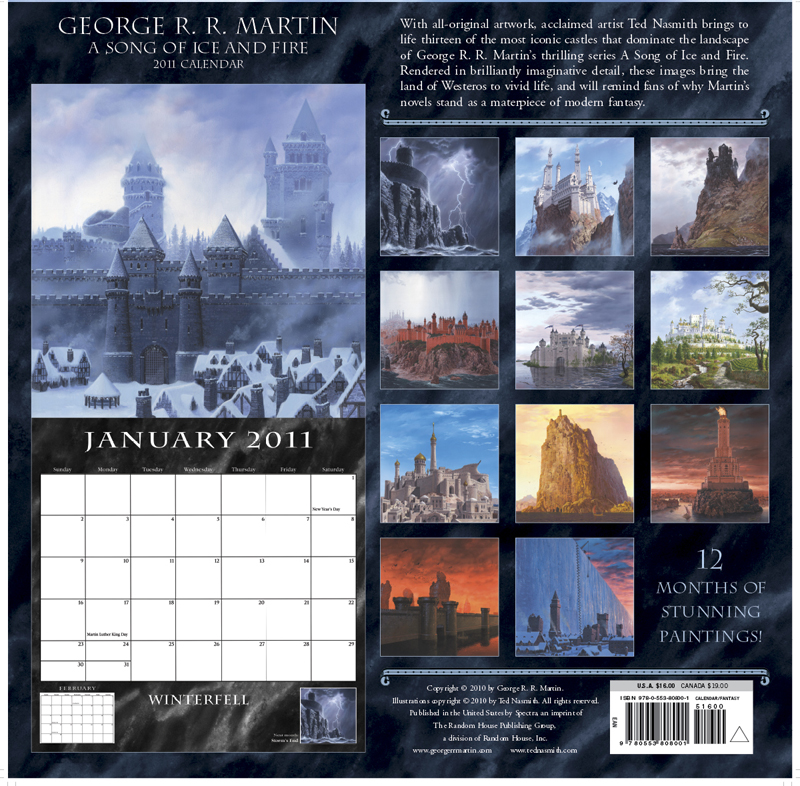
The back of the 2011 A Song of Ice and Fire Calendar

Click for bigger

To see Nasmith turn his eye towards Westeros, the world of George R.R. Martin’s A Song of Ice and Fire, is an absolute fangasm. I haven’t needed a calendar in years, but one this pretty might just find its way onto the wall of my office.

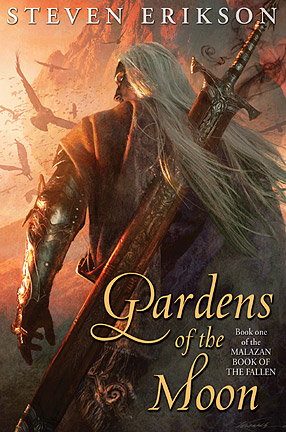
Gardens of the Moon by Steven EriksonThough he has no website of his own, Steven Erikson is in the midst of blogging over at Life as a Human. In the latest in his series of articles title Notes on a Crisis, Erikson digs deep into his craft.

What’s neat is that he does so by taking an excerpt from his upcoming novel, The Crippled God, the final volume of the Malazan Book of the Fallen series, and breaks down what one short scene can reveal about the structure and thought process necessary to build a much (much, much, much) longer piece of fiction.

In a general sense, I write elliptically. By that I mean I open sections with some detail I want to resonate throughout the entire section, and through the course of writing that section you can imagine me tapping that bell again and again. Until with the final few lines, I ring it one last time – sometimes hard, sometimes soft, depending on the effect I want, or feel is warranted. It’s become such a habit now that I often do it without conscious thought.

On a most basic level it shows up in paragraphs (and no, there’s nothing unique to me in any of this). Look two paragraphs upward on this screen. The opening line talks about multiple points of view; the last line describes the many ways of seeing the world. But that last line isn’t just reiterating the first one. Something is added (in this case, a personal comment on my desire to experience every one of them). It’s probably the only structural lesson I learned in school that I still use on occasion – the whole introductory and concluding sentences to frame a paragraph.

Anyway, extrapolating this pattern is how I write — within a scene, from section to section, from chapter to chapter, from novel to novel. While the narrative infers something linear, as in the advancement of time and a sequence of events, in fact the narrative loops back on itself again and again. And each time it returns, the timbre of that resonance has changed, sometimes subtly, sometimes fundamentally.

I read somewhere that Scott Bakker has recently complained that I’m repeating myself in my series, but he’s missing the point. It’s more that I return again and again to particular themes, from as many perspectives as I can. Maybe it still rates as a flaw in my writing, but it’s also my whole point in writing. Forget the conceit of hunting for the right answers – let’s start with trying to find the right questions. Personally, I doubt I will ever get past that stage; for me, the more ways I discover of looking at something, the more humbling the whole exercise becomes (Think you got the answers? Sorry, don’t believe you. Never will).

Elliptical. Looping back. It can be an image, a detail of setting, a mood or flavour, a particular action, or an idea. There’s countless ways of coming round back to where you started, and I admit I like the sly ones, though sometimes it pays to be more obvious.

Erikson’s comments on Bakker’s observations are interesting (in no small part due to the fact that Erikson was a large influence on Bakker first being published), and reveal a little bit about why his series encompasses ten massive volumes. As he says, some readers consider this repetition to be a flaw in his writing (which is somewhat my issue with the Malazan books, though I’ve only read two); but if it’s the point he’s trying to make, then how does one judge whether the Malazan books are a success? Do you care if he achieves his personal goals of recursive reflection if it gets in the way of proper storytelling? Do you like his novels because of the themes and the similarities in the characters’ internal battles? Or do you like it because even the weakest of his characters could rend the world in half on a cranky day?

Whatever the case, Erikson goes into a fairly in-depth analysis of the excerpt, picking apart the structure and language he uses and gives rather lucid and insightful consideration to the nitty-gritty decisions made by writers almost every day. Will it be useful to everybody? Maybe not, Erikson has a very defined style. But it’s certainly a revealing look at the process behind one of the most complex, convoluted and, well… huge fantasy series on the market today.

You can read the whole article, and the excerpt, HERE.

Corvus by Paul Kearney

It is twenty-three years since a Macht army fought its way home from the heart of the Asurian Empire. The man who came to lead that army, Rictus, is now a hard-bitten mercenary captain, middle-aged and tired. He wants nothing more than to lay down his spear and become the farmer that his father was. But fate has different ideas. A young warleader has risen to challenge the order of things in the very heartlands of the Macht. A soldier of genius, he takes city after city, and reigns over them as king. What is more, he had heard of the legendary leader of the Ten Thousand. His name is Corvus, and the rumours say that he is not even fully human. He means to make himself absolute ruler of all the Macht. And he wants Rictus to help him.

Eerily similar to Chris McGrath‘s covers for The First Law trilogy [1, 2, 3] by Joe Abercrombie, particularly Before They Are Hanged. It makes sense that Solaris would position Kearney towards that same market, but it might have been nice if they had at least asked McGrath to switch up his colour pallet.

My experiences with Kearney’s The Ten Thousand, to which Corvus is a sequel, are well documented (HERE, HERE and HERE), but I’m looking forward to giving him another shot. It also helps that the early synopsis posted above sounds damn good!

Corvus is due for publication in November.

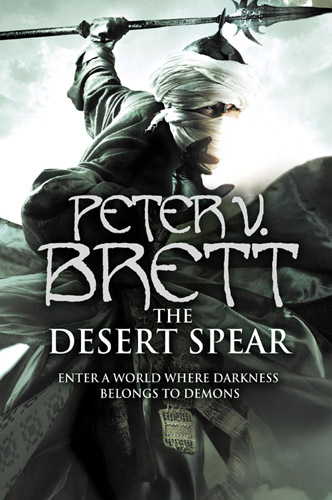
Last year, Peter V. Brett surprised a lot of people with his debut novel, The Warded Man (or The Painted Man, depending on your region). We’ve long since forgotten that Brett wrote the novel on his Blackberry (or equivalent device), and he’s since established himself as a bright new voice in the genre.

I’m sure Im not alone in look to The Desert Spear as one of the most anticipated novels of 2010. When I started reading it a few weeks ago, I knew I wanted to bring a sneak peek to my readers. Peat and I discussed a few different scenes from the novel, and eventually settled on Chapter 15: Marick’s Tale as a perfect taste of what the novel has to offer. I’m sure you’ll recognize a few faces!
Read More »