Yearly Archives: 2011

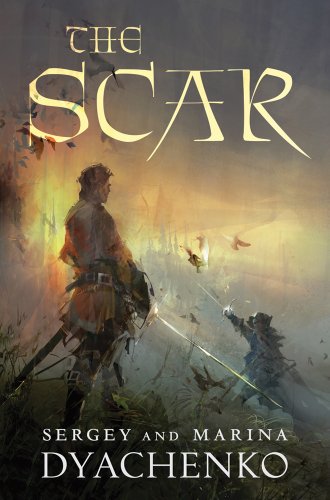
The Scar by Sergey and Marina Dyachenko

Where did he come from and where is he going? He wanders the world like the constellations wander the sky. He roams along the dust-laden roads and only his shadow dares to follow in his footsteps.

It is said that he possesses great powers, but they are not of this world.

Even the mages avoid him, for he is not subject to them. Whoever stands in his way, either through the whim of fate or through his own folly, curses the day of that encounter.

His intentions are unknown. The roads serve him like dogs.

The mountain heights and the pebbles of the far sea; the hills, ravines and fields; the forests and foothills; the plains and shores; the lanes and highways: all hide his secrets.

It is said that he will roam and wander eternally. Take care not to meet him, either in a crowded fair or in a hermit’s den – for he is everywhere.

And if one day you should hear the footsteps of the Wanderer at your door…

Several weeks ago, I gushed enthusiastically about the cover art for The Scar by Marina and Sergey Dyachenko, a well-respected novel by the Ukranian authors that is finally being translated and brought to English readers. I love the idea of tackling Fantasy from the perspective of writers from different cultures than the usual UK/North American/Australian writers, so this is firmly on my radar, but I can’t say that this excerpt has me too excited; a lot of passive, overly complicated writing:

The room became quiet immediately, so quiet that the landlady stuck her inflamed, purple nose out of her kitchen. The revelers looked around in mute amazement, as if they expected to see the menacing Spirit Lash on the smoke-fouled ceiling. Bewildered, at first Ita just opened her mouth, but then, finally realizing what had happened, she dropped an empty jug on the floor.

Yowza.

Still, you can read the excerpt from The Scar by Marina and Sergey Dyachenko and judge for yourself.
Anne McCaffrey

It is with a certain sadness that I learned of Anne McCaffrey’s passing. I have not read any of her novels, but my mother, who introduced me to Science Fiction and Fantasy and greatly encouraged and nurtured my love for the genres, is an enormous fan. This loss means that the Fantasy and Science Fiction community is now a poorer place than it once was, though enriched greatly by McCaffrey’s contributions to our beloved literature.

RIP, Anne.

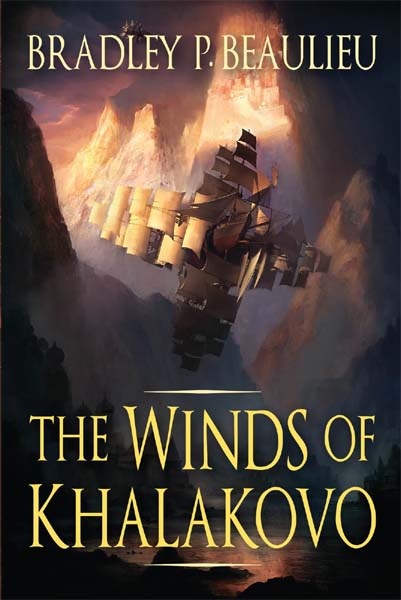
The Winds of Khalakovo by Bradley P. BeaulieuMy friends, sometimes you have to be careful what you ask for. When I first started talking to Aidan about a guest post on A Dribble of Ink, I thought of a couple of subjects that seemed easy at the time. The first was about the differences between writing a Book 1 in a series vs. its sequel. The second was about finding the sweet spot in terms of the number of POV characters for an epic fantasy. The first one was pretty easy to knock out, because it was more about relating my experiences over the course of writing the first and second novels in my trilogy. This second one, though, has been a tough nut to crack.

Why? That’s a fair question, because let’s face it: on the surface this question is easy to answer. How many POVs do you need? However many the story needs to tell it effectively. While I believe this to be true, it’s also about as useful as a screen door on a submarine. It doesn’t really illuminate the choices that have to be made with respect to POV, so I think what I’ll try to do is examine the question using two epics I’ve read recently.

On the one extreme, we have George R.R. Martin’s A Song of Ice and Fire. How many POVs does Martin have now? A few dozen between A Feast for Crows and A Dance with Dragons, which really comprise a single novel broken up geographically (as opposed to breaking a large novel up temporally). Had anyone told an editor twenty years ago that they were going to start a series in which the novels would expand to twenty POV characters, they would have been laughed out of New York. And yet, here it is, a masterful story with a scope about as wide as you can have in fiction.
Read More »

From the press release:

Bella Pagan, Senior Commissioning Editor at Tor UK, an imprint of Pan Macmillan, has acquired world rights to the first two volumes of a fantasy series by Mark Charan Newton. The agent was John Jarrold.

The first book in a series provisionally titled DRAKENFELD introduces the eponymous hero, an investigator. The series is set in a fantasy world, but will appeal to fans of historical mysteries. In this opening volume, Lucan Drakenfeld is called home after the death of his father – but is immediately thrown into the investigation of a royal death. He also finds that his father’s demise is not as clear-cut as it at first appears…

Pagan said ‘Mark writes compulsive adventures set in utterly convincing new worlds – he’s a terrific writer. I couldn’t ask for a better start to my new position at Tor UK than this first deal’.

And Mark’s own thoughts on Drakenfeld:

A little more? It’s very much a fantasy novel, but equally a crime novel, with a locked-room mystery at the heart of it. Whilst I’ve dabbled with the odd crime sub-plot before, it was mainly a pastiche – Drakenfeld is much more committed to the crime genre, perhaps along the lines of the CJ Sansom novels. (It needs to be rewarding for readers of both genres.) The world is very much a classically inspired setting (Ancient Rome in particular), and there virtually no weirdness. I’m also really enjoying writing the Drakenfeld novel, much more so than any of the previous series, and especially the locked-room element: the impossible crime.

The most divisive and recognizable element in Newton’s writing isn’t necessarily his weirdness (though that’s certainly an aspect that separated Legends of the Red Sun from the many more traditional Epic Fantasies that flood store shelves), but more for his slippery, interesting prose that draws comparisons (whether apt or not) to other ‘weird’ authors like Mieville and and Vandermeer. Newton’s prose fits perfectly with the weird dystopian fantasy world explored in Legends of the Red Sun, lending atmosphere and a unique voice to his novels. I’m not convinced, though, that this style of prose would work so well in a more traditional Fantasy/Crime novel that has ‘virtually no weirdness.’ It will be interesting to see if Newton adopts a new voice to compensate for this change of tone, or if the echoes of his ‘weird’ lineage permeate the new work.

Either way, I’m a fan of Newton’s work and love the idea of him changing gears and working on something entirely new. Drakenfeld is currently slated for release in 2014, though Newton hints that there might be a possibility of a 2013 release.

Comments closed

Via Deadline:

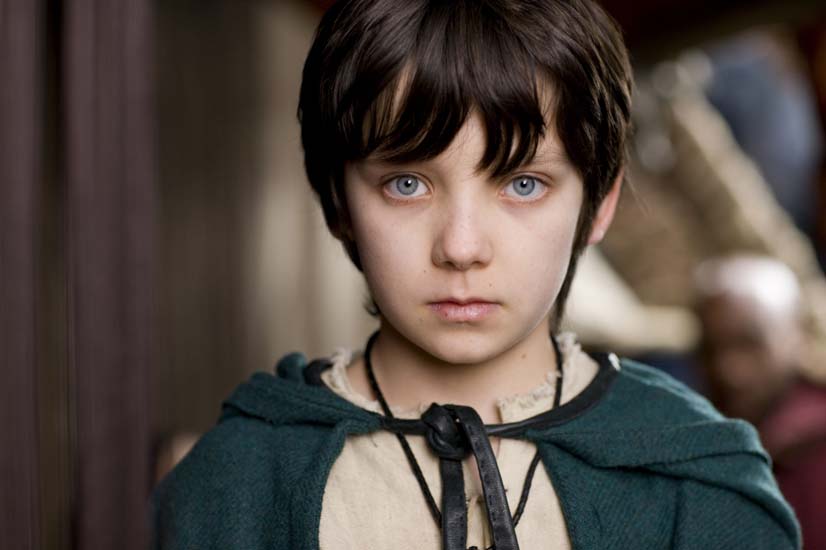
Asa Butterfield is Ender in the Ender's Game movie

Asa Butterfield, the 14-year old title star of Martin Scorsese’s 3D film Hugo, has been offered the title role in Ender’s Game, the Odd Lot Entertainment adaptation of the Orson Scott Card science fiction novel.

The kid looks the part. He’s small and has intelligent eyes. Plus, Scorsese casting him as the lead in Hugo certainly lends credibility to his casting chops and ability to hold his own as the star of a big budget film. It’s all just rumour now, however; but it’s fun to speculate.

Comments closed