Yearly Archives: 2013

3point0

Welcome to the latest version of A Dribble of Ink!

Last March, I launched a new template for A Dribble of Ink. Being a web developer/designer by day, I enjoy fiddling around with my template and continuing to evolve the look, feel, features and functionality of A Dribble of Ink. With a new spring, I felt like it was time to revisit my template and continue that evolution. This time around, however, I’ve done an entire from-the-ground-up rebuild of the theme, rather than the small tweaks and visual changes that I normally make. You might notice that the visual identity of A Dribble of Ink hasn’t change drastically from the previous theme. This is intentional. I still like the look of the old template, so instead of spending time re-inventing the wheel, I’ve updated and evolved the look. The real heavy lifting comes in some of the behind-the-scenes features that will make it easier for me to maintain A Dribble of Ink (loads of custom post types, allowing me to get creative with featured articles and reviews, and automating some things), and more enjoyable/easier for you, the readers, to read and interact with the blog.

The main purpose of the previous redesign was to increase site speed. This redesign focusses on improving user experience with a simpler layout, and by embracing the shift towards responsive CSS3/HTML 5 layouts. What does this mean? Well, in years past, it was likely that you’d be reading this blog post on a computer screen. Nowadays, however, a large portion of my readers come to the site on computers, tablets and phones. So, this new theme is designed to adapt itself dynamically to whatever screen a reader is viewing it on.

On a phone it looks something like this:
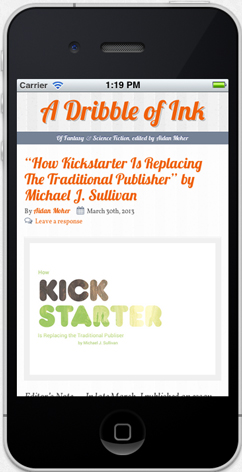
A Dribble of Ink Mobile

Same code. Same content. Fun times.

I’ve also tried to keep it as consistent cross-browser, though there are always compromises that must be made in these situations. If you want to experience all the new fun stuff, and have A Dribble of Ink look its best, make sure you’re using a modern browser like Chrome or Firefox. Most of my readers do so already, according to my web analytics. It’ll work just fine in Internet Explorer 9+, but Microsoft are a little behind the curve in integrating the new HTML5 and CSS3 features, so it’s impossible to replicate all of these features.

I hope you like it. I’d also love to hear from you. Last time around, reader feedback was extremely helpful in terms of layout improvements, polish and bug fixing, so, if you have suggestions, please feel free to (kindly) provide feedback in the comments section here. I’m sorry if you still don’t like orange.
Star Wars

According to The Verge, Disney is planning to release a new Star Wars film every summer for five years. This schedule will begin with Episode VII in 2015, VIII in 2017, and IX in 2019. Sandwiched between these releases will be standalone films, presumably starring some of the series’ more popular characters (Yoda, Han Solo and Boba Fett have all been rumoured.

Thoughts?

You Are Reading an Essay: How Metafiction Can Alienate Readers by Adam Callaway

The birth was messy. Sweat, blood, tears, and cerebrospinal fluid slicked the white tile. Dirty forceps, scalpels, and fountain pens were strewn haphazardly. In a pail of ink, a half-formed idea wailed. The thought-doctors could only guess if it would make it.
–From Skull Born, the very first (and thankfully unpublished) Lacuna story

Metafiction, at its most basic, is fiction about fiction. This can take a variety of forms. Everything from John Barth’s Lost in the Funhouse to Carlos Ruiz Zafon’s Shadow of the Wind, can be considered metafiction.

Stories about storytelling have always interested me. An early influence on my writing were Walter Moers’ Zamonia books, specifically The City of Dreaming Books. In it, he imagined a decadent, surreal wonderland of writers, publishers, and booklovers. Books and stories literally came alive and posed serious dangers to the citizens of Bookholm.

The first Lacuna story was more-or-less Bookholmian fan fiction as seen through the eyes of China Mieville. It was very metafictional, with book ideas being torn from the skulls of writers in a bizarre send-off of a birthing ritual. These idea-babies were fed books, poems, emotions; anything to make them more robust. Literary devices manifested as physical deformities on the idea-husk. They would develop into golemic mandrake roots of pulp and story. Once they became large enough, the authors would consume the idea, go into a trance-like state, and write an entire manuscript in one sitting. Read More »

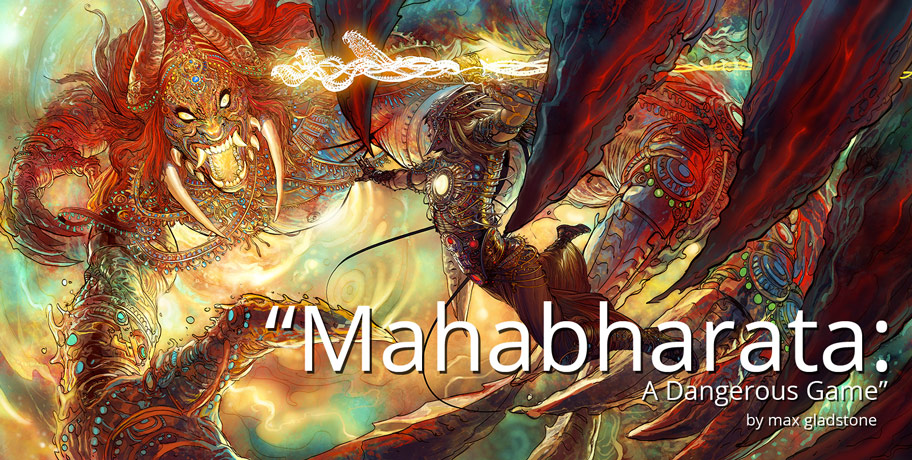
Mahabharata: A Dangerous Game by Max Gladstone

Art by Nisachar

Mahabharata: A Dangerous Game

My enthusiasm and love for these characters and this story will serve for the purpose at hand: encouraging you, dear reader, to immerse yourself in the Mahabharata.

The last two iterations of this column have played it safe. I’ve read Journey to the West in two languages and studied it from a variety of angles, and Romance of the Three Kingdoms, too though to a lesser extent. I could continue in this vein—the next logical essay would be on Outlaws of the Marsh / The Water Margin, China’s great Robin Hood novel and one of Mao Zedong’s favorite books, followed probably by Dream of the Red Chamber for more domestic source material. (Or Jin Ping Mei, if we want to get the sexy-fun-times element in play…)

But while all these stories are great, I’m not as passionate about them as I am about the story I want to discuss now. The problem is, I’m nowhere near as cut out to write this essay as I was the first two—I don’t know the source language, Sanskrit, and I haven’t spent as much time studying the work’s cultural context. (I’m not ignorant, I just don’t have a four year degree, six years of language study, and three years in-country.) There’s also much more chance I’ll do inadvertent harm writing this essay, since the text I’m about to discuss is a live, and lived, religious document in addition to one of the greatest adventure stories, romances, war stories, and apocalyptic tales of all time.

That said, maybe my enthusiasm and love for these characters and this story will serve for the purpose at hand: encouraging you, dear reader, to immerse yourself in the Mahabharata. And I hope that will be worth whatever unintentional harm I do. Read More »

The High Druid's Blade by Terry Brooks

On Suvudu, Shawn Speakman, webmaster for Terry Brooks, reports on the first details about The High Druid’s Blade, the Shannara novel recently completed by Brooks and set for a 2014 release. Speakman says:

The High Druid’s Blade takes place a century after Witch Wraith. It is the first Shannara stand alone novel since 1996’s First King of Shannara. Terry has long been entrenched in long epic series. Instead, with Blade, he is telling a very different tale. Fewer characters being scattered to the winds of the Four Lands. Instead, Terry has crafted a more personal journey, of a hero unable to protect his family unless he unleashes the power of his ancestors.

Brooks also revealed on the tour that the main protagonist of The High Druid’s Blade will be a Leah, a family that has been integral to many novels in the series since The Sword of Shannara. This will, however, mark the first time that a protagonist of a (chronologically) post-The Sword of Shannara novel will feature a sole protagonist that isn’t of Ohmsford blood. The Leah family, thanks to events in The Wishsong of Shannara, are in possession of the Sword of Leah, a sword imbued with the magic of the Druids. Is there a connection here between the High Druid (who’s identity I know, but for fear of spoiling Witch Wraith, Brooks’ upcoming novel, I won’t reveal), and the Leah family? Additionally, Brooks said that the novel will take place in areas of the Southland that have not been explored in previous novels.