Voting for the 2014 Hugo Awards opened on Friday, June 6th. I’m using this opportunity to reprint the introduction to A Dribble of Ink’s collection included in the voter packet provided to all eligible voters. Whether you’re a voter or not, you can download the collection below -ed.
Over the past several years, vast change has come to many of the fan categories at the Hugos.
The “Best Fanzine” category has seen a dramatic shift in the past two years, since SF Signal’s first nomination, and traditional zines are being replaced by blogs and online magazines. “So never the twain shall meet…,” said Mike Glyer, of the many-times nominated File 770, describing the seemingly impassable gulf that exists between the online community and the traditional fan community. I don’t believe Mr. Glyer. While this divide between the two fan communities is undeniable, genre fandom is ripe with opportunity for creating a global fan community that embraces diversity—of voice and publishing platform—and challenges readers, authors, and publishers to become more inclusive and welcoming than ever before. Read More »
Via Tor.com, the list of nominees for the 2014 Hugo Award nominees (with added squee!):
2014 Hugo Award nominees
Best Novel (1595 ballots)
-
Ancillary Justice by Ann Leckie (Orbit)
-
Neptune’s Brood by Charles Stross (Ace / Orbit)
-
Parasite by Mira Grant (Orbit)
-
Warbound, Book III of the Grimnoir Chronicles by Larry Correia (Baen Books)
-
The Wheel of Time by Robert Jordan and Brandon Sanderson (Tor Books)
Read More »
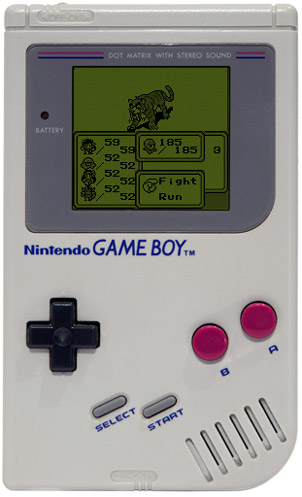
I still remember the first time that I saw a Japanese Roleplaying Game (JRPG). Like many people of my generation, it was a Final Fantasy game, though not one so obvious as Final Fantasy, Final Fantasy VI (or Final Fantasy 3, if you’re familiar with the North American naming scheme), or Final Fantasy VII. No, it was Final Fantasy Legend II in all of its monochromatic glory on the Nintendo Game Boy.
I was at a friend’s house, and his cousin was also visiting. I’d never met the cousin, but he had a Game Boy (like me), so I liked him almost instantly. But, where I was eradicating (or, more accurately, being eradicated by) the Footclan in Teenage Mutant Ninja Turtles, or dodging winged-Moai statues in Super Mario Land, he had this slow, boardgame-like game, with numbers, equipment, a map, and so many other elements that I was unfamiliar with. In particular, I remember a fight with a tiger. The one pictured here, in fact. As I think back on it, I can only assume that it’s a low level enemy, fought in one of the early game environments. At the time, however, it was something different. Something frightening.
If you do your homework, however, you’ll quickly discover that my first experience with Final Fantasy was, in fact, not with Final Fantasy at all, but with Akitoshi Kawazu’s infamous SaGa series. See, when Square the developer of the Final Fantasy series, wanted to bring over Kawazu’s zany Makai Toushi SaGa, the first in the SaGa series, to North American shores, they decided that it made more sense to release the title under a respected and successful brand, Final Fantasy, rather than attempting to sell something new. It was the right decision. Final Fantasy Legend II became Square’s first million-selling product. Read More »
If the books and TV show seem to be revelling in the worst aspects of human nature, that’s partly because those aspects are what Westeros helps us to recognize in ourselves.
In a recent interview with Vanity Fair, George R.R. Martin discussed the past, present, and future of his mega-popular series, A Song of Ice and Fire, and its television adaptation, Game of Thrones. Some of the most interesting moments in the interview concern the future of HBO series and the potential that it might catch up with Martin’s work on the novels.
“The minute you have a series [of books] and a book comes out,” Martin explained (surprising no one), “people immediately begin asking, ‘Where’s the next book?’ And the more successful the series is, the more people ask that question, and the more pressure you begin to feel.”
Martin’s struggle against that pressure is one of the most publicized and scrutinized stories to hit SFF fandom is the past decade. Here’s a creator working on a seminal work of fantasy, adored by millions of people around the world, who is also crushed under the weight of his fame, criticized for his own fannish activities (such as watching football, or attending conventions) and condemned for not writing fast enough. As if works the calibre of those he’s producing can come over night.
Prominence of this issue hit its peak when Neil Gaiman, another writer who understands the intricacies of dabbling in many mediums, wrote an open letter to Martin’s detractors. “George R.R. Martin is not your bitch,” he famously said. “This is a useful thing to know, perhaps a useful thing to point out when you find yourself thinking that possibly George is, indeed, your bitch, and should be out there typing what you want to read right now.
“People are not machines. Writers and artists aren’t machines.” Read More »
It’s no secret that I believe we need to do a better job at engaging in positive discussion about genre’s best works in relation to award season. We’re really good at getting annoyed, upset and frothy at the mouth about some things (as Abigail Nussbuam recently wrote about with much finer words, and more hands, than I could ever hope for), and it’s important to also apply that passion and energy to screaming loudly enthusiastically about the books, films, and people we love.
Over the past six months, I’ve discussed my own ever-evolving list of recommendations for Hugo nomination. I’ll do so once more before the close of the nomination period on March 31st, 2014. However, those posts are very distinctly one person’s opinion, and the genre fanscape is much larger than one opinion (no matter how highly I think of it.) In fact, the reason that I’ve decided to post various versions of my ever changing nomination ballot is because the good people of the Internet (they do exist, we’re not all bad!) have alerted me to so much cool stuff that I’ve had no choice but to revise my ballot several times.
So, here I’m curating a collection of publishing Hugo Award recommendations, in the hopes that you (like me) might find something of value in there that makes it onto your final ballot (if you’re a Hugo voter), or just makes you smile. Read More »