2015 Hugo Nominations v 0.1
Best Novel

The flush of the 2014 Hugo Awards is fading, and, with the holidays just peeking around the corner, I wanted to take the time to discuss some of my favourite novels from 2014, the ones that, at this very moment, would comprise my nomination slate for the 2015 Hugo Award for Best Novel. Will it change by next spring when nominations are due? Undoubtedly.

These are all terrific novels, and, if you haven’t read them already, well, I envy you.

Best Novel

City of Stairs by Robert Jackson Bennett

Say hello to the best fantasy novel of 2014.

Even as I was startled by its twisted depth, I adored every moment I spent with City of Stairs. Colonialism lies at City of Stairs‘ centre, and RJB handles it with equal parts boldness and delicacy. The ruined beauty of Bulikov and its fallen gods haunted me long after I turned the final page.

Robert Jackson Bennett is best known for his contemporary fantasy and horror crossovers, such as American Elsewhere and The Troupe, so his move into more traditional epic fantasy put him on the radar of a lot of new readers, and the result is something special. On first reading City of Stairs, I described it to a friend as “China Mieville without the ego.” I’m not sure I still agree with that statement, because it’s unfair to saddle one writer with another’s baggage, but while reading City of Stairs I couldn’t fight the feeling that RJB was mixing and refining elements from some of my recent favourite fantasies. Other touchstones exists, such as Kameron Hurley’s The Mirror Empire and Max Gladstone’s Craft Sequence, that place RJB among the most exciting and vibrant young fantasy writers working today.
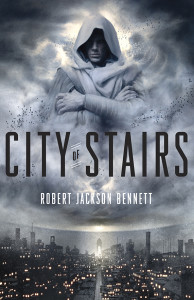
City of Stairs by Robert Jackson Bennett
Buy City of Stairs by Robert Jackson Bennett
Read More »

Prisoners, Deserters,
and an Age of Heroes

I was a college freshman on 9/11. The events of that Tuesday morning kicked off the 21st century in the United States of America, and changed my life, as it changed the lives of so many young people of my generation in the USA and beyond.

9/11 started the “War on Terror,” two wars in the middle east, poured nitrous oxide into the burning engine of the United States’ national debt, and set the tone for the first decade of the 21st century in the USA, the first decade of my adulthood. I remember telling classmates that we needed to write to our representatives, ask that they not go and start a war over this, that we could do better.

I created an Individualized Major of Creative Mythology, with the aim of studying how myths and legends were structured, how the ur-stories of world cultures were formed.

When I arrived at Indiana University, I declared an East Asian Studies major. I wanted to learn more Japanese, study Japanese history, and go off and work for a video game company, or an anime company, or something involving that skill, and that interest. But after 9/11, I was flailing for meaning, desperate to find some way forward as the world very quickly spiralled away from the future I had expected. As members of my age cohort signed up for the armed services, to be analysts, anything to help, I looked back to Mythology, to hero legends, and in looking back, saw my path forward.

We make meaning out of stories – that’s what humans do. I needed to make meaning out of what was happening in my world, needed to imagine an alternative to the path that history was taking, to dream a brighter future. In spring of 2002, I created an Individualized Major of Creative Mythology, with the aim of studying how myths and legends were structured, how the ur-stories of world cultures were formed, so that I could make 21st century myths and legends to help point the way forward, to see through the cloud of ashes and confusion and anger left by the fall of the towers.

But 9/11 wasn’t the first time the WTC towers had loomed tall in my life, with their presence or their absence. Read More »

Conversations with
My Favorite Author

“Guess how long the space ships are in this book!”

“Guess how long the space ships are in this book!”

The conversation often starts something like this. Sometimes it’s, “Guess how many different genders are in this world!” or, “Guess what Gwenna just discovered about Annick!”

I’m not the person asking. My husband poses these questions, and it is my job to answer them. If I don’t guess correctly, I’ll get another opportunity in a few minutes, a few hours, a day or two. When he’s reading a new book, each masterful bit of world-building is fodder for a conversation like this one. When he’s writing a new scene, each plot point or moment of character development is an opportunity for a pop-quiz.

“I don’t know,” I reply. “Half a galaxy long?” I think this is a plausibly impressive size, given his enthusiasm, given the volume and intensity with which he has asked the question. He knows that I cannot tell a furlong from a parsec, but he refuses to believe that a person can live in the world without understanding basic measurement and scale. Read More »

“The thing is,” I pointed out, “It’s all work. This is work.”

“The thing is,” I pointed out reasonably, “I’m working even when my fingers aren’t physically pressing the keys.” I pointed helpfully at my head, trying to indicate the furious labor going on inside. “Writing is not a linear process. It’s all work. This is work.”

My argument might have been more compelling if I hadn’t been standing in my boxer shorts at 2 o’clock on a Tuesday afternoon drinking an IPA and watching the local porcupine trying to snag that last apple without falling out of the tree.

“You may be working,” Jo replied, “but I want to punch you really hard in the neck.”

It seemed like an uncharitable thing to say to a man who was hard at work writing his second novel. It seemed doubly uncharitable given that Jo is my wife, and that our division of labor – the very division that led me to be standing on the porch in my boxers in the first place – was something we had hammered out together, something we had both happily embraced.

I pointed this out. The things she said next were even less charitable. Read More »

What We Didn’t See:
Power, Protest, Story*

My parents taught me not to stare.

My parents taught me not to stare.

As children, even as adults, prolonged staring at others is something we do when we first encounter difference. It’s a long, often critical or fascinated look at something to try and understand it, to gauge where it fits in our taxonomy of things. First: is this a threat? Should I respond with a fight…or flight? Second: where does this person fit within my existing boxes? Woman or man? Black or white? Friend or foe?

We have nice neat boxes for everything, boxes we learned in childhood which have been reinforced by stories, by media, by our peers, as we grow older. We stare longest when we cannot fit what we see into an existing box; when we cannot figure out if it’s dangerous, or merely different: which many of us, unfortunately, still feel are the same thing.

And, if after staring long enough, we decide that this different thing is dangerous: we kill it.

Read More »