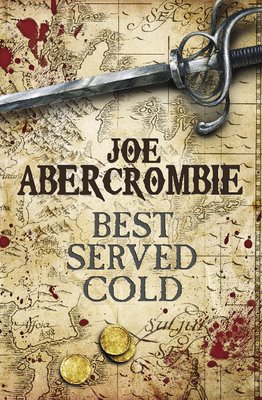
Best Served Cold
Author – Joe Abercrombie
Trade Paperback
Pages: 544 pages
Publisher: Gollancz
Release Date: June 1st, 2009
ISBN-10: 0575082453
ISBN-13: 978-0575082458
You can say many things for Joe Abercrombie.
You can say he’s leading the way for no-holds-barred Fantasy. You can say he’s a great stylist, with satisfying, easy-to-read prose. You can give him credit for being adept at writing convincing, startling endings (a trait sadly lacking in the Fantasy genre). You can say his action scenes are among the best out there. You can say he loves to set the reader up, then pull the rug out from under them by subverting the tropes we all know and abhor/love.
You can say all these things about Joe Abercrombie, and they all certainly apply to Best Served Cold as surely as they did for his first trilogy, The First Law. I recognized all of these qualities while reading the novel, but the whole time I also couldn’t fight the feeling that something was off, that I wasn’t connecting to this Abercrombie novel as I had to previous ones. It took me a few days, and a couple of conversations with others who had read the book, to finally unearth the roots of this feeling.
To begin with, Abercrombie continues to flex his muscles in using narrative voice to help define his characters. Where most authors dealing with multiple Point of View characters use a standard voice (grammar, structure and vocabulary) across all viewpoints, Abercrombie joins the ranks of authors like George R.R. Martin in his ability to reveal pieces of their personality through the way they tell their story. Few authors do it so well as Abercrombie. A few examples:
An introspective Barbarian:
First thing Shivers noticed as the boat wallowed in towards the wharves, it was nothing like as warm as he’d been expecting. He’d heard the sun always shone in Styria. Like a nice bath, all year round. If Shivers had been offered a bath like this he’d have stayed dirty, and probably had a few sharp words to say besides. Talins huddled under grey skies, clouds bulging, a keen breeze off the sea, cold rain speckling his cheek from time to time and reminding him of home. And not in a good way. Still, he was set on looking at the sunny side of the case. Probably just a shitty day was all. You get ’em everywhere. (p. 20)
A border-line autistic killer, obsessed with numbers:
The dice came up six and one. The highest dice can roll and the lowest. A fitting judgement on Friendly’s life. The pit of horror to the heights of triumph. And back.
Six and one made seven. Seven years old, when Friendly committed his first crime. But six years later that he was first caught, and given his first sentence. When they first wrote his name in the big book, and he earned his first days in Safety. Stealing, he knew, but he could hardly remember what he stole. He certainly could not remember why. His parents had worked hard to give him all he needed. And yet he stole. Some men are born to do wrong, perhaps. The judges had told him so.
He scooped the dice up, rattled them in his fist, then let them free across the stones again, watched them as they tumbled. Always that same joy, that anticipation. Dice just thrown can be anything until they stop rolling. He watched them turning, chances, odds, his life and the life of the Northman. All the lives of the great city of Talins turning with them.
Six and one. (p. 48)
A pompous poisoner:
It was just the kind of afternoon that Morveer most enjoyed. Crisp, even chilly, but perfectly still, immaculately clear. The bright sun flashed through the bare black branches of the fruit trees, found rare gold among dull copper tripod, rods, and screws, struck priceless sparks from the tangle of misted glassware. There was nothing finer than working out of doors on a day like this, with the added advantage that any lethal vapours released would harmlessly dissipate. Persons in Morveer’s profession were all too frequently despatched by their own agents, after all, and he had no intention of becoming one of their number. Quite apart from anything else, his reputation would never recover. (p. 63)
All distinctly Abercrombie, but each with their own twist on language that gives an immediate resonance to their character. Morveer the poisoner is long winded and grandiose; Shivers the Northman speaks with simple, but often profound words, playing with an almost first-person level of introspection; Friendly the convict is number obsessed and has an almost clinical way of describing the characters and events surrounding him. And this is just a portion of the characters narrating the novel. Others include Monza and her more traditional narrative style, and Nicomo Cosca, whose sly wit is most pleasurable of all. This connection to the characters is both the strength and the ultimate weakness of the novel.
With The First Law, Abercrombie rose to prominence with his portrayal of a dark world full of grey, morally corrupt characters and even more morally ambiguous situations. You often weren’t sure who to root for, and it certainly wasn’t easy to define the ‘good guys’ from the ‘bad guys’, if such things exist in Abercrombie’s world. But, Best Served Cold is Abercrombie’s attempt to out-Abercrombie himself and everything is meaner and bloodier than last time; even the shades of grey have been left behind in favour of blood spattered black.
Best Served Cold is a novel about revenge, but, unlike the best revenge stories, there is little room for redemption. Now, I’m not afraid of dark stories, ribald language or close-to-the-camera violence, but it all needs to have some sort of a payoff at the end, some sort of redemption for the characters. Best Served Cold is, if nothing else, a story about its characters. Some of these characters change, some of them end the novel no different than they began it (though perhaps six feet under the earth) and some, in the case of Shivers, go through a complete recession of character.
Take a look at that quote above, from the ‘introspective Barbarian’. These are the lines that open Shivers’ story. It is immediately obvious that his newfound optimism is going to be put through a gauntlet of misery, testing his faith to the very end. Shivers’ moral decay through the novel (reaching its peak at a truly startling scene near the middle) is heartbreaking and difficult, but never bears any fruit. Though this is essentially the point Abercrombie is trying to make (there is no redemption in revenge), this subversion of the typical good-turns-bad-turns-good-again story sapped my willingness to go back to Best Served Cold once I’d put it down. As the novel wore on, I became less connected with the characters, instead of growing more fond towards them, finding it more and more difficult to care about Monza’s plight. I kept hoping for her plans to be thrown awry, for some event of more magnitude to reveal itself, to shed new light on the events of the novel. But it never came. How does one care about characters who keep telling the reader that even if they succeed in their hopeless task, they’re still fucked once they come out the other end?
Best Served Cold took me a bloody month to read. At the time, I couldn’t put a finger on why it was taking so long. I recognized the many strong qualities inherent to Abercrombie’s novels – style and voice, action and subversion – but by the middle of the book I was going through the motions, chugging my way to the finish line with that hope in my heart that it wasn’t going to end exactly where I thought it was headed. Relentless, but ultimately frustrating, Best Served Cold showcases Abercrombie’s growth as a writer amid his difficult-to-appreciate decisions as a storyteller.

This was an *excellent* review, Aidan – really glad you managed to put pen to paper (as it were) and get down what the problems were with the book. A really fair analysis.
you said it better than I did. Good review.
So… Did you like it? Purchase or Library rental? Stop what I’m doing and read it right now or wait until tomorrow? (Or the next day; or the next day…)
Excellent review Aidan. To each their own. I tore through it in a matter of days and while it didn’t feel quite as ‘fulfilling’ as the trilogy, I found it enjoyable and well worth the time. So Chad, I’d say if you liked Abercrombie before, this book won’t change your mind about him either way. It’s almost like his earlier style has been simmered over a slow burn for hours, cooking off the extra liquid, leaving you with concentrated Abercrombie goodness (and the darkness that goes along with it).
Great review as always but I disagree with one of your statements. I think it can be enthralling to watch characters falling down, be it physically,psychologically or morally.
Maybe it’s just me, but those types of stories of self-destruction have always interested me.
@Amanda, Cara and Neth – Thanks!
@Chad Hull – I, uh, thought it was an above average, but ultimately flawed novel. Still no less a fan of Abercrombie.
@Tom – That’s an apt way of putting it. It’s an Abercrombie reduction.
@The Dude – I enjoy the deconstruction emotionally unstable characters, too. My heart was broken a few times through the novel, my frustration was that, at the end, it was left shattered and unredeemed. I don’t think the message, on a narrative level, was quite so strong as it could have been.
This was an excellent review. Like everyone else said. Bravo. I have The First Law trilogy in my to-read pile, but I wonder if it’s something I’ll enjoy.
Great review. That’s exactly how I felt about The Blade Itself, actually. I greatly enjoyed the writing; the storytelling… not so much. I love fantasy, I love low/dark fantasy, and I love authors who subvert the genre; but reading Abercrombie, I just feel like he’s trying to subvert every trope in the book, and it’s quite frustrating. I actually wanted to shout “I get it, the world sucks, nothing will change and 8 out of 10 characters will end up screwed” at times. Gah.
Great author, but I just can’t connect with his characters. Grim is good, subversion is good, but there can be too much of a good thing.
Could we get a story where the disillusioned protagonist actually becomes an idealist, rather than the (obligatory)obverse, for a change?
I have this problem with several great books, this one included. I like my fantasy dark and complicated but ultimately something that makes you feel good in the end.
And a lot of times you get either the happy but corny or dark and clever but depressingly cynical.
Brilliant review and spot on I think.
The first law Trilogy was much better than Best Served Cold. I kind of liked Shivers in the First Law, but at the end of BSC he could have died and I would not have cared either way. Abercrombie achieved the effect that I didn’t care about the fate of the characters.
I loved Logen the whole way through the 1st Law, I hope he survived and that we will see some more of him. Shivers can go drown himself in the sea for all I care.
Is it just me or did Abercrombie tire of his own character? Seemed like Shivers just dropped off in the latter half of the novel as his plot-line was just tires spinning in mud for a while….
I hated this book. I didn’t care if Monza achieved her goal. I had no connection to any character. The Kill Bill of fantasy, and very boring at that too. With such an obvious and conventional plot (which is laid out at the very beginning), you’d think he would have infused some very strange, weird, or unexpected circumstances, but most of it was fairly ho-hum.
I agree with this review, I thought I was the only one who thought best served cold was’nt the best novel on planet earth. I like Abercrombie but somehow I just did’nt care what happened to the characters it felt like a cast of supporting roles.
I must agree with johann.
“Shivers can go drown himself in the sea for all I care.”
Eloquently put. My feelings exactly.
Aidan, this is such an astute review. I still love his writing, but the attempt to ‘out-Abercrombie’ himself is just how I was trying to explain it to a fellow fan. And I did wonder why it was taking me so long to read it too…the title does warn us it’s best served cold, but it was very, very cold.
As a writer of epic fantasy very much in the Abercrombie-camp, I’m relieved to hear that other fans of this style still enjoy a redemptive hug here and there and I don’t have to dive back into my edit and start slaying everyone. I think in order to be truly realistic about your characters, as Abercrombie did so well in the First Law trilogy, you have to recognise that some people actually are fair, just, and optimistic. Obviously NOT as many as in fantasy days of yore, though. That was really hurting the genre.
Really big fan of your site – thanks for your wonderful reviews.
[…] In unrelated news, Best Served Cold has been named as SFFWorld’s favourite book of 2009. And is third on SFSite’s reader’s choices of 2009. Jeff Vandermeer has a comprehensive review of his best fantasy of 2009 over at Locus Online, in which Best Served Cold gets a mention alongside Richard Morgan’s Steel Remains and David Anthony Durham’s The Other Lands in the “Not your grandmother’s heroic fantasy” section. Aidan at Dribble of Ink had a more ambivalent opinion : […]
[…] I thought Best Served Cold was a bit of stumble for Abercrombie(see my REVIEW), The Heroes is still near the top of my list of most anticipated novels. It’ll be fun to […]
Realism in a completely unrealistic setting is what makes all of Joe Abercrombie’s books (or at least all that I have read) ones that I am not at all ashamed to turn friends on to.
I have been a closet fantasy/adventure fan my entire life, starting with David Eddings’ Belgariad and Mallorean, which I must have read 15 times, but to my shame, only shared with a few people.