It is with an equal helping of bittersweet melancholy and bright-eyed excitement that I am announcing the closure of A Dribble of Ink today.
A Dribble of Ink first opened in 2007, when I was a freshly graduated web development student, and in the intervening years has turned into the most passionate and rewarding professional and personal project of my life so far. The energy and enthusiasm I poured into A Dribble of Ink was rewarded in 2014 when I won a Hugo Award for “Best Fanzine,” an accolade that’s still sinking in, and in the many, many people who have read and commented on the news bits, reviews, interviews, essays, and more that have been posted here.
However, in the past year, since the birth of my daughter and the release of my first book, Tide of Shadows and Other Stories, my personal and professional goals have begun to find themselves at odds with the time and attention it takes to run an SFF publication to the standard I expect of myself and A Dribble of Ink. I want to focus more on writing fiction and, even more so, on spending time with my growing family. Read More »
Juxtaposition is one of the most powerful tools in a writer’s arsenal
One of my favourite novels is Cao Xuequin and Gao E’s Dream of Red Mansions, which has nothing we would recognise as a plot by modern standards: it follows the “twelve beauties of Jinling”, the main characters of a decaying household in China under the Qing dynasty; and juxtaposes and contrasts their experiences to achieve a powerful and moving tapestry of narratives that speak both to the female and human experience.
This act of juxtaposition is one of the most powerful tools in a writer’s arsenal, and one that I’m particularly affectionate towards. A common example is dichotomies for characters: X being a foil for protagonist Y, or the opposites antagonist/protagonist, hero/villain. I prefer to think of it in terms of contrasts, to decentre the story—I go for moral ambiguity very often, and therefore my fiction tends to function in terms of POV characters rather than heroes. Read More »
As we are currently running the Uncanny Magazine Year Two Kickstarter, here’s a look back at how we accomplished the first one.
The Pithy Version
- Decide you really enjoy spending quality time with spreadsheets.
- Spend 150% more time sending email than you planned. You are now a professional emailer.
- Come up with an awesome mascot as an off-the-cuff joke to your designer.
- Love short SF/F. A lot. To the point of unreasonableness. Recommend and promote the stories you love in other venues for years, so people begin to trust your exquisite taste.
- Make peace with the notion that you will not be up to date on any of the latest TV series or films.
- Develop a stubborn streak (if you don’t have one already).
- Work as a submissions editor, or an associate editor, or just buy an established editor a drink or an appetizer so you can learn more about what they do.
- Learn about taxes.
- Learn about running small businesses.
- Learn about ebook formatting. In a minimum of 3 file types.
- Learn to lie about deadlines to contributors. Always.
- Have a plan B, C, D, and E for when things inevitably fall apart. Probably F, just in case.
- Buy plenty of bourbon and/or chocolate.
- Publish an issue you’re proud of featuring your best work, but always strive to make the next issue even better.
- Another 712 things we’re trying to remember. We know we wrote them down somewhere.
The Less Pithy Version
When we decided to Kickstart our own magazine, Uncanny Magazine, we’d been building up the skills to do it for many years. We had worked as editors on several nonfiction anthologies and Apex Magazine. We felt we knew how to edit a magazine that would be special based on our vision and previous successes (award nominations and increased sales wherever we were). We quite successfully Kickstarted an anthology, Glitter & Mayhem, with John Klima, who had some Kickstarter experience already. We learned a lot about Kickstarter from that project, but it’s always a challenge to move from a one-and-done project model to an ongoing magazine. We talked to magazine editors and publishers about how they did things, including John Joseph Adams, Christie Yant, Neil Clarke, Sheila Williams, C. C. Finlay, Irene Gallo, Julia Rios, and Sonya Taaffe. We talked to authors like Tobias Buckell, who has done some excellent analysis of how to Kickstart a project. Read More »
Publisher: Roc -
Pages: 624 -
Buy: Book/eBook
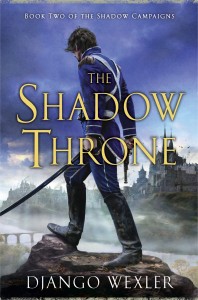
The Shadow Throne is the second volume in Django Wexler’s ongoing Shadow Campaign series, picking up right where the events of The Thousand Names left off: with protagonists Winter Ihernglass and Marcus d’Ivoire returning home to Vordan from Khandar under the leadership of Colonel Janus bet Vhalnich, there to continue the latter’s secret campaign against the sinister Duke Orlanko. It’s a flintlock fantasy series, full of secret magic, roaring battles and deadly politics: excellently written, superbly paced and all-round good fun. The Thousand Names was so polished, I had trouble believing it was Wexler’s first novel, and The Shadow Throne only improves from there, the shift in setting from foreign desert to home city managed with aplomb. Wexler is a master at writing battles, tactics and political intrigue with just the right level of detail: everything feels believable and, even more impressively, cunning, and despite the change in location between the two books, the consistent characterisation and martial focus means it never feels like we’ve leapt genres. Read More »
Last time I visited A Dribble of Ink, I wrote about worldbuilding in the air and monsters. Aidan asked me to return and talk about food in fantasy, which I do fairly regularly for my interview series Cooking the Books.
Running a food-oriented interview series makes me think really hard about food in every book I write, including Updraft (Tor 2015), because I don’t want to suddenly have a cow-based product (like milk) appear in a world that has not seen a cow in forever, and where a cow would have to scale a sky-high tower made of bone to get that milk there. NO that would be bad and has never happened, ever. (Thank you again, brilliant copy editor Ana Deboo, for, ehrm … Completely Unrelated Reasons.)
So when Aidan asked, I began to think about those Fantasy Foodies who get it right — and who make our mouths water in the process. Here are thirteen of my favorites (there are many more, but the list grew unmanageable), in alphabetical order, and I’ve given you some amuse-bouche quotes to go with them. Read More »