Yearly Archives: 2009

Pat’s recent post reminded me that I meant to make a similar post that I’ve been wanting to point out Blake Charlton‘s Spellwright.
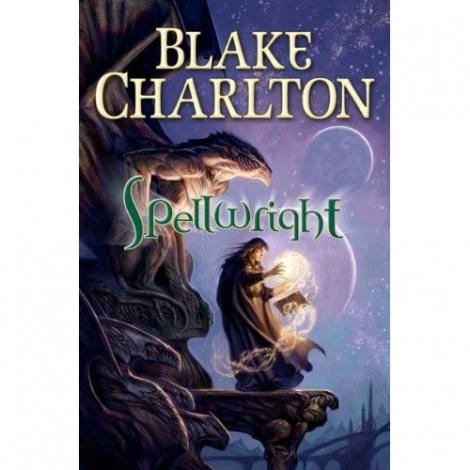
Spellwright by Blake Charlton

Imagine a world in which the written word can leave a page to physically lift a man into the air, sharpen his pitchfork, or stop his beating heart.

Such a world is home to Nicodemus Weal, a young wizard with tremendous talent for forging the magical runes which can create spells. Indeed, throughout his adolescence, Nicodemus was thought to be the Halcyon, a powerful magic-user prophesized to save the land from a coming apocalypse known only as the Disjunction.

There was only one problem: runes must be placed in an exact order to create a spell. Any deviation results in a “misspell”–a flawed spell that behaves in an erratic, sometimes lethal, manner. It so happens that Nicodemus is a “cacographer,” one unable to correctly reproduce even simple texts.

Now twenty-three, Nicodemus lives in the devastating aftermath of having failed to live up to prophecy. His magical talent is restricted to the kitchen, where he cleans pots and scrubs walls with childish language. Life slips by one aggravating day at a time until a visiting author identifies an ancient curse infesting the young wizard’s mind. The malicious text has, in fact, stolen his ability to spell. Suddenly, the two wizards closest to Nicodemus are murdered violently and he is forced to flee his home in a desperate quest to recover the stolen part of his mind.

SPELLWRIGHT is the first volume of Nicodemus’ journey across the kingdoms of Faragard, his encounters with monsters and gods who distort language to their own ends, and his internal struggle to accept himself as whole without his ability to spell.

Like most of the hyped-up debut novels of the last few years (The Blade Itself by Joe Abercrombie, The Name of the Wind by Patrick Rothfuss, The Red Wolf Conspiracy by Robert V.S. Redick, etc…) Spellwright doesn’t sound like a bastion of new, uncharted ideas, but what’s getting me excited about it are the list of authors who have been providing nice blurbs about it.

Blake Charlton has not only invented a fascinating world and peopled it with realistic people and wonderful, grisly monsters, but he has also created one of the few truly original magical systems we’ve seen in fantasy fiction. The lucid complexity of the magic reminds me of Jack Vance, which is high praise indeed. I’m fascinated to see what happens next and will be following every word with the absorption of an apprentice spellwright. You will be, too. –Tad Williams

Nicodemus Weal is a protagonist that all of us can identify with. SPELLWRIGHT features a unique system of magic and characters that are genuine inhabitants of that world. SPELLWRIGHT is a letter-perfect story: an absorbing read and recommended. –Robin Hobb

SPELLWRIGHT is exactly the kind of book that got me into fantasy in the first place. Blake Charlton has built a world that his as new as it is classic, and a story that kept me reading late into the night. Blake Charlton is a talent to watch. –Daniel Abraham

Blake Charlton’s novel is, quite literally, a magical and spellbinding adventure about overcoming the sort of odds that many in our own world struggle with. –Tobias Buckell

I usually don’t give a whole lot of thought to author blurbs, but I can’t really ignore when the list includes so many of my favourite authors. Whether Spellwright will set the world on fire or not remains to be seen, but it has certainly done enough (hey, the beautiful Todd Lockwood artwork on the cover helps, despite the lame font) to make sure I keep an eye on it.

You can find Charlton’s website HERE and his (entertaining) blog HERE.
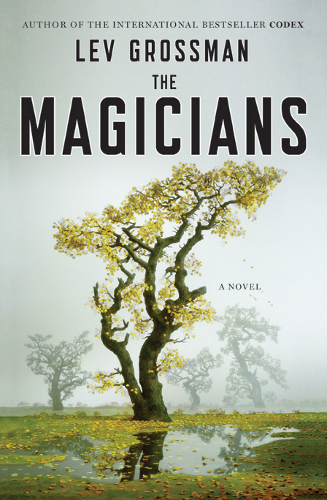
The Magicians by Lev Grossman

Quentin Coldwater is brilliant but miserable. He’s a senior in high school, and a certifiable genius, but he’s still secretly obsessed with a series of fantasy novels he read as a kid, about the adventures of five children in a magical land called Fillory. Compared to that, anything in his real life just seems gray and colorless.

Everything changes when Quentin finds himself unexpectedly admitted to a very secret, very exclusive college of magic in upstate New York, where he receives a thorough and rigorous education in the practice of modern sorcery. He also discovers all the other things people learn in college: friendship, love, sex, booze, and boredom. But something is still missing. Magic doesn’t bring Quentin the happiness and adventure he thought it would.

Then, after graduation, he and his friends make a stunning discovery: Fillory is real.

Early buzz for the novel has been strong, since it’s UK release in March, gathering favourable quotes from authors like George R.R. Martin, author of A Song of Ice and Fire:

These days any novel about young sorcerers at wizard school inevitably invites comparison to Harry Potter. Lev Grossman meets the challenge head on… and very successfully. The Magicians is to Harry Potter as a shot of Irish whiskey is to a glass of weak tea. Solidly rooted in the traditions of both fantasy and mainstream literary fiction, the novel tips its hat to Oz and Narnia as well to Harry, but don’t mistake this for a children’s book. Grossman’s sensibilities are thoroughly adult, his narrative dark and dangerous and full of twists. Hogwart’s was never like this.

and Junot Diaz, author of The Brief Wondrous Life of Oscar Wao:

Stirring, complex, adventurous – from the life of Quentin Coldwater, his slacker Park Slope Harry Potter, Lev Grossman delivers superb coming of age fantasy.

Certainly enough to get me to give it a good, close look the next time I’m at the bookstore. You can find Grossman’s website HERE.

One of my favourite features of SFSignal has always been their Mind Melds, where they get together a big group of well-known authors/publishers/bloggers and all pit them with a question.

SFSignal Logo

Well, this week, along with the likes of (Hugo Winner) Mike Resnick, David Drake and a bunch of others, I was asked to answer a simple question:

What book or books hold special memories for you? What are they?

To which I responded:

I hate to stumble into a dreadful cliché, but the title that jumps immediately to mind for me is J.R.R. Tolkien’s The Hobbit. You see, I’ve always been a voracious reader, but during my grade-school years it was always Adventure (The Gammage Cup by Carol Kendall, which, in retrospect, is probably more Fantasy-ish than I realized) and Science Fiction (Tom Swift by, erm…Victor Appleton II and any novel I could get my hands on by Michael Crichton) and dismissed Fantasy as being ‘full of unicorns and princesses, only for pansies and my mom” – an eloquent, but not terribly original opinion for a 10-year-old boy, but there it is.

Then, in the summer after Grade Six, for some unfathomable reason (probably very subtle hinting from my mother, if I know her), I picked up The Hobbit, and, well, the rest is history.

Needless to say, Tolkien blew away my preconceptions and opened a myriad of doorways to whole new realms of possibility. He began my love-affair with Fantasy and I try my damndest to read The Hobbit once a year, counting it as my second-favourite novel, behind only…

The Shadow of the Wind by Carlos Ruiz Zafon sat on my bookshelf for, literally, years before I finally read it. I think, more than anything, I was afraid that it wouldn’t live up to the hype heaped upon it. So it sat, neglected and gathering dust … which is rather fitting, when one considers the story within.
Then, with a 2 month Eastern-European backpacking trip around the corner, I figured it was finally time to dive in and give the book a shot. I began it on the plane ride over and Zafon’s words still haunt me, almost a year later.

The obvious combination of a life-changing nine-week period coupled with a hauntingly beautiful book have carved a special place in my heart, and I’d give almost anything to be able to be back in that place – rumbling traincar; the beautiful, rugged landscape of the Czech Republic and Slovakia; The Shadow of the Wind glued to my hand. Ahh, memories!

The final book that sticks out is The Dragonbone Chair by Tad Williams, the first of his Memory, Sorrow and Thorn trilogy, a classic in the genre. What’s interesting about it, though, isn’t how I fell in love with it from the first page, but rather how I couldn’t get into it, despite wanting to fall head-over-heels.

In fact, I read it three-and-a-half times before I finally discovered the beauty! The first couple of times I managed to finish it, even reading a bit of the sequel, The Stone of Farewell once, but just lacked interest in the story. One time I couldn’t even make it past the half-way point.

But, being a stubborn jackass, I picked it up for a forth time… and fell completely, utterly in love. I still can’t explain what the difference was this time (I was older; I had enjoyed Shadowmarch by Williams; I was a fan of slower narrative novels, like Robin Hobb’s Farseer Trilogy), but everything just clicked and I burned through the rest of the trilogy in short order. I now considering Memory, Sorrow and Thorn to be my favourite completed Fantasy series. Not a bad turn-around, eh?

Of course, the list could go on forever (if I included the likes of Ender’s Game by Orson Scott Card, which saved me from getting jaded on reading; or The Elfstones of Shannara, which filled that void after I had finished Tolkien; or The War of the Flowers by Tad Williams, which is a huge inspiration for my Work-in-progress; or The Anubis Gates, which took me forever to track down and was worth every second of the search), but I won’t ramble… too much.

Taking part in Mind Meld has been something I’ve wanted to do for a long time, so it’s a bit of a thrill to see my name, and my list of books, up there with the rest of them. Of course, next to the rest of the folk, I sounded like a rambling little babe, just crawled out from the crib, but it was fun nonetheless! I even got to write a bio for myself.

Be sure to check out the rest of the replies HERE.

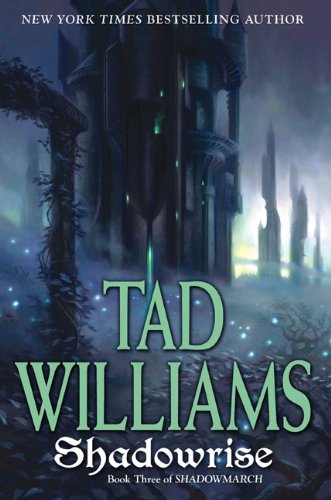
News spread a week ago that the final volume in Tad William’s Shadowmarch trilogy, Shadowrise, would be split into two volumes, each only a bit smaller than the first two volumes. Not a terrible surprise, considering each of William’s series have ended up being four books (if you consider the paperback release of Memory, Sorrow and Thorn.)

Well, hot on the heels of that news comes the cover art for what is now the third volume in the tetralogy:

Shadowrise by Tad Williams, the third volume in the Shadowmarch trilogy

These days I find Todd Lockwood’s art to be a little hit-or-miss, especially his paintings that don’t include action (his strength, in my opinion), but I think this one works in an otherworldly way that Shadowplay didn’t.

What do you think?

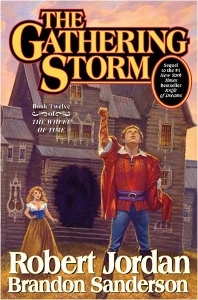
The Gathering Storm by Robert Jordan and Brandon SandersonBack when Robert Jordan was still alive, there was a lot of talk (and even a novel, New Spring) about novels set outside of the mainline Wheel of Time series. Oddly enough, even Jordan’s passing was not enough to quell the rumours.

Brandon Sanderson, who was chosen to complete Jordan’s series, spoke out (rather bluntly) about his opinion on expanding the series beyond the planned 13 volumes:

Mr. Jordan spoke with Tor (and even signed contracts) regarding some other books set in the WoT universe. The talk was originally centered on the three prequels Mr. Jordan wanted to write (New Spring, which was published, was the first of these three.) Later, Mr. Jordan shifted the discussion to something called “The Outriggers” which were within WoT continuity, taking place after the end of the series. They were to deal with some certain characters from the main storyline, expanding on their lives.

[…]

I think that Harriet and I are on the same page when we say we’ve got our hands full with the three books of A MEMORY OF LIGHT. Really, this is big enough a project for now, and all of our energies are focused on making certain these last novels are everything they need to be.

[…]

That doesn’t answer your questions though, does it? Will the other books get written? Here’s where we get vague, because I simply can’t tell you a yes or a no.

The decision will be Harriet’s. She gets to make the call. And since all of her energy is focused on these last three books, I suspect we’re not going to know the fate of the Outriggers or the Prequels for some time yet. I’m afraid you’ll just have to be patient.

At JordanCon, Tom Doherty (CEO of Tor) mentioned the Outriggers and how excited he is for them. (They would be about his favorite character.) Tom has been very involved in the WoT all through its life, and is a huge fan.

[…]

Tom wants the Outriggers.

[…]

I don’t want to see the Wheel of Time turn into an eternal franchise. I said this last weekend at my signing in Montreal. Part of the value of a great work of art is, in my opinion, the ending. An ending loses power if it isn’t allowed to be…well, the END.

[…]

I haven’t specifically told Harriet not to do the Outriggers. That isn’t my place. When she’s asked for my input, I’ve said “My suggestion is to be very, very careful. I would err on the side of protecting Jim’s legacy, and don’t know if it would be appropriate to do any more books.” However, if she asks me to do them, I will most probably say yes.

Why? Well, a couple of reasons. My soul is not part of the Wheel of Time. This series is NOT mine–it is Harriet’s and it is yours. But my soul is in there, and it would be very hard to let someone else write it. Almost as hard as it would be to let go of another series. My reasoning would be the same as my reasoning behind picking up AMOL in the first place. If Mr. Jordan’s not here, I want to make certain that someone who respects the series is writing on it.

[…]

I have told Harriet, and I have repeated it on blogs, that I would say no (though it would hurt to do so) if a decision were made to go beyond the Outriggers and the prequels.

But please, understand. There has been very little talk of these things. AMOL is what NEEDS to be done.

Phew! Believe it or not, this is a very abridged version of Sanderson’s thoughts on the subject (say anything about the man, but don’t say he doesn’t like to talk!) and it’s interesting to see him struggling to straddle the line between fan and author of the series.

Out of respect for Jordan, it seems like it would behoove Tor to let the series stand, after Sanderson has completed it. Even as it is, there are fans out there who are unhappy with someone else getting their hands on Jordan’s series, and I have a hard time believing that whole new novels (written mostly without guidance from Jordan’s notes, which were plentiful for A Memory of Light) would go over well.

My own opinion about it is that one can’t help but feel that any attempt to expand the world beyond the main series would be nothing more than a money-grab, taking advantage of Jordan’s immense popularity. Just take a look at what happened to the Dune series after Frank Herbert passed away and control of the series fell to Kevin J. Anderson and Brian Herbert.

In any case, it’s worth taking a look at Sanderson’s whole account of the Outrigger Trilogy over at Dragonmount.