Posts Categorized: News

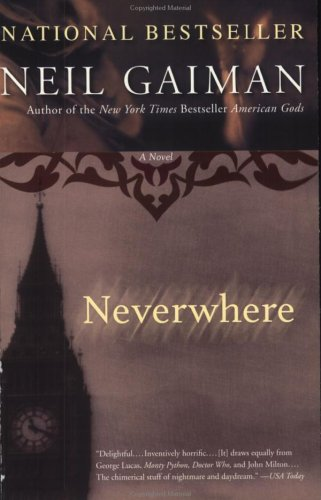
A few months ago, Neil Gaiman gave away electronic copies of his Hugo winning novel, American Gods. Well he’s back at it again, and this time he’s giving away copies of Neverwhere.

Neverwhere by Neil Gaiman

EDIT: Looks like it’s open for US residents only. I’m not sure if it works, but for those of you who live outside of the US, you could always try to use a fake US address.

UPDATE: Looks like the PDF file will only last for 30 days, so read fast!

From Gaiman’s blog:

For those people who grumbled about reading American Gods online, here’s Neverwhere. You can read it online, and it’s also downloadable. That’s the good news.

The bad news is you don’t get to keep it forever. It’s yours for thirty days from download, and then the pdf file returns to its electrons. But if you’ve ever wondered about Neverwhere or wanted to read it for free, now is your chance. And free is free…

You can download the novel HERE.

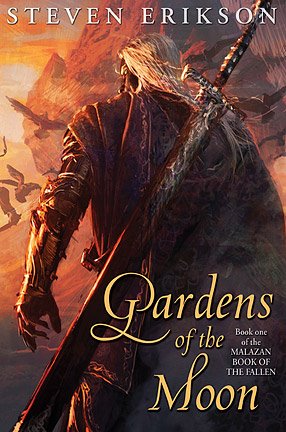
There’s some exciting news out of Pat’s Fantasy Hotlist, as it looks like Patrick St. Denis, (relative) veteran blogger and bigtime Steven Erikson fan, will have a hand in the upcoming Limited Edition publication of Erikson’s Gardens of the Moon.

In other news, guess who’s going to pen the flap copy of the Subterranean Press limited edition of Erikson’s Gardens of the Moon!?! Yep, Yours Truly!

So if the gorgeous art by Michael Komarck wasn’t enough, now you’ll have a 200-250-word story blurb from me to look forward to!

Gardens of the Moon by Steven Erikson

Exciting for Pat, to be sure, but this is also a great step forward for bloggers and goes to show that what we’re doing can have a positive effect on the industry!

A big congrats to Pat! My envy burns very brightly indeed….

Comments closed

Paul Kearney, whose latest novel, The Ten Thousand (REVIEW), was just released worldwide, has released information about his next project. Following the steps of Tobias Buckell (whose penning an upcoming novel based on the popular Halo series of videogames), Kearney will be working on a tie-in novel for the televisions series Primeval.

Stolen from Werthead:

TIME FOR ADVENTURE

A Brand New Novel Based On The Hit TV Series, Primeval

Continuing the exciting new series of original novels spinning out of the prime time ITV series from Impossible Pictures comes PRIMEVAL: THE LOST ISLAND [Titan Books, 24 October 2008, £6.99].

When strange anomalies in time start to appear, Evolutionary Zoologist Professor Cutter and his team must help track down and capture a multitude of dangerous prehistoric creatures from Earth’s distant past.

Written by Paul Kearney (The Monarchies of God, The Sea Beggars), The Lost Island finds Cutter and his team stranded on a mysterious island amidst the perilous Irish seas, where they must fight to survive as anomalies wink in and out around them, releasing untold dangers into the deadly storm.

A heady mixture of action and adventure, Primeval has captured the imagination of audiences and critics alike. Titan’s first novel, Primeval: Shadow of the Jaguar [£6.99, 9781845766924] was a Bookscan #1 bestseller, while the DVD release of the second series topped TV DVD charts with 35,000 copies sold in its week of release.

As the show continues to be syndicated to networks across the world, these brand new original novels take Professor Cutter and his team to places and situations outside of the show to confront new creatures and face new dangers in the Primeval universe.

With the third series scheduled to air in early 2009, Titan’s thrilling new fiction is the perfect way for fans to keep their appetites whet and immerse themselves in the world of the show.

It’s interesting to see acclaimed writers turning to the world of tie-in novels. Maybe we’ll finally start seeing tie-in novels worth reading? Kearney and Buckell’s names attached to a novel are certainly more than enough to get me interested.

Also, here’s a few more tidbits pulled from comments he made on his own forums:

You folk still waiting to read the darn thing may or may not be interested to know that I’ve been hammering out a new idea for a big fantasy series for Solaris. I don’t really want to revisit the world of Kuf in the near future, and the rights to the Beggars still haven’t reverted, so it’s plough on elsewhere time. I’ve decided to really pull my finger out this time and go a bundle on the fat fantasy ethos, setting the new series in seventeenth century Europe, but an alternate Europe – not like in the Monarchies, but in our own geographical and historical world, though with obvious tweaks and differences – the addition of magic and so on. I’m thinking of basing the main character on Oliver Cromwell, but the series will be about the whole Thirty-years-war era. Still in the preliminary stages, but so far Solaris are very happy with the concept.

I’ve been thinking about my style of writing too. Reading some of the reviews for The Ten thousand, I think perhaps I’ve become a little too lean and mean with my prose, and the focus of the narrative. So I’m thinking of being a little more discursive with the new stuff. I’d be interested in some feedback from you good people out there on that one…
Anyway, as soon as I can let you know more, I will.

This new idea, which in my mind is entitled Fury, is something I’ve been toying with in my head since I finished Ships from the West. I’ve decided to try and write ‘fatter’ as it were, and really pad out the characters, the milieu and all the stuff fat fantasy thrives on. Whether it’ll work out, only time will tell, but one thing’s for sure, if someone tells me one more time my books are too short, I’ll smack them on the nose.

Despite my reservations for The Ten Thousand, I’m still very excited about these rumblings. Can’t wait to see what Kearney and Solaris have up their sleeves.

Old Man's War by John ScalziIn a particularily candid move, John Scalzi, the author of Old Man’s War (REVIEW), The Ghost Brigades (REVIEW) and The Last Colony, pulled back the curtain a bit and is giving fans a look at some of the things that just weren’t good enough to make it into The Last Colony.

From the Subterranean Press web site:

This particular excised chapter comes from an iteration of The Last Colony that I didn’t write (or more accurately, didn’t complete): the second iteration, in which I had planned to write the books in alternating chapters of first person and third person, the first person chapters featuring John Perry, the hero of Old Man’s War, and the third person chapter featuring other characters, particularly General Tarsem Gau, the leader of the Conclave. Eventually, I abandoned the idea for two reasons: it rapidly became clear it would be a structural nightmare, and also because if I wrote it this way, the book would end up in the 180,000 word range — i.e., I’d have written enough for two books, and would only be paid for one. Bad writer, no cookie.

And as it turns out, I mined it again for part of Zoe’s Tale. You’ll have to wait to see which part and how, but the fact that I could (and did) goes to show that nothing has to be wasted. This excised chapter itself will never see the light of day as part of a larger story, but little bits and pieces can be moved around and used and recycled. Waste not, want not.

The lesson here for writing is that even your “failures” — the stuff that doesn’t work for your book, for whatever reason — can still have value to you as you’re wrestling with your work. This is one reason way, whenever I chop out a significant chunk of text from a book I’m writing, I don’t simply delete it: I cut it and paste it into an “excisions” document that I keep handy. That way I can go back to that material for reference, or to drop a line or an idea into the final version, perhaps in a completely different context, but where it will do some real good. This is what I do, and it’s worked for me so far.

The whole article can be found HERE.

Having just finished The Last Colony, it’s certainly interesting to get a peek at some of the process that goes into writing, and editing it. Look for a review of The Last Colony soon.

Richard Morgan, whose latest novel, The Steel Remains, was just released in the UK, has written a terrific article about his novels as the, erm… debacherous content often found within.

The first thing he tackles is a subject I (along with John from Grasping for the Wind and Joe Abercrombie) am familiar with. Swearing.

Not long ago, I received a curious communication through the fan-mail portal of my website. It was from an American reader who’d picked up a copy of my last novel Black Man (or Thirteen as it’s rather more primly known in the US) was about a hundred pages in and had now, he informed me, closed the book and wouldn’t be continuing. Well, them’s the breaks, of course, can’t please everyone – but what fascinated me was this offended reader’s reason for quitting. He was unhappy, he said, with my repeated use of the word “f*ck”.

Now, if you’ve not read Black Man (or indeed any of my other work), this might not, as it stands, seem strange. After all, not everyone likes to hear high-powered expletives slung around in their fiction. But consider here a couple of background details. Black Man begins with the surgical dismembering of a drugged and helpless woman for food. That’s the prologue. By the end of chapter one, elsewhere, our central protagonist has been stabbed, has killed his assailant with his bare hands, and has then gone on to shoot dead another man and woman. The body count dips a bit after this, but there’s an undercurrent of desperation and violence in the book as a whole which means that anyone reaching the hundred page mark has waded through a handful of other murders and a welter of savage hand to hand combat to get there.

All of which was, apparently, just fine and dandy with my offended reader. He had, he insisted, actually been enjoying the book as, and I quote, “a well written and entertaining thriller”. Physical beatings, stabbings, shootings, the odd bit of enforced cannibalism – hell, nothing wrong with any of that, right? All part of the ride. But throw in a few four letter words, and suddenly this guy’s throwing down the book – a book he’s enjoying, mark you, a book he bought and paid for – and will not finish it.

I give up.

Next up: Homosexuality and the sexual habits thereof.

So what’s the stumbling block this time?

The protagonist is gay, and we get to see him in action.

No, really. That’s it.

Well, here I’m tempted to say read the book and decide for yourself. But before you go out and spend your hard-earned money to that purpose, here’s a quick glance over the salient features (and, I guess, a warning for those too tender to face the specifics of the text itself):

There are two explicit male-on-male sex scenes in The Steel Remains, and one male-on- male post-coital conversational scene that might, I suppose, answer to a charge of “risqué”. All three scenes involve front-line protagonists and all three have a significant impact on both the characters involved and the direction of the narrative. The two explicit scenes play off one another to demonstrate emotional growth and a shifting power dynamic within a relationship vital to the central strand of the narrative. The post-coital scene is also, I confess, something of an icebreaker, a slow pass at the protagonist’s sexuality in order to get us ready for what’s to come later. But in general and in all honesty, I’d have to say these are the least gratuitous sex scenes I’ve ever written. In fact, as a straight guy, I wrote this stuff with a depth of clinical detachment and attention to craft that I certainly never needed to deploy when I was writing straight sex scenes in other books. I like to think, of course, that none of the sex in any of my books is “gratuitous”, that it all serves some plot function or other, and that I don’t let my own erotic imagination run away with me. But this is the first time I can be absolutely sure of that fact; I didn’t write this stuff for jollies. In fact, when I was done, I had to run the scenes by a gay male acquaintance for approval, to make sure I was hitting the nail on the head, so to speak. (I was told, incidentally, that what I had written was actually quite arousing for anyone that way inclined; and I confess I feel a quiet, craftsman’s pride in that fact. But no arousal, as far as I can tell.)

Personally, I like sex. Excluding a couple of emotionally painful episodes here and there, pretty much all the sex I’ve ever had has been life affirming and delightful. And I see no reason not to put that sensation, explicitly, into the fiction I write. Properly done and with appropriate precautions, sex is one of the great joys of human existence. You’d no more want to miss out on it than you’d want to give up seeing in colour or feeling the sun and wind on your face, or any other of life’s myriad sensory pleasures. And when it comes to story-telling, I’m no more going to soft-pedal my descriptions of sex than I’m going to cheat my readers of that wind on their face, or cool water at the end of a day’s dusty travel, or the furnace glow of sunset across a bustling cityscape somewhere south.

Morgan rounds things out with violence:

Of course, life – and especially the life of desperate, violent men with swords – is also full of pain. And fiction that attempts to evoke life must deal in that pain. The Steel Remains does so, with an intensity that is brutal and unforgiving (and without reviewer disapproval, it seems). You will not lack for spilled blood or hate or suffering here. But if we don’t mingle the pain in our fiction with life’s pleasures as well, then we are guilty of a crucial misrepresentation of the facts and, worse still, of perpetuating a po-faced, sanitised denial of what life is really about and who we really are. If we do not allow ourselves detailed descriptions of sex in our fiction, then we deny the core significance those acts have in our lives. And if we do not permit those descriptions to extend to gay men, then we deny their right to those same core motivations as everyone else.

I don’t intend to be found guilty of any of those sins. I try to evoke life in my fiction, because it’s the only way I know how to write, and quite honestly I’m not interested in learning another way, no matter how wholesome and safe for sales it might turn out to be. If this makes The Steel Remains controversial or gratuitous, then it is only because it represents a controversy and a gratuitousness that I see in life everywhere I look.

Whether you love or hate his novels, Morgan is well known for pushing the boundaries with his Science Fiction and (now, with the release of The Steel Remains) his Fantasy. Certainly an interesting read.

You can find the whole article HERE.