Via Tobias Buckell:

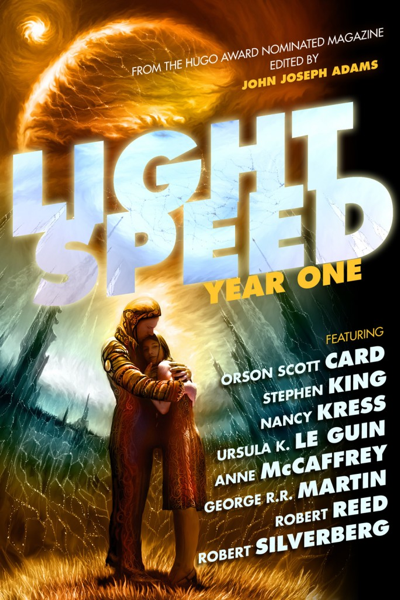
Lightspeed, Year One

Lightspeed: Year One compiles all the fiction published by the online science fiction magazine Lightspeed in its first year. Originally published stories include Nebula Award finalists Vylar Kaftan’s “I’m Alive, I Love You, I’ll See You in Reno” and Adam-Troy Castro’s “Arvies” as well as Carrie Vaughn’s Hugo Award-nominated “Amaryllis”. Plus there are classic stories by Stephen King, Ursula K. Le Guin, George R. R. Martin, and more.

The popular, critically-acclaimed Lightspeed is edited by bestselling anthologist John Joseph Adams. Lightspeed publishes all types of science fiction, from near-future sociological soft sf to far-future star-spanning hard sf—and everything in between. Each month, Lightspeed features a mix of original and classic stories, from a variety of authors, showcasing the best new genre voices along with bestsellers, award-winners, fan favorites, and notable authors readers already know.

And the Table of Contents:

June 2010, Issue One
I’m Alive, I Love You, I’ll See You in Reno – Vylar Kaftan
The Cassandra Project – Jack McDevitt
Cats in Victory – David Barr Kirtley
Amaryllis – Carrie Vaughn

July 2010, Issue Two
No Time Like the Present – Carol Emshwiller
Manumission – Tobias S. Buckell
The Zeppelin Conductors’ Society Annual Gentlemen’s Ball – Genevieve Valentine
…For a Single Yesterday – George R. R. Martin

August 2010, Issue Three
How to Become a Mars Overlord – Catherynne M. Valente
Patient Zero – Tananarive Due
Arvies – Adam-Troy Castro
More Than the Sum of His Parts – Joe Haldeman

September 2010, Issue Four
Flower, Mercy, Needle, Chain – Yoon Ha Lee
The Long Chase – Geoffrey A. Landis
Amid the Words of War – Cat Rambo
Travelers – Robert Silverberg

October 2010, Issue Five (SF-Horror Hybrids Issue)
Hindsight – Sarah Langan
Tight Little Stitches in a Dead Man’s Back – Joe R. Lansdale
The Taste of Starlight – John R. Fultz
Beachworld – Stephen King

November 2010, Issue Six
Standard Loneliness Package – Charles Yu
Faces in Revolving Souls – Caitlin R. Kiernan
Hwang’s Billion Brilliant Daughters – Alice Sola Kim
Ej-Es – Nancy Kress

December 2010, Issue Seven
In-Fall – Ted Kosmatka
The Observer – Kristine Kathryn Rusch
Jenny’s Sick – David Tallerman
The Silence of the Asonu – Ursula K. Le Guin

January 2011, Issue Eight
Postings from an Amorous Tomorrow – Corey Mariani
Cucumber Gravy – Susan Palwick
Black Fire – Tanith Lee
The Elephants of Poznan – Orson Scott Card

February 2011, Issue Nine
Long Enough And Just So Long – Cat Rambo
The Passenger – Julie E. Czerneda
Simulacrum – Ken Liu
Breakaway, Backdown – James Patrick Kelly

March 2011, Issue Ten
Saying the Names – Maggie Clark
Gossamer – Stephen Baxter
Spider the Artist – Nnedi Okorafor
Woman Leaves Room – Robert Reed

April 2011, Issue Eleven
All That Touches the Air – An Owomoyela
Maneki Neko – Bruce Sterling
Mama, We are Zhenya, Your Son – Tom Crosshill
Velvet Fields – Anne McCaffrey

May 2011, Issue Twelve
The Harrowers – Eric Gregory
Bibi From Jupiter – Tessa Mellas
Eliot Wrote – Nancy Kress
Scales – Alastair Reynolds

I know it might seem silly to be anticipating an anthology that’s full of short fiction already available to read for free on the web (or eReader), but I admire Adams and his work and, well… that cover’s just lovely! In case you needed a bit of reading for the weekend, I’ve provided links to each of the stories on Lightspeed’s website!

What’s your favourite Lightspeed published story?

Via io9 and Ghibli Blog:

Lego art inspired by Hayao Miyazaki's films Lego art inspired by Hayao Miyazaki's films Lego art inspired by Hayao Miyazaki's films Lego art inspired by Hayao Miyazaki's films

Hayao Miyazaki has such a lush, organic style to his art, which makes it doubly impressive that Iain Heath, the artist behind these renditions, was able to capture the spirit of the legendary filmmaker’s characters and movies. My favourite, by far, is the piece from Ponyo.

You can find more of Heath’s Lego constructions (Miyazaki-inspired or not) on his Flickr account!

Comments closed

The Girl Who Plucked Red Flowers Beneath the Queen's Window by Rachel Swirsky“The Lady Who Picked Red Flowers Beneath the Queen’s Window” by Rachel Swirsky is a Hugo Award-nominated novella that begins when a sorceress dies and follows her spirit as it is summoned through the ages by a variety of different people and cultures seeking her magic and knowledge. Swirsky’s considered by many to be among the best new voices in genre short fiction, and this novella is yet another piece of her fiction worth reading and, more importantly, examining.

The most startling aspect of the story is Swisky’s decision to tell the tale over the course of many millennia. By casting a trapped spirit as a protagonist and narrator, Swirsky is able to cover an enormous amount of time in a relatively small amount of space. One of my favourite aspects of Speculative Literature, especially that which covers vast amounts of time, is its ability to suppose about societies and how they will evolve over time. We see only bits and pieces of each time period, but the juxtaposition of placing a static character in an ever-changing environment and then asking her to try to adapt almost immediately to new ideologies, new races, and new forms of magic, allows Swirsky to explore the regrets of acting blindly on the whispers of endless prejudice and thoughtless bigotry.

“I will not desecrate women’s magic by teaching it to men.”

“How is it desecration?”

“Women’s magic is meant for women. Putting it into men’s hands is degrading.”

“But why!”

Our argument intensified. I began to rage. Men are not worthy of woman’s magic. They’re small-skulled, and cringing, and animalistic. It would be wrong! Why, why, why? Misa demanded, quoting from philosophical dialogues, and describing experiments that supposedly proved there was no difference between men’s and women’s magic. We circled and struck at one another’s arguments as if we were animals competing over territory. We tangled our horns and drew blood from insignificant wounds, but neither of us seemed able to strike a final blow.

“Enough!” I shouted. “You’ve always told me that the academy respects the sacred beliefs of other cultures. These are mine.”

“They’re absurd!”

“If you will not agree then I will not teach. Banish me back to the dark! It does not matter to me.”

Of course, it did matter to me. I had grown too attached to chaos and clamor. And to Misa. But I refused to admit it.

Naeva’s main conflict with these societies, as you can see above, is her hard-nosed and brutally stubborn abhorrence towards men. She was raised in a matriarchal society that treated their men as little more than baby-makers—useless and vile otherwise. It’s not surprise, however, that the societies that she is summoned to through the following millenniums are more liberal in their views toward gender equality. Naeva is faced with confronting her sexism, but it never feels like there is any progress made—she starts out unreasonable, and finishes unreasonable, angry and alone. The ending of the novel hints at redemption, but by then it’s too late for herself and the reader.

Ultimately, I’m not sure that any sort of conclusions are drawn to the questions and problems posed by Swirsky. Of course, humanity’s difficulty with individually adapting from the mindsets and bred-in prejudices of the societies we grow up in can never be solved, or properly explored, in a short novella, but I felt that, ultimately, the explorations of the themes are more of a meandering than a straight drive towards any sort of conclusion. As a story, I enjoyed it immensely, mostly because of the time-travel aspect, and Swirsky’s prose is always top-notch, but as a thematic piece, especially concerning the examination of sexism, it’s a bit of a rocky road. I much preferred Swirsky’s “The Stable Master’s Tale” (REVIEW), which was published around the same time.

From Ahmed’s blog:

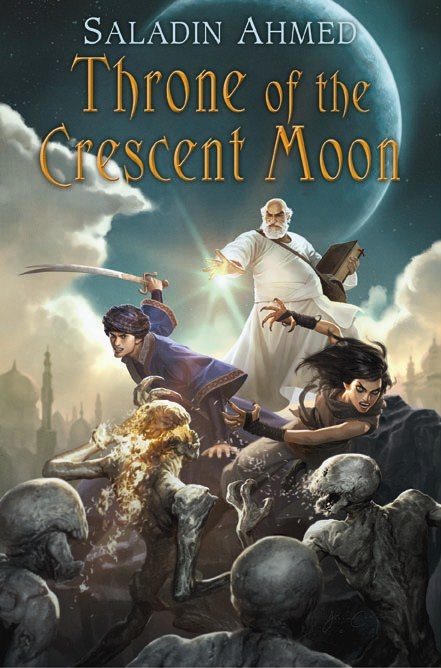
THRONE OF THE CRESCENT MOON by Saladin Ahmed

The Crescent Moon Kingdoms, land of djenn and ghuls, holy warriors and heretics, Khalifs and killers, is at the boiling point of a power struggle between the iron-fisted Khalif and the mysterious master thief known as the Falcon Prince. In the midst of this brewing rebellion a series of brutal supernatural murders strikes at the heart of the Kingdoms.

Doctor Adoulla Makhslood, the last real ghul hunter in the great city of Dhamsawaat, just wants a quiet cup of tea. A fat old man who has grown weary of hunting monsters and saving lives, he’s more than ready to retire from his dangerous vocation. But when an old flame’s family is murdered, Adoulla is drawn back to the hunter’s path.

Adoulla’s young assistant Raseed, a hidebound holy warrior whose prowess is matched only by his piety, is eager to deliver God’s justice. But even as Raseed’s sword is tested by ghuls and manjackals, his soul is tested when he and Adoulla cross paths with the tribeswoman Zamia.

Zamia Badawi, Protector of the Band, has been gifted with the power of the Lion-Shape, but shunned by her people for daring to take up a man’s title. She lives only to avenge her father’s death. Until she learns that Adoulla and his allies also hunt her father’s killer. Until she meets Raseed.

When they learn that the murders and the Falcon Prince’s brewing revolution are connected, the companions must race against time – and struggle against their own misgivings – to save the life of a vicious despot. In so doing they discover a plot for the Throne of the Crescent Moon that threatens to turn Dhamsawaat, and the world itself, into a blood-soaked ruin.

I written before about Jason Chan and his artwork. I appreciate how he’s able to straddle that thin line between fun/serious without falling into looking like a cheap comic book. I like this, though Doctor Adoulla Makhslood (who I’ve enjoyed since first discovering Ahmed’s short fiction), doesn’t look nearly as down-in-the-gutter ragged and imposing as I always pictured him. It’s fun and reminds me of old Sword & Sorcery novels from Lieber, Howard and their ilk (which, from what I can tell, is accurate of the novel, too). It’s also nice to see DAW embracing the Middle Eastern roots, rather than painting it with a more ambiguous image (as we’ve too often seen).