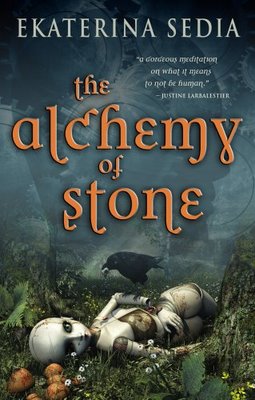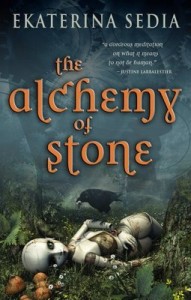
The Alchemy of Stone
Author – Ekaterina Sedia
Hardcover
Pages: 304
Publisher: Prime Books
Release Date: November 1st, 2009
ISBN-10: 1607012154
ISBN-13: 978-1607012153
I stumbled into reading Ekaterina Sedia’s The Alchemy of Stone via a twitter conversation between Paul Jessup and Matthew Delman. It wasn’t a conversation about the novel’s themes or its characterizations, nor was it even about the quality; rather, they debated tone and setting. Delman likened the setting to Eastern Europe, akin to medieval Prague or Moscow, but Jessup didn’t see the connection. Having travelled quite extensively through that part of the world (in modern times, not medieval, mind you), I was curious about the distinction, and so took the novel from the (proverbial) pile and jumped into it knowing very little about Sedia or her work.
With the tale behind me now, I’m not surprised that Delman and Jessup’s conversation so heavily leaned on atmosphere. The nameless city in which the novel’s set is as important a character as any of the other characters: human, automaton or otherwise. Through the living stone Gargoyles, Sedia gives the city a voice:
There is a house on the top of the hill – no man’s land, no-place, too steep for agriculture and too rocky for pasture, out-of-the-way and inconvenient for city dwellers and farmers both. This hill, the Ram’s Skull, the bald forehead of the once-mountain worn to a nub by time (slipping, slipping, faster and faster) is nothing but bedrock and loose stones. The house on the top sits lopsided already, its northern corner sinking with the decay of the slope under its supports
The mechanical girl and the Soul-Smoker enter the house – we hear the long squeal of a door as it opens and a slam as it closes behind them. We do not know what is happening inside, but we can guess – there is light in the fireplace and the gurgling of a kettle, and low, guilty voices. And we think of the souls and we count them – we had known every ghost in the city, and we can recall their names. We marvel at the cruelty of their fate without having the capacity to truly comprehend it – no more than to merely recognize it as grotesque. But, like the mechanical girl, we have no souls, and we are not afraid of the Soul-Smoker, we have no reason to worry that the souls inside him will somehow lure ours away and we will fall dead on the spot, abandoned by our animating essence. We think about the nature of souls and listen to the small domestic noises reaching us from the little house on top of the hill.
But the nameless city, and its gradual degradation and destruction as two warring factions wage war in its streets, isn’t the ultimate make-it-or-break-it facet of the novel. Rather, that’s Mattie, a mechanical girl, an automaton, as she’s coined in the novel, trying to break free from the shackles that society has placed on her. The reader’s willingness to buy into Mattie will likely determine their attachment to the novel. She’s a well drawn, sympathetic character, much moreso than many of the secondary human characters (the only one who comes close to her level of complexity is Loharri, who’s woefully under-explored), but, in the end… she’s also a mechanical construction with little explanation of how a gunpowder society is able to create a fully sentient, emotional and adaptable A.I. This is doubly hard to buy into when much of the crux of the novel’s plot (which happens around and despite Mattie, rather than because of her) centres around a massive computer (for lack of a better term) that is powered by coal and much less sophisticated than Mattie. I was often enthralled by her, but then she would do something too human, and I’d be whisked away from the story. Ironically, perhaps, her character would have been better served if she was more alien – Ted Chiang’s Exhalation is a brilliant example of how to draw a sympathetic but believable robotic character. Her struggles with trying to break away from the preconceptions cast on her by society were fascinating, but her emotional relationships with human characters are hard to empathize with. Ultimately, had Sedia pulled back the curtain on Mattie’s creation, and given reason for why she was so far ahead of the technology curve (and I believe there was a very ample opportunity to do this, if she’d just followed one plot string about a trio of young boys to a deeper conclusion), all of a sudden the dichotomy of Mattie’s personality and emotional abilities would have been worlds easier to accept.
Read More »