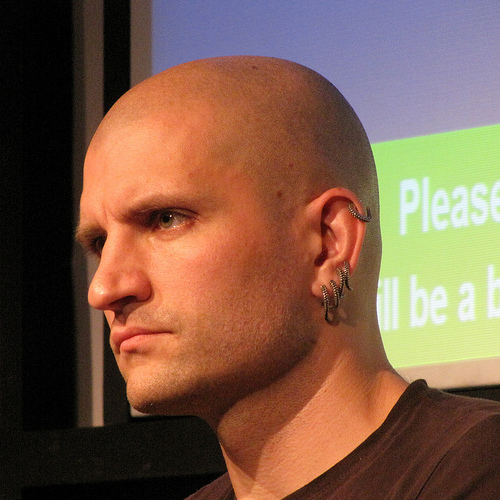
China MievilleFrom an interview with Mieville (via Walker of Worlds):

I was left wondering how he finds time to write given the range of references and interests he revealed in his conversation, be that politics, pouring over old horror novels by HP Lovecraft or chaotically catching up with modern writers – Nick Mamatas and Helen Oyeyemi were two he mentioned as well worth a look.

However he revealed his next book is already with his editor – ’science fiction, aliens and spaceships, but I don’t want to give too much away’ – and should be out next year, while adding he has a bunch of books in mind that he wants to write in the future.

Could a return to Bas-Lag be among them?

“I’m certainly not bored of Bas-Lag or anything like that and it would be easy for me to go back there,” he said. “But the books I wrote about Bas Lag had an arc to them and matter a lot to me.

“I don’t want to undermine that, so my argument would be it would have to be a story that really needed to be in that setting.

“We can all think of franchises that milked themselves dry too and can end up killing the thing you love by doing that. So I will be staying away for a while yet, although I do have a long term idea in mind,” he added, with just the right air of mystery.

Reading China Mieville sometimes makes my brain hurt. Reading Science Fiction sometimes makes my brain hurt. Slap the two of them together and you get the most enjoyable migraine the world’s ever seen. Mieville’s certainly been on a roll of late, having turned in The City & The City (released in 2009) at the same time as the soon-to-be-released Kraken; if the unnamed Science Fiction novel is with his editor, it means whatever he’s working on now (Bas-Lag or not) is his next next novel, and likely won’t be on store shelves until 2012.

The Last Page by Anthony Huso

The city of Isca is set like a dark jewel in the crown of the Duchy of Stonehold. In this sprawling landscape, the monsters one sees are nothing compared to what’s living in the city’s sewers.

Twenty-three-year-old Caliph Howl is Stonehold’s reluctant High King. Thrust onto the throne, Caliph has inherited Stonehold’s dirtiest court secrets. He also faces a brewing civil war that he is unprepared to fight. After months alone amid a swirl of gossip and political machinations, the sudden reappearance of his old lover, Sena, is a welcome bit of relief. But Sena has her own legacy to claim: she has been trained from birth by the Shradnae witchocracy-adept in espionage and the art of magical equations writ in blood-and she has been sent to spy on the High King.

Yet there are magics that demand a higher price than blood. Sena secretly plots to unlock the Cisrym Ta, an arcane text whose pages contain the power to destroy worlds. The key to opening the book lies in Caliph’s veins, forcing Sena to decide if her obsession for power is greater than her love for Caliph.

Meanwhile, a fleet of airships creeps ever closer to Isca. As the final battle in a devastating civil war looms and the last page of the Cisrym Ta waits to be read, Caliph and Sena must face the deadly consequences of their decisions. And the blood of these conflicts will stain this and other worlds forever.

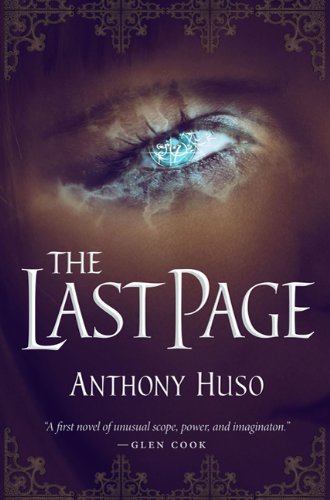
Last night, the Functional Nerds asked me for a few upcoming releases I was looking forward to. One of the first to come to mind was The Last Page, a debut novel from Anthony Huso. Lo-and-behold, a copy showed up at my doorstep this afternoon. The Last Page first caught my attention when Liviu at Fantasy Book Critic performed fellatio on gushed about it. The lovely cover certainly kept me interested in it. Lovely and iconic, I appreciate the bold splash of blue amid the browns of the cover. In the era of carbon-copy covers, I’m glad to see Huso getting some attention from Tor’s formidable art department.

Just reading the synopsis and skimming through a few pages, it gives off a kinda Mark Charan Newton-meets-Jay Lake-by-way-of-Tad Williams vibe. Not a bad first impression, by any stretch. Certainly something I’d like to get to sooner rather than later!

The Last Page will hit store shelves on August 17th, 2010 from Tor Books.

Angry Robot Books

The press release:

Leading Non-Fiction Publisher Acquires Specialist Sci-Fi Fiction & Fantasy Imprint

Following an acclaimed first year of publishing, the revolutionary science fiction imprint Angry Robot Books has parted company with HarperCollins UK. It will now run as an independent publishing imprint, with the full backing of niche publishing experts, Osprey Publishing.

Angry Robot will continue to operate from its Nottingham base and with its existing team under Marc Gascoigne, its founder and publisher. Marc said: “With the support of HarperCollins UK, my team and I have worked very hard on Angry Robot since it was founded. We have a great publishing programme in place and a dedicated bunch of supporters, the Robot Army, as well as some excellent sales of our first titles in the UK and an imminent launch into the USA. We are very pleased to have become part of the burgeoning Osprey empire. They understand our business and the enthusiasts who drive it.”

Chris Michaels, HarperCollins Digital Publisher, Fiction/Non-Fiction, who helped set-up Angry Robot, said: “Having helped build the foundations for a successful future, we are delighted that the Angry Robot team has found a new publishing partner in Osprey. We believe this will help them develop their niche offering, supported by Osprey’s specialist sales and marketing teams. We wish them good luck for the future.”

Marc Gascoigne added, “Our publishing programme for 2010/11 will be basically unaffected by these changes. There will be a short break while the transition is sorted out, but we will be re-launching in September 2010 and then it will be business as usual.”

Osprey’s move is a reflection of the company’s continuing strategic drive into niche communities that share a deep enthusiasm for their interest or hobby, whether it be military history (Osprey Publishing), heritage (Shire Books), or science fiction and fantasy.

Richard Sullivan, Marketing Director at Osprey commented: “We have a great deal of experience of serving specialist niches with a very tight product focus. Angry Robot is a great fit with our existing businesses. We are very excited about the opportunity to enter into a new market and we are looking forward to helping Angry Robot, its authors and its readers go to some exciting places.”

Given that Angry Robot Books doesn’t publish in my region (Canada), I can’t really speculate on the the sale of the imprint to Osprey Publishing, though it does seem odd that HarperCollins would pass on a (supposedly) successful imprint after so short a time, especially when Angry Robot Books was one of the more successful than most small publishing companies at embracing the idea of new media (twitter, social networking, eBooks, etc…). Still, it sounds like, after a brief hiatus, the publishing habits and schedules of Angry Robot Books will stay intact. But, can a niche non-fiction publisher like Osprey provide them with the support and distribution that HarperCollins was able back financially?

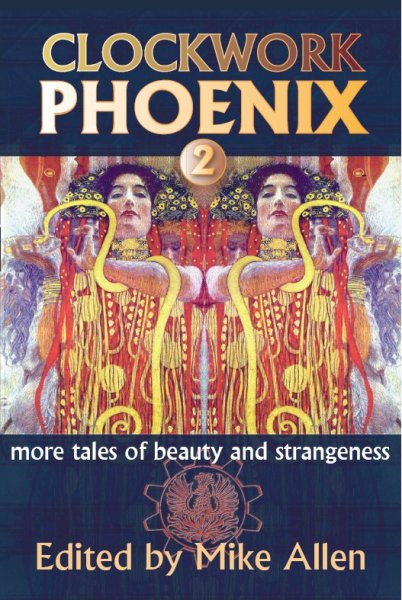
Clockwork Phoenix cover -- Includes 'Hooves and the Hovel of Abdel Jameela' by Saladin Ahmed

I first caught wind of Saladin Ahmed when he was interviewed by the charming Blake Charlton. I was impressed with the interview, and the things he said of embracing Muslim themes and mythology and integrating them into the sometimes stale Fantasy genre. When I saw that his short story Hooves and the Hovel of Abdel Jameela was on the ballot for the Nebula Award, I figured it was time to get my ass in gear and give his fiction a go.

As soon as I arrive in the village of Beit Zujaaj I begin to hear the mutters about Abdel Jameela, a strange old man supposedly unconnected to any of the local families. Two days into my stay the villagers fall over one another to share with me the rumors that Abdel Jameela is in fact distantly related to the esteemed Assad clan. By my third day in Beit Zujaaj, several of the Assads, omniscient as “important” families always are in these piles of cottages, have accosted me to deny the malicious whispers. No doubt they are worried about the bad impression such an association might make on me, favorite physicker of the Caliph’s own son.

The latest denial comes from Hajjar al-Assad himself, the middle-aged head of the clan and the sort of half-literate lout that passes for a Shaykh in these parts. Desperate for the approval of the young courtier whom he no doubt privately condemns as an overschooled sodomite, bristle-bearded Shaykh Hajjar has cornered me in the village’s only café—if the sitting room of a qat-chewing old woman can be called a café by anyone other than bumpkins.

I should not be so hard on Beit Zujaaj and its bumpkins. But when I look at the gray rock-heap houses, the withered gray vegetable-yards, and the stuporous gray lives that fill this village, I want to weep for the lost color of Baghdad.

Instead I sit and listen to the Shaykh.

As a writer, one of my goals is to transport not only myself to another place, another realm, but the readers as well. I could learn a thing or two from Ahmed. In Hooves and the Hovel of Abdel Jameela, Ahmed takes Iraq, removes any reference to time period, and paints a haunting, dusty picture of a world as alien as it is similar. The story of Abdel Jameela and his mysterious wife is curious and alarming, magical and unsettling. Ahmed has the ability to touch on all the reader’s senses, the psychedelic synesthesia during the climax (for lack of a better term) of the story being the most obvious and memorable example – he embraces those little details that so many authors ignore. For writing about something I am totally ignorant of (the Middle Eastern setting, the mythology, etc…), Ahmed, in the slim space provided by a short story, set me down in his world and made me forget, if only for a short time, of my own.

It’s nice to see a writer stepping outside of Fantaty’s typical faux-medieval politics or over-sexed vampires and draw fantasy from a mythology that is unusual but rooted deep in our world. Looking at the blockbuster releases and the bestselling authors, it’s easy to complain that the genre is getting stale, but with writers like Ahmed providing alternatives, it seems like a silly comment to make.

In short, Hooves and the Hovel of Abdel Jameela is only the first of what I hope to be many trips into the weird, wonderful world of Saladin Ahmed.

You can read Hooves and the Hovel of Abdel Jameela on Fantasy Book Critic. Alternatively, you can listen to Hooves and the Hovels of Abdel Jameela on Podcastle. It first appeared in Clockwork Phoenix 2, an anthology edited by Mike Allen.

The Enterprise of Death by Jesse Bullington

As the witch-pyres of the Spanish Inquisition blanket Renaissance Europe in a moral haze, a young African slave finds herself the unwilling apprentice of an ancient necromancer. Unfortunately, quitting his company proves even more hazardous than remaining his pupil when she is afflicted with a terrible curse. Yet salvation may lie in a mysterious tome her tutor has hidden somewhere on the war-torn continent.

She sets out on a seemingly impossible journey to find the book, never suspecting her fate is tied to three strangers: the artist Niklaus Manuel Deutsch, the alchemist Dr. Paracelsus, and a gun-slinging Dutch mercenary. As Manuel paints her macabre story on canvas, plank, and church wall, the apprentice becomes increasingly aware of the great dangers that surround her. She realizes she must revisit the fell necromancy of her childhood – or death will be the least of her concerns.

One of my favourite covers from last year was Jesse Bullington’s The Sad Tale of the Brothers Grossbart from Orbit Books. Bold and iconic, it set itself apart from other novels due to some terrific art by István Orosz.

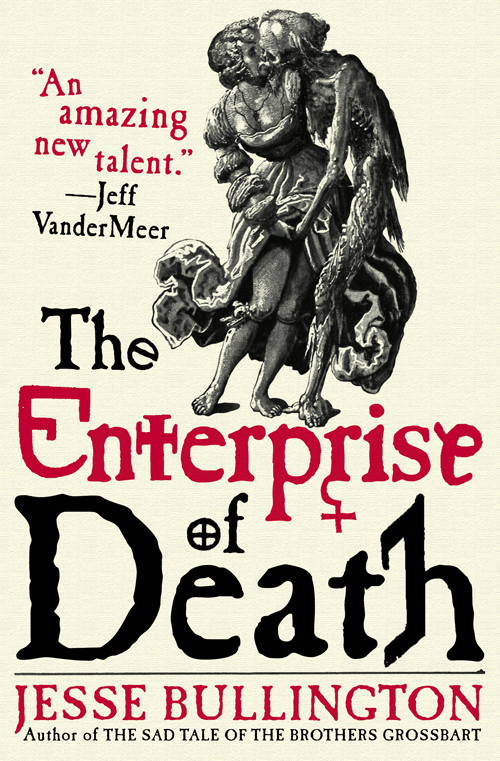
The Enterprise of Death, Bullington’s follow-up novel, had it rough, having to follow such a strong cover and, frankly, falls a little short, thanks to the lack of such bold artwork. Still the saucy artwork (based on this art by Nicklas Manuel, who appears in the book!) is suitably macabre for Bullington’s work, and I’ve always felt that Panepinto’s work is strongest when she’s working with interesting typography. While it doesn’t have the impact I was hoping for, Bullington’s got another interesting cover on his hands.

If you’re interested, you can read my interview with Jesse Bullington, which includes more information on The Enterprise of Death and an original piece of flash fiction.

Cheer to Orbit Books and Lauren Panepinto for giving me the chance to debut this cover!