Well, this is certainly different! It’s fantastic to see Tor continuing to push these new covers in new directions. Though it’s not exactly practical, it suits the medium, and will be an interesting practice once we see more e-readers with full colour, dynamic screens.
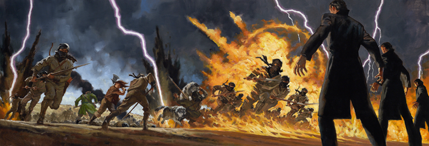
The Battle of Dumai's Well by Greg Manchess

Artist Greg Manchess on the cover:

I told Irene that I was offering to do a grander, wider scene so that the viewer could explore the battle. It would stretch far enough to break the borders of the square, but to compensate, I composed it so that we could pick a ‘sweet spot’ to place on the cover. I let that spot dictate the broader POV.

As I stretched the scene, stage left, I found myself able to include more of what was happening in the story. I wanted to give a sense of distance to the landscape, while bringing figures forward enough that they’re almost on top of you. But the closer the figure, the more they block. And explosions take up a lot of real estate in a painting.

I had to pick the moment carefully. Depict a moment too far in advance of the mayhem and it weakens the excitement. Too far after the initial firestorm and I’d be depicting heaps of charred meat. I chose the moment just before the detonations went rending through the ranks completely. The wave is just starting to sweep over the Aiel, but as timing isn’t quite so precise, I depicted the flames cresting quickly from right to left, allowing the viewer “time” to see what was about to come. Utter flaming chaos.

Manchess absolutely nails the Battle of Dumai’s Well, one of the most intense and immediately recognizable scenes in the entire Wheel of Time series. My favourite in the series so far is still The Fires of Heaven, but it’s nice to see Tor change pace and provide a frenetic action scene to accompany the mostly characters-based covers for the previous volumes.
To celebrate today’s release of his debut novel, Blake Charlton, with the help of Mark D. Hines, has created an hour long (!!!) audiobook containing the prologue and first four chapters of Spellwright!

Imagine a world in which you could peel written words off a page and make them physically real. You might pick your teeth with a sentence fragment, protect yourself with defensive paragraphs, or thrust a sharply-worded sentence at an enemy’s throat.

Such a world is home to Nicodemus Weal, an apprentice at the wizardly academy of Starhaven. Because of how fast he can forge the magical runes that create spells, Nicodemus was thought to be the Halcyon, a powerful spellwright prophesied to prevent an event called the War of Disjunction, which would destroy all human language. There was only one problem: Nicodemus couldn’t spell.

Runes must be placed in the correct order to create a spell. Deviation results in a “misspell”—a flawed text that behaves in an erratic, sometimes lethal, manner. And Nicodemus has a disability, called cacography, that causes him to misspell texts simply by touching them.

Now twenty-five, Nicodemus lives in the aftermath of failing to fulfill prophecy. He finds solace only in reading knightly romances and in the teachings of Magister Shannon, an old blind wizard who’s left academic politics to care for Starhaven’s disabled students.

But when a powerful wizard is murdered with a misspell, Shannon and Nicodemus becomes the primary suspects. Proving their innocence becomes harder when the murderer begins killing male cacographers one by one…and all evidence suggests that Nicodemus will be next. Hunted by both investigators and a hidden killer, Shannon and Nicodemus must race to discover the truth about the murders, the nature of magic, and themselves.

Hines does a wonderful job reading, and gives readers neat look at a novel in a medium that’s close to the subject matter of the novel. Charlton’s novel is a fun romp that reminded me of my early days discovering fantasy, while at the same time playing with tropes and delivering a deliciously intricate magic system. You can find my review of Spellwright HERE.

From The Hollywood Reporter:

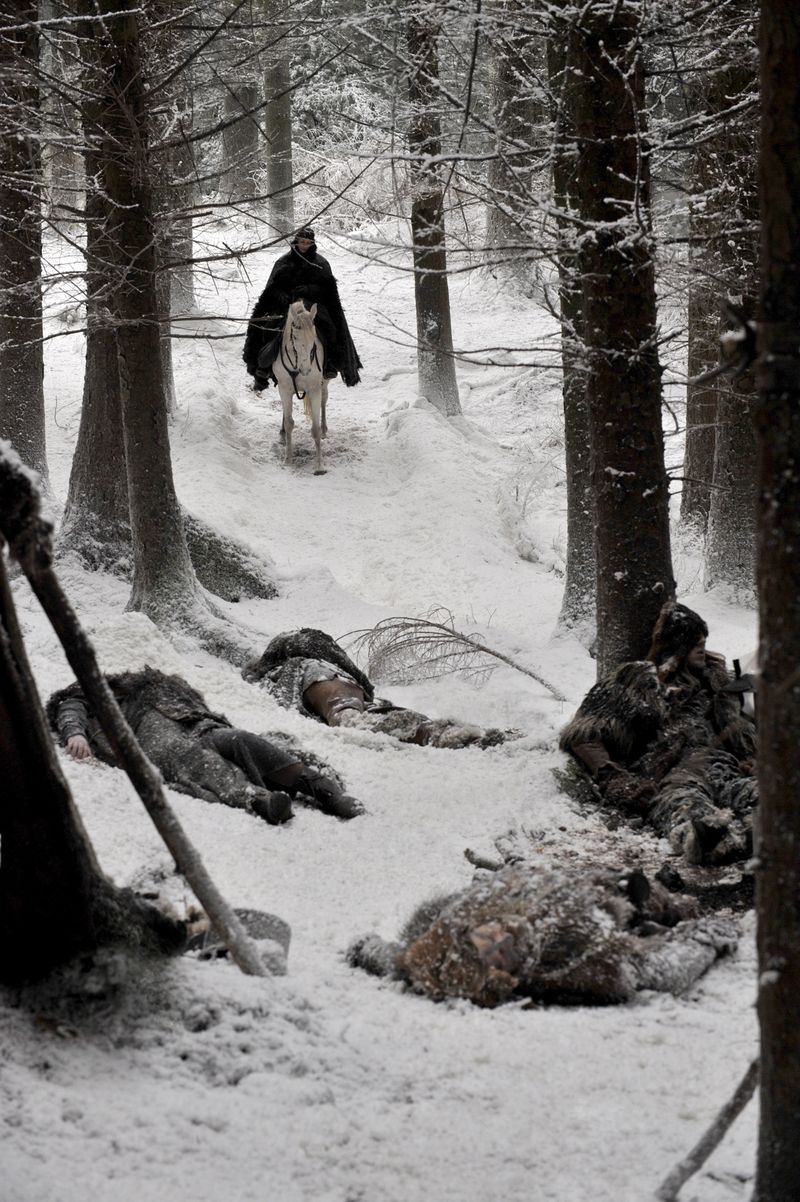
An image from HBOs A Game of Thrones

Winter is, indeed, coming.

HBO has greenlighted highly anticipated fantasy series “Game of Thrones.”

The premium network has picked up the project for a first season debut next spring (below is the first released photo from the series). Nine episodes plus the pilot have been ordered. Production will begin in Belfast this June.

From the moment the project was first announced in development, the series based on the George R.R. Martin novels has generated enormous, perhaps unprecedented, online interest for a series at such an early stage.

The sprawling tale set in the mythical land of Westeros tells the story of the noble Stark family who become caught up in high court intrigue when patriarch Eddard (played by Sean Bean) becomes the king’s new right-hand man. The four-and-counting books in the series would each be used as one season of the series.

Unlike many fantasy novels, the “Thrones” series largely avoids relying on magical elements and instead goes for brutal realism — think “Sopranos” with swords. Martin, a former TV writer (“Beauty and the Beast”), writes each chapter as a cliffhanger, which should lend itself well to series translation.

Well, now that’s good news.

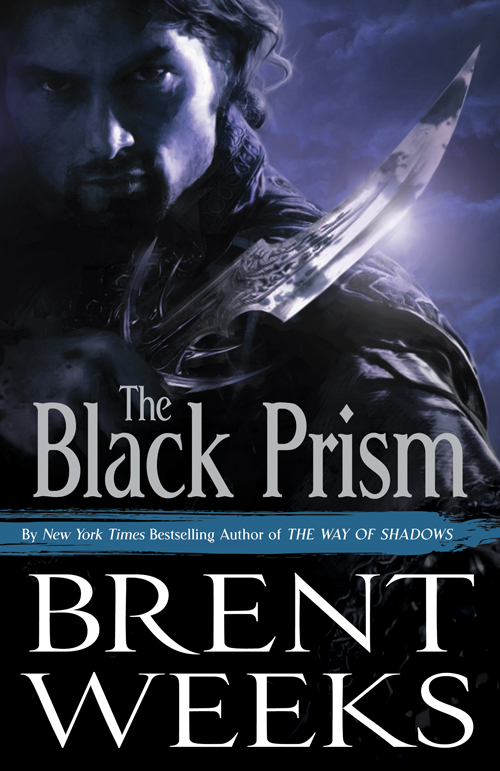
The Black Prism by Brent Weeks
Artwork by Richard Jones

Gavin Guile is the Prism, the most powerful man in the world. He is high priest and emperor, a man whose power, wit, and charm are all that preserves a tenuous peace. But Prisms never last, and Guile knows exactly how long he has left to live: Five years to achieve five impossible goals.

But when Guile discovers he has a son, born in a far kingdom after the war that put him in power, he must decide how much he’s willing to pay to protect a secret that could tear his world apart.

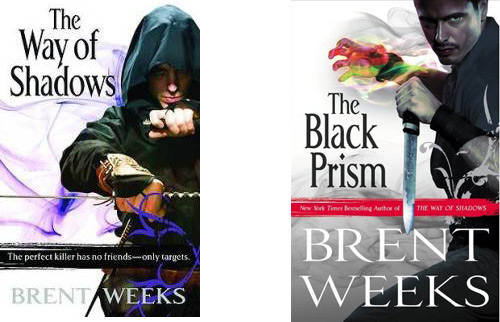
A few months ago, I raised a bit of a stink when I stumbled across a leaked cover for Brent Weeks‘s The Black Prism. My main criticism about the cover wasn’t so much the quality of the artwork, the layout of the typography or the general tone of the cover, but rather that it looked exactly like Weeks’ previous series, The Night Angel Trilogy, which is completely unrelated to The Black Prism. Now, fast forward a few months and we have this, the revamped cover for The Black Prism that seems to finally hit the nail the previous cover was going for.

A comparison of Brent Weeks covers

Lauren Panepinto, the designer, on the cover:

Your friendly neighborhood Creative Director here really had a hard time balancing how much to show, what tone the cover should have, what the color of the cover could be (hint, hint), and still remain true to the story and world inside. We must have gone through a thousand poses, color and lighting treatments, and crops. Debate raged for months over this one, as some of you heard about when a prior version of the cover was unofficially released. What was great was so many people were involved in the development of this cover, and so much feedback was taken into account, that I think we’ve really nailed this cover for a book which we hope will blow you away both inside and out.

While I’m not always a fan of the super-realistic digital painting technique used for the art (at least on covers, artwork using the style can be quite striking), I applaud the Orbit team for coming up with a cover that manages to identify with Weeks’ previous novel without resorting to completely emulating it. If there’s anything I’ve learned since the first cover was leaked, it’s that familiarity, and creating a brand for an author (especially one as immediately successful as Weeks) is important for continued success and making sure that Weeks’ fans, the casual ones in particular, can find the book as easily as possible.

I may not love this cover, but I appreciate that Orbit was willing to take a step back and consider some of the feedback generated by my post and others like it.

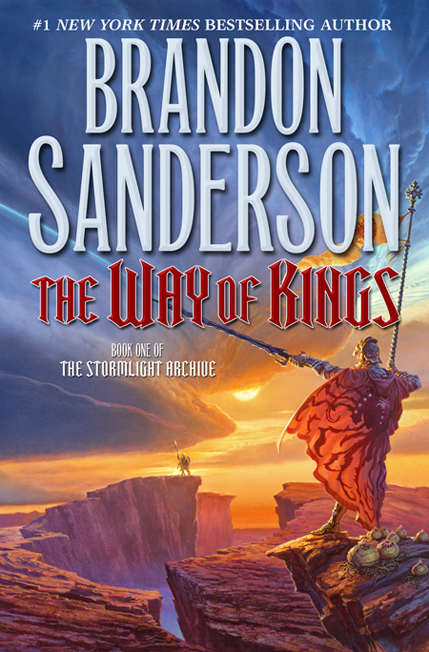
The Way of Kings by Brandon Sanderson

Whelan’s thoughts on the cover:

When I received the manuscript from Tor I was somewhat dismayed. 1400 pages! I felt that it would be tough sledding to work my way through such a massive fantasy epic.

As it turned out, though, I was soon hooked and lost in the world Mr. Sanderson so skillfully realized. It helped that the writing had a rich cinematic quality that brought images of scenes, characters and creatures to my mind as if I were immersed in a Myst-style virtual reality adventure, or watching a movie.

That was fun to read, but it made my work for the cover art very difficult indeed. How can one successfully distill enough of this novel to possibly do justice to the book with one picture? It was a steep challenge.

I’m an enourmous, slavering, hopeless Michael Whelan fan. I love the way he embraces scope. I love the way he uses colour. The cover for The Way of Kings is classic Whelan. I’m also charmed b is how involved he gets in the cover process, reading the novel before setting to work on the cover. Great detail, down to the forbidding storm cloud swallowing the sunlight, in reference to the overall title of the series, The Stormlight Archives.

Mr. Whelan’s been missed and it’s nice to back, if only for a one shot deal.