Posts Tagged: Art

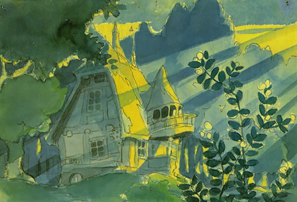
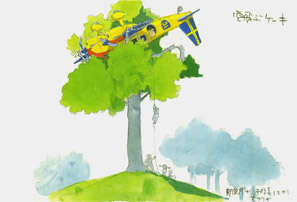
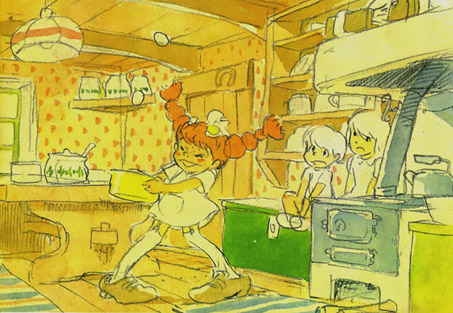
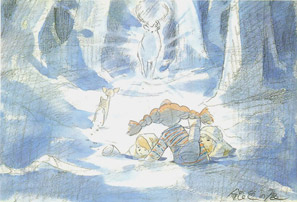
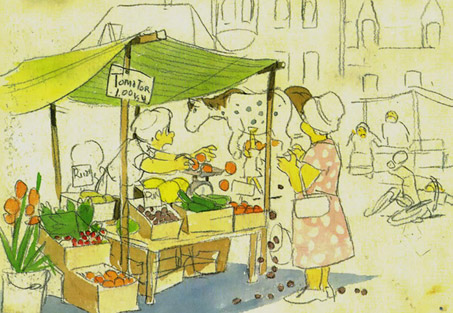
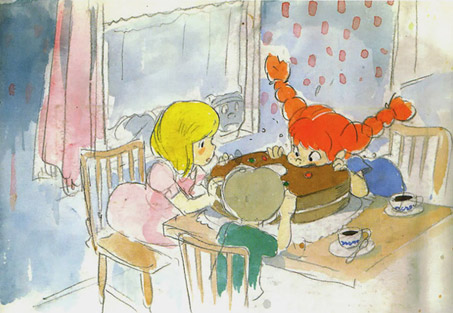
It’s no secret the Hayao Miyazaki is one of the most masterful and celebrated film makers of the past century. The Japanese writer/director’s studio, Studio Ghibli, author to contemporary classic like My Neighbour Totoro, Spirited Away, and Princess Mononoke, has helped introduce countless young (and old) people to the beautiful Japanese legends and myths that so frequently form the heart and soul of their movies. They also provide a nice counterpoint to the Hollywood-heavy Disney and Pixar films of today. But not all of Miyazaki and Studio Ghibli’s films are focused on the retelling of Eastern stories. This recently revealed concept art shows what could have been if Studio Ghibli had moved ahead with production on an adaptation of the classic Swedish story of Pippi Longstocking.
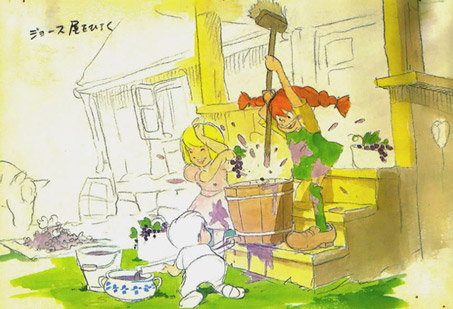
pl-4pl-5pl-3pl-2pl-7pl-1pl-6

Funny enough, io9 reports, “Hayao Miyazaki and [fellow animator] Isao Takahata began preproduction on an adaptation of Astrid Lindgren’s Pippi Longstocking books, but in the end, were unable to secure Lindgren’s permission.” Looking at Miyazaki’s history as a film maker, it’s difficult to believe that Miyazaki would run into such road blocks, but it’s important to note that in ’71 he was still in the infancy of his career as a film maker, working at Toei Animation. Lucky for us, Miyazaki’s concept art for the film still exists.

By exploring themes of adventure, nurturing love, and family, Miyazaki’s films encourage children and adults alike to remember that there’s magic in the world if they just look for it. With her superhuman strength, adventurous and unconventional personality, it’s no surprise that the master filmmaker was drawn to Pippi Longstocking.
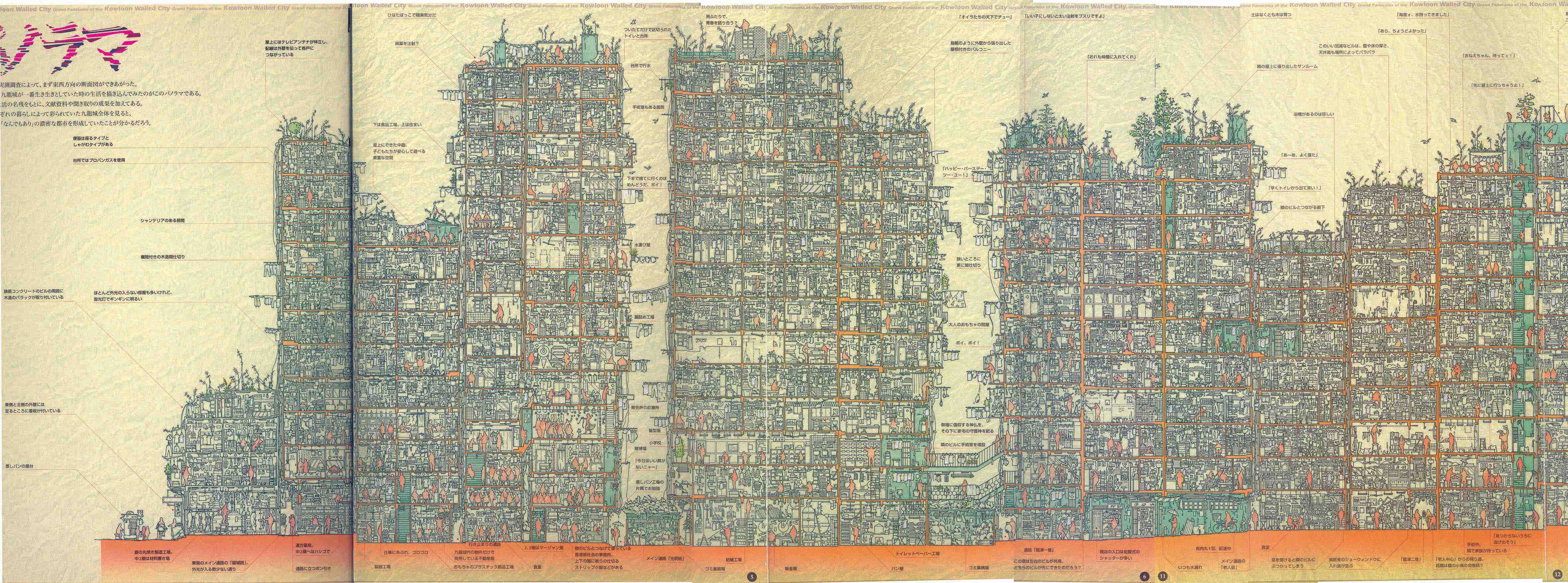
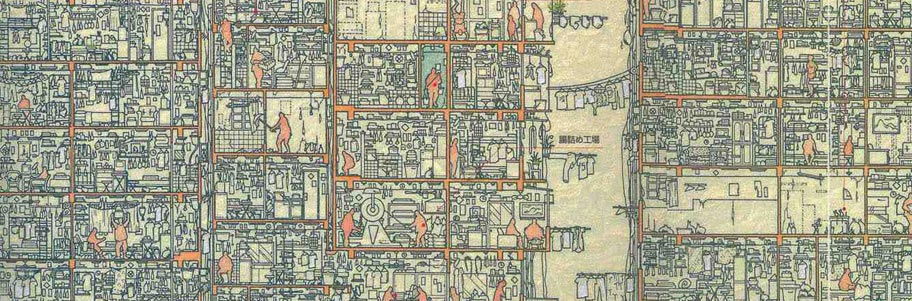
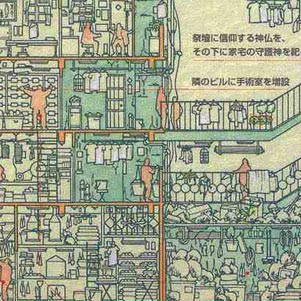
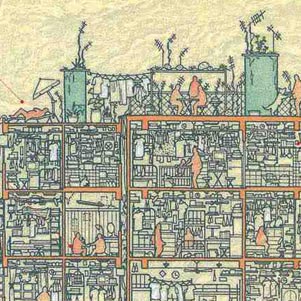
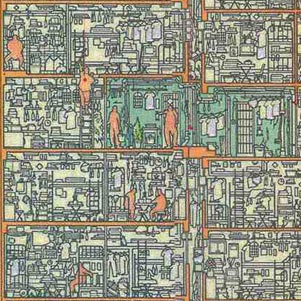
For many readers, escaping into a good fantasy or science fiction novel is a way to leave the ordinary world behind, to enter into a land of wonder, where anything can happen and things of magical beauty and indescribably evil can coexist and clash for supremacy. But, ask anyone who has examined our own world, and you’ll soon realize that Earth has as much wonder and fascinating people, places and events to match even the most bombastic genre novel. Kowloon’s Walled City, traceable back to its origins as a salt-trading post during the Song Dynasty, was home to as many as 50,000 people. The Walled City was demolished in 1993.

Just one look at this amazing cross-section of the city illustrates the staggering breadth of human creation and adaptability.

kowloon-4kowloon-2kowloon-1kowloon-3

On Visual News, Paul Caridad explains the nature of Hong Kong’s walled city:

At one time, one of the most densely populated areas on Earth, Kowloon, was a walled city within Hong Kong. It was unregulated by the then-ruling British authorities, who reluctantly allowed it as the only Chinese settlement. It was a no man’s land because of this; run by the Chinese mafia and filled with brothels, sweat shops, illegal hospitals, and trashy eateries.

Originally, Kowloon was built as a watchpost for guards who would protect the area from pirates. But as the population grew–from 10,000 in 1971 to a staggering 50,000 in 1990–attempts were made by the government to evict the squatters living in the city. In 1992, the governent succeded in evicting the population and, in 1993, the 15 story tall block of buildings was torn down. Today, a park with tennis courts covers the area.

For more on Kowloon’s Walled City, io9 highlight’s a German (English-subtitled) documentary about the city, and 99% Invisible podcast about the city. They’re both worth a look, and also worth reflecting, perhaps, on some of the luxuries that we all take for granted today.

What are some of your favourite real world locations that would fit right in in a fantasy or science fiction novel?

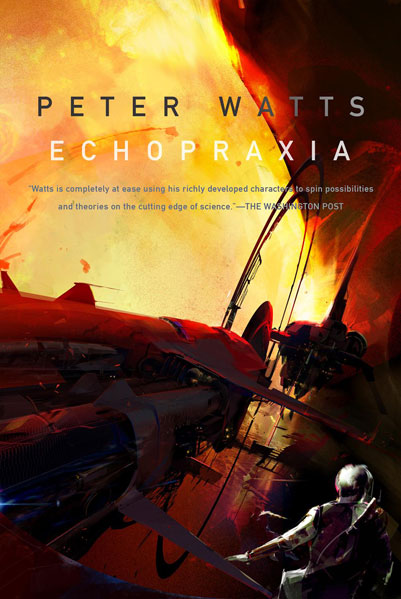
Echopraxia by Peter Watts

Peter Watts is the Hugo-winning Canadian author of Blindsight, described by The Globe and Mail as, “a hard science fiction writer through and through and one of the very best alive,” which is a reputation he has lived up to among fans of hard science fiction. Through their Spring/Summer catalog, Tor has revealed details about Echopraxia, his first novel since 2006.

Prepare for a different kind of singularity in this follow-up to the Hugo-nominated novel Blindsight.

It’s the eve of the twenty-second century: a world where the dearly departed send postcards back from Heaven and evangelicals make scientific breakthroughs by speaking in tongues; where genetically engineered vampires solve problems intractable to baseline humans and soldiers come with zombie switches that shut off self-awareness during combat. And it’s all under surveillance by an alien presence that refuses to show itself.

Daniel Bruks is a living fossil: a field biologist in a world where biology has turned computational, a cat’s-paw used by terrorists to kill thousands. Taking refuge in the Oregon desert, he’s turned his back on a humanity that shatters into strange new subspecies with every heartbeat. But he awakens one night to find himself at the center of a storm that will turn all of history inside-out.

Now he’s trapped on a ship bound for the center of the solar system. To his left is a grief-stricken soldier, obsessed by whispered messages from a dead son. To his right is a pilot who hasn’t yet found the man she’s sworn to kill on sight. A vampire and its entourage of zombie bodyguards lurk in the shadows behind. And dead ahead, a handful of rapture-stricken monks takes them all to a meeting with something they will only call “The Angels of the Asteroids.”

Their pilgrimage brings Dan Bruks, the fossil man, face-to-face with the biggest evolutionary breakpoint since the origin of thought itself.

Before becoming a writer, Watts acquired a PhD in Zoology and Resource Ecology from the University of British Columbia, which makes me even more curious to see that Echopraxia appears to deal with the merging of biology and technology. Watts is known as one of the best authors at weaving intelligent scientific exploration and debate into the narratives of his story, and everything about the synopsis for Echopraxia tugs at my interests. Peter Watts can be trusted with big ideas, and Echopraxia appears to be full of them.

echopraxia1echopraxia4echopraxia3echopraxia2

Watts’ most famous novel, Blindsight had, erm… less than inspiring cover art, so it’s nice to see Tor giving him the attention that a writer of his calibre deserves. There’s an obvious similarity to covers for James S.A. Corey’s enormously popular Expanse trilogy, but the clean typography separates the two and also brings to mind Tor’s equally impressive work on the John Harris covers for John C. Wright’s Count to the Eschaton Sequence. I’m not sure how anyone could pass this book in a bookstore and not pick it up.

Lock In by John Scalzi

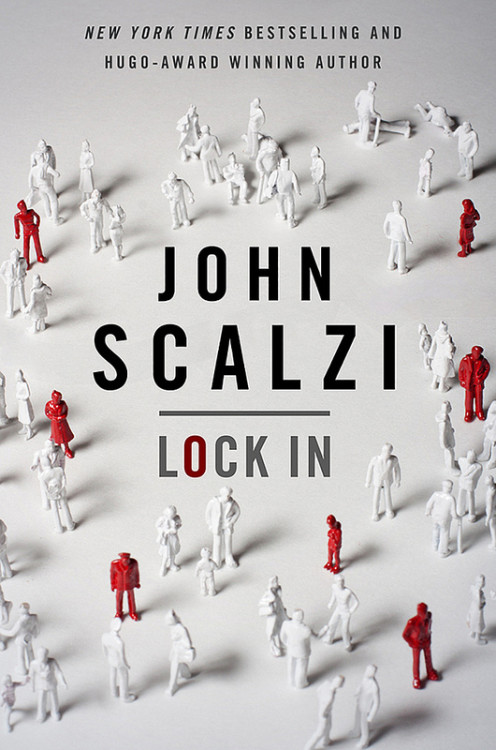
Say one thing for John Scalzi, he gets some damn fine covers from his publisher. Scalzi describes the book as ‘a near-future thriller involving a disease that causes people to be “locked in” inside their own bodies,’ and indicates that he feels the cover captures this essence. Irene Gallo, Art Director at Tor Books, describes the creation of the cover, ‘You can often describe an art director’s job as being a match-maker for author and designer and the John/Peter pairing has been a good for us. […] Peter [Lutjen] created a cover that expressed both their isolation and connectivity by painting tiny train model people.’

Tor.com has the first official synopsis of the novel:

Fifteen years from now, a new virus sweeps the globe. 95% of those afflicted experience nothing worse than fever and headaches. Four per cent suffer acute meningitis, creating the largest medical crisis in history. And one percent find themselves “locked in”—fully awake and aware, but unable to move or respond to Stimulus.

One per cent doesn’t seem like a lot. But in the United States, that’s 1.7 million people “locked in” …including the President’s wife and daughter. Spurred by grief and the sheer magnitude of the suffering, America undertakes a massive scientific initiative. Nothing can restore to the “locked in” the ability to control their own bodies. But two new technologies emerge. One is a virtual reality environment, “The Agora,” in which the locked-in can interact with other humans, both locked-in and not. The other is the discovery that a few rare individuals have brains that are receptive to being controlled by others, meaning that from time to time, those who are locked in can “ride” these people and use their bodies as if they were their own.

This skill is quickly regulated, licensed, bonded, and controlled. Nothing can go wrong. Certainly nobody would be tempted to misuse it, for murder, for political power, or worse…

Lock In, which Scalzi is in the processing of completing at the time this cover was revealed, is due for publication on August 26th, 2014.

The Darkling Child by Terry Brooks

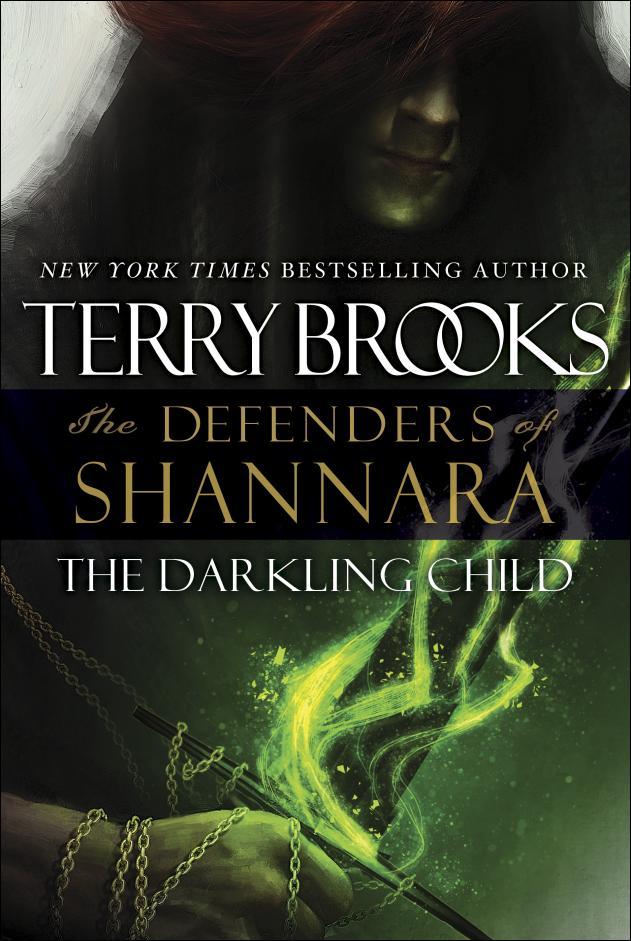
Terry Brooks’ next novel, The High Druid’s Blade, isn’t even out yet, but the cover for the follow-up novel, The Darkling Child, is already loosed on the world. (See what I did there? It’s like a demon from the Forbidding.) And, it’s just as pretty as the previous cover. I really like the rough, impressionistic quality of the painting they’ve used.

The Darkling Child is the second in The Defenders of Shannara, a loose trilogy of standalone Shannara novels that follow the events of Witch Wraith, Brooks’ most recently published novel. The High Druid’s Blade and The Darkling Child will be released in 2014.