Posts Tagged: Fantasy

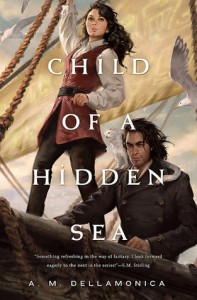
Child of a Hidden Sea by A.M. Dellamonica

Publisher: Tor Books - Pages: 336 - Buy: Book/eBook
Child of a Hidden Sea by A.M. Dellamonica

Tell if you’ve heard this one before:

A young, perky college student — a little lost as they search for a purpose in their terrifying maturation from youth to adulthood — is whisked away to a fantasy world, thrust into the middle of a crisis that, if they’re not complicit in finding a solution, will be disastrous for their newfound friends. By leveraging their otherworldly knowledge (and modern technology/understanding of medicine/science), they’re able to triumph over the bad guys and restore peace to the troubled fantasy land.

Got it?

You might be thinking of Guy Gavriel Kay’s Fionavar Tapestry, or Diana Gabaldon’s Outlander series, Lev Grossman’s The Magicians, or Lewis Carroll’s classic Alice in Wonderland. You wouldn’t be wrong, all of these are popular examples of “portal fantasy.” Unlike protagonists in traditional epic fantasies, who at least understand most of the overarching societal values and some of the physical/metaphysical rules of the world, portal fantasies allow the author to cast a character who has no more understanding of the laws and societies of the fantasy land than the reader themselves (and often less, if the protagonist isn’t an avid fantasy fan who’s probably seen it all before). Over the course of the novel, the reader discovers the world, magic, etc. at the same rate as the protagonist. It’s a tried-and-true formula, but therein lies the issue with most portal fantasy: we have seen it all before. Read More »
Author’s Note:

This piece is meant to be a broad-ranging retrospective on the work of Gene Wolfe, one of the most significant authors of speculative fiction. As I imply in the essay below I think it is quite impossible to “spoil” a Gene Wolfe novel (each work is just too protean), but I do discuss both his plots and possible interpretations of several puzzles his books present. So if you haven’t read the books in question, you’ve been warned.

A good essay, like any good story, needs solid bones.

A good essay, like any good story, needs solid bones. It needs a foundation, a structure, a framework on which the subject can hang. When I sit down to write about a genre, or a story, or an author’s work I always start with that core: I try to find some central tenet, a grain of sand small and indivisible, some immutable truth inherent to the work around which my analysis can accrete. But trying to sift the work of Gene Wolfe – one of my favorite authors – I find that each grain becomes as mutable, as multifaceted, as slippery as his work itself. And maybe it is that slipperiness, that coy teasing play, that is itself the heart of Wolfe’s writing. Perhaps that is as good a place to start as any.

Gene Wolfe – as he has stated time and again – sets out to write books which can deliver a different kind of enjoyment each time they are read or re-read. He engineers his work from the very start to operate on multiple levels, to manipulate the reader using different levers.

Read More »

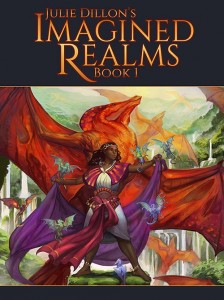
imagined-realms-by-julie-dillon

It’s no secret that I’m a big fan of Julie Dillon’s artwork. In fact, when it came time to redesign A Dribble of Ink earlier this year, I knew I wanted to feature some gorgeous fantasy-inspired art in the header, and Julie, with her warm, colourful style, and ability to imbue her art with an otherworldliness without losing its grounded sense of wonder and emotion, was the perfect choice for the project. Luck was with me, and now A Dribble of Ink is graced with a beautiful original piece of Dillon’s artwork.

Dillon’s star is rising, perhaps most evidently by her nominations for the 2012 and 2013 Hugo Awards. In 2013, she became the first woman to be nominated in the Best Professional Artist category since Rowena Morrill in 1986 (1986! 28 years!).

Earlier this month, Julie Dillon launched a Kickstarter campaign for Imagined Realms: Book 1, which Dillon describes as “the first in a series of annual art books that I am illustrating and self-publishing.” Each annual volume of Imagined Realms will contain 10 exclusive illustrations, a pretty exciting proposition for Dillon’s growing legion of fans.

Read More »

exile-trilogy

“Yes, I will write Captal’s Tower,” Mealnie Rawn revealed to her fans on Kate Elliott’s blog yesterday. Anyone who’s followed Rawn’s career knows what huge news this is, but for those that aren’t familiar with Rawn’s Exiles trilogy, know that the path to the trilogy’s conclusion has been slow and fraught with peril.

“I’m very sorry it’s taken so long. My sincere thanks to all of you who have been so patient,” Rawn told fans. “I’m currently writing the fifth book in the Glass Thorns series, and after that my plan is to get to work on Captal’s Tower.”

The Captal’s Tower is the final volume of Rawn’s Exiles trilogy, which began in 1994 with The Ruins of Ambrai. Fans have been waiting for the end of Collan Rosvenir’s tale since the 1997 release of the second volume, The Mageborn Traitor. Personal issues, including clinical depression, prevented Rawn from completing work on The Captal’s Tower in the late ’90s.

This is, of course, fantastic news for fans of the trilogy, who have been waiting for 17 years for its conclusion, and great news for Rawn, who begins work on a project that has long cast a shadow over her other works of fiction during the past two decades. Time is often the best and only medicine for such illness. Though work on The Captal’s Tower stalled, Rawn has been a productive author during that period of time, publishing six novels and several short stories.

In the author’s note for her novel, Spellbinder, published in 2007, Rawn addressed the issue surrounding To Captal’s Tower. “To those who are disappointed that this isn’t another book — The Captal’s Tower or an offering the Golden Key or Dragon Prince universes — well, what can I tell you?” she wrote. “Life happens. So does clinical depression. […] When I was able to write again, I wanted — needed — to do something entirely different than anything I’d done before.”

As one can imagine, Rawn has faced criticism similar to that directed toward popular authors such as George R.R. Martin, Scott Lynch, and Patrick Rothfuss. However, the enthusiasm and hunger for The Captal’s Tower remains strong and speaks to the quality of the first two volumes in the trilogy. This seems as good a time as any to reread Neil Gaiman’s wonderful post about reader entitlement.

There is no release date for The Captal’s Tower, and Rawn has said on her website that it can take anywhere from “18 months to five years” for her to write a book. So, be excited, but also patient.

For more Melanie Rawn-goodness, Judith Tarr’s recently began a re-read of The Dragon Prince trilogy for Tor.com, which is a great way to revisit a genre classic.

I’ve read an awful lot of fantasy, and watched an awful lot of anime, and both canvases are incredibly broad and notoriously hard to characterize.

When first discussing this essay, comparing and contrasting the traditional hero narrative in fantasy fiction and anime, with my friend Casey Blair, I found myself in a bit of difficulty. I’ve read an awful lot of fantasy, and watched an awful lot of anime, and both canvases are incredibly broad and notoriously hard to characterize.

Fantasy, after all, includes classics like Lord of the Rings, heroic secondary-world epics like The Wheel of Time, wainscot fantasy like Harry Potter, and the magical realism of The City & The City, covering sub-genres like urban fantasy and steampunk in between. It’s very hard to write a coherent comparison that covers both C.S. Lewis’ The Chronicles of Narnia and Max Gladstone’s Three Parts Dead, for all that we shelve them in the same genre.

Similarly, anime is unbelievably diverse, more so than all but the most hardcore of fans realize. (Because the US translation companies skim the cream of the crop, picking the hit shows and often passing over the stuff with less broad appeal.) From staples like Dragonball, Sailor Moon, or Naruto, anime goes all the way to Revolutionary Girl Utena (which is so symbolic as to be almost abstract) and Non Non Biyori (which is about a bunch of girls in a rural village chatting about nothing in particular). It includes every genre of speculative fiction we have in the US, and some we don’t. Read More »