Posts Categorized: Feature Article

Mahabharata: A Dangerous Game by Max Gladstone

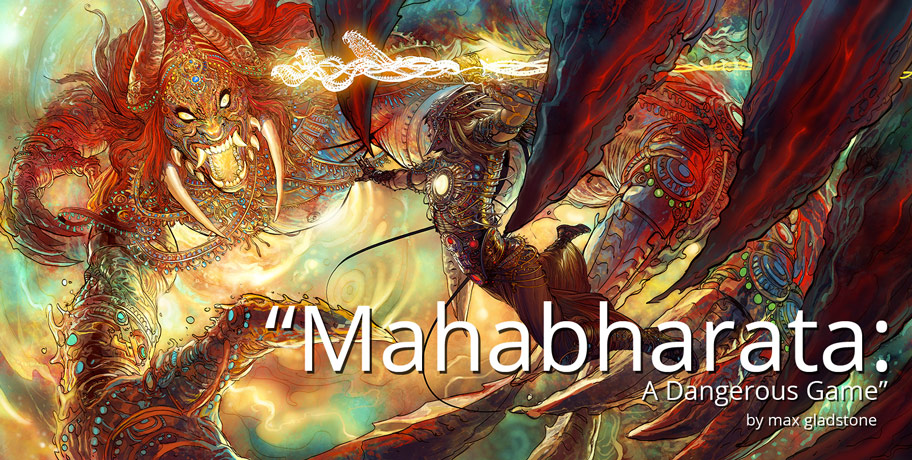
Art by Nisachar

Mahabharata: A Dangerous Game

My enthusiasm and love for these characters and this story will serve for the purpose at hand: encouraging you, dear reader, to immerse yourself in the Mahabharata.

The last two iterations of this column have played it safe. I’ve read Journey to the West in two languages and studied it from a variety of angles, and Romance of the Three Kingdoms, too though to a lesser extent. I could continue in this vein—the next logical essay would be on Outlaws of the Marsh / The Water Margin, China’s great Robin Hood novel and one of Mao Zedong’s favorite books, followed probably by Dream of the Red Chamber for more domestic source material. (Or Jin Ping Mei, if we want to get the sexy-fun-times element in play…)

But while all these stories are great, I’m not as passionate about them as I am about the story I want to discuss now. The problem is, I’m nowhere near as cut out to write this essay as I was the first two—I don’t know the source language, Sanskrit, and I haven’t spent as much time studying the work’s cultural context. (I’m not ignorant, I just don’t have a four year degree, six years of language study, and three years in-country.) There’s also much more chance I’ll do inadvertent harm writing this essay, since the text I’m about to discuss is a live, and lived, religious document in addition to one of the greatest adventure stories, romances, war stories, and apocalyptic tales of all time.

That said, maybe my enthusiasm and love for these characters and this story will serve for the purpose at hand: encouraging you, dear reader, to immerse yourself in the Mahabharata. And I hope that will be worth whatever unintentional harm I do. Read More »
Hugo Awards LogoSo, Hugo Award nominations. Every year, it seems to be both an invitation to bellyaching among those who want the award to take itself more seriously, to again become a fair and trustworthy snapshot of the genre’s best year-in-and-year-out, and an everybody-hug-circlejerk-ignore-the-trolls-you-deserve-this-i-voted-for-you twitter fun factory between nominees. Fun times, especially for frustrated Internet pundits like myself. This year’s ballot was particularly blah, though. I won’t go through each category because, well… I don’t have an opinion on a lot of it. But there are a few spots I’d like to explore.

My first thought on the list of nominations for the ‘Best Novel’ was a tepid lack of inspiration. The inclusion of Ahmed’s Throne of the Crescent Moon (REVIEW) is the lone bright spot, and also the only novel from my list of nominations to appear on the final ballot. Redshirts (REVIEW) is entertaining, but no more worthy of a Hugo than a fourth-or-fifth episode of Dr. Who appear in the ‘Best Dramatic Presentation (Short Form)’ category; I’m not surprised to see it there, but I am disappointed that another of Scalzi’s wash, rinse, repeat efforts was rewarded with a nomination. The novels from Bujold and Grant are included, for all intents and purposes, because of the name on their cover, rather than the text inside. I’m sure they’re both fine novels, but neither made waves in fandom or genre discussion this year. Kim Stanley Robinson is another Hugo darling, and 2312 was at least a significant release in Science Fiction, which, alongside David Brin’s Existence (a novel that some will should have been included instead of Robinson’s), reopened a style of hard Science Fiction that has a long legacy in the genre but little recent activity. Read More »

How Kickstarter is replacing traditional publishers by Michael J. Sullivan

Editor’s Note — In late March, I published an essay by Bradley P. Beaulieu about the changing landscape of publishing and why he decided to leave his publisher, Night Shade Books, and relaunch his Epic Fantasy trilogy, The Lays of Anuskaya as a self-published series of eBooks. Seeing this, Michael J. Sullivan, author of The Riyira Chronicles, one of Fantasy’s early self-published success stories, wrote to me with his own valuable take on the world of ‘hybrid publishing.’ You can find more information about Sullivan’s upcoming novel, Hollow World, on the official Kickstarter page.

I first met Brad Beaulieu at ConFusion this January. We were having lunch and after telling me about what was going on at Night Shade we tossed around the various options. I encouraged him to retrieve his rights, do another Kickstarter, and take control of what I saw as a valuable franchise. He was probably already leaning that way. Hopefully I gave him the last nudge to take the leap. I will be taking the hybrid route myself with one of my upcoming novels, Hollow World, and I couldn’t be more thrilled with his decision, and I think it will work out very well for him.

I’m a huge supporter of the hybrid model. Traditional publishing opened doors for me that I couldn’t get when I was self-published. Now that my books are in libraries and bookstore, my audience broadened. I received more foreign deals, and the advances on those were probably larger than they would have been without Orbit. There was even book club and audio versions produced, which paved the way so to Theft of Swords being named a finalist for an Audie (the audio book equivalent of the Grammy). These are all good things, but there are also aspects that I miss from my self-publishing days. Read More »

"Love and Social Science Fiction" by Karen Lord

It’s social science fiction, experimenting with questions of power, compromise, dependence and independence, identity and self-determination.

When I started thinking about how to describe The Best of All Possible Worlds, I decided not to call it a romance for two reasons. First, I didn’t think it was a romance. I have a certain admiration for romance writers because they possess a skill set that I don’t have, not yet. I knew that what I’d written lacked the tension and angst and passion I associate with the traditional romance template. Calling it a romance, then doing a bait and switch into Science Fiction, felt dishonest. Second, I couldn’t guarantee there would be any romantic subplots in the sequel (though I also can’t guarantee there won’t be).

Don’t think I’m being polite when I say I admire romance writers. Remember that Sturgeon’s Law applies to all genres. A good, well-written romance is as beautiful and rare as a good, well-written science fiction novel. Even better than both is a blend of genre, a book that can give you a little bit of this and a little bit of that and somehow bring it all together in a very satisfactory, holistic and human way. People fall in love in the future, they encounter mysteries both mundane and uncanny, have adventures, make bad career decisions, experience personal crises and grow – sometimes all at the same time. I don’t mean to suggest this should be all packed in haphazardly like a soap opera, drama piled upon drama for no good reason. There must be order: minor subplots tweaked to reinforce the main plot, characters and situations juxtaposed in ways that create resonance, themes and motifs orchestrated to please and satisfy the subconscious. Read More »

why-i-am-going-hybrid-by-brad-beaulieu

I shuddered at the thought of switching editors mid-stream, as many of my colleagues have been forced to do.

Editor’s Note: When news came that Bradley P. Beaulieu was leaving his publisher, Night Shade Books, and making the change to self-publishing, I was puzzled and intrigued. I’ve invited him here to talk about his experience, his decision and the changing landscape of publishing. If you’d like to support Beaulieu, he is currently running a Kickstarter to support the relaunch of his trilogy, The Lays of Anuskaya.

Several months back, I learned that my editor, Ross Lockhart, was let go from Night Shade Books. It had been very good to work with Ross up to that point. He was enthusiastic about the series, he kept the wheels of publishing (at least for my books) oiled and running smoothly, and he gave me some great advice on the series. I’m grateful he was there to help for all three of the books in The Lays of Anuskaya trilogy, and I shuddered at the thought of switching editors mid-stream, as many of my colleagues have been forced to do. Such a change can end up well in the end, but it can just as easily cause serious and permanent damage to an author’s career.

So Ross’s departure was worrying news, indeed. It comes as no surprise to any who have cared to look that Night Shade has been a cash-strapped business for some time. This is bad enough, worrying about where your future with them was headed, but the loss of my editor made me doubly worried about how my books would now be handled. Taking a pragmatic look at the change, cutting back on staff is normal in business. It can help a business survive. But when it happens it means that fewer people will be doing a lot more things, at least in the short- to medium-term. None of this boded well for the release of my third book, which frankly I hadn’t heard much about from my publisher. Not having heard anything different, I had assumed it would be coming out in April of 2013, as the first two books had been released that same month. Everything else—the initial editing, copy edits, and artwork—were all in works already, so things seemed good for an April release, even if it would be a bit rushed. Read More »