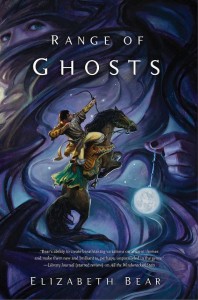
Publisher: Tor Books -
Pages: 320 -
Buy: Book/eBook
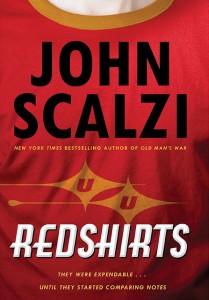
Like many twenty-something Science Fiction fans, I grew up with a love of Star Trek and Star Wars (yeah, both of ’em. Come at me!) gifted to me by a family member. Star Trek, in particular, was a shared interest between me and my mom. I couldn’t match her, who read every novel published, and watched every episode of every series, in her enthusiasm, but I hold a fond spot in my heart for Geordi La Forge, Data and Quark, and even before-my-time Sulu and Kirk. That love in mind, Redshirts was of particular interest to me in its attempt to deconstruct the lazy narrative ambitions of network television and the Science Fiction genre as a whole.
The main narrative in Redshirts is told through a tight third-person voice, following Ensign Dahl, who, in very un-Scalzi-like fashion, is plain. Yeah, he’s also likable, like all of Scalzi’s other protagonists, but lacks the acidic tongue and wit that usually marks Scalzi’s other stars. This plain personality is even discussed at one point, when two characters examine his place in the overall narrative. They eventually peg as the everyman protagonist — which, of course, he is. The rest of the cast, however, more than makes up for this plainness, and Scalzi’s trademark humour and mile-a-minute dialogue hums along as expected. Read More »
Publisher: Tor Books -
Pages: 720 -
Buy: Book/eBook
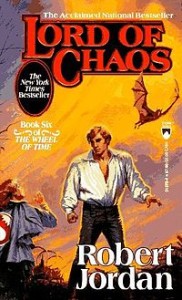
I’ve reached the halfway point at least in this series to date. Death is like a feather, duty like a mountain, and around 5000 pages of WoT is like carrying a 400 lb. woman wearing spandex and a tube top on your shoulders as you run up that mountain. Not the most pleasant of images, true, but this book was much more of a slog than the previous book, The Fires of Heaven, had proven to be.
When I first read Lord of Chaos back in November 1997, I even then found it to be the most difficult of the seven books to date to enjoy. Back then, used as I was to reading cultural and religious histories in English and German, it wasn’t the size of the novel that daunted me but rather how disjointed it felt. Nearly 13 years later, that sense of disjointedness was even more pronounced. It was a struggle at times to pay attention to what was transpiring, which might explain in a perverse fit of reasoning why I am reviewing it so soon after completing it (I finished it about an hour before I began writing this post), when I typically wait 1-2 days. Between the often-interchangeable character types (Aes Sedai, Cairhein, Aiel, Forsaken, Tairens, etc.) and the over-explanations of things that I first read about several books ago, I fear my own complaints may become just as repetitive if I don’t spice them up with some actual observations. Read More »
Publisher: Small Beer Press -
Pages: 264 -
Buy: Book/eBook
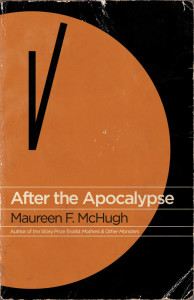
I get e-mails from time to time offering me electronic copies of self-published or small press titles for review. I usually say yes, with the caveat that I may never actually read it or get past the first chapter. Most of them are not very good. This was my mindset when I received a copy of a short story collection by Maureen McHugh, called After the Apocalypse. At the time, I wasn’t aware of Small Beer Press and what they’re about. I went in to After the Apocalypse functionally blind. After reading it, I feel like I can see.
I’d never heard of McHugh prior to this book. It turns out she’s published four novels and over twenty short stories. Her first novel, China Mountain Zhang, was nominated for both the Hugo and the Nebula Award. In 1996 she won a Hugo Award for her short story The Lincoln Train. After reading this collection, none of that surprises me. Many of the stories in this collection are “award worthy” – especially the three new ones that are published here for the first time. Read More »
Publisher: Tor Books -
Pages: 992 -
Buy: Book/eBook
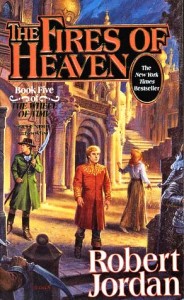
Five volumes into the Wheel of Time series, I find myself struggling more and more to pay close attention to all the details. The earlier novels were easier in that the number of subplots were very few and generally no more than a few chapters separated any bunching of each subplot. The narrative was relatively straight-forward and although the prose never was anything to write home about, enough interest was generated in the characters to make the first few novels at least bearable to read and on quite a few occasions, enjoyable.
However, by the fourth volume, The Shadow Rising, my interest began to waver. I noted in my previous commentary that I believed Jordan tried to cover too much, to explain more than what was vitally essential to the main plot of the series, that of the Dragon Reborn being readied for the upcoming Last Battle. Here in The Fires of Heaven, my complaints about the previous volume probably can be multiplied by at least a factor of ten. Although I recall enjoying this volume almost the same as the previous one when I first read it in 1997, a decade away from reading it has reminded me that time might have the ability to remove bad memories and to enhance the few positive ones that remained. The Fires of Heaven was at times a terrible mess of a novel to wade through. Read More »
Publisher: Tor Books -
Pages: 336 -
Buy: Book/eBook
Epic Fantasy is in the midst of something of an identity crisis. See, mainstream readers love to lap up recognizable tales of valourous kitchen boys, big magic, elves, dwarves and warring kingdoms. Such novels sell like hotcakes, and publishing companies love them. And why not? We all grew up on it, didn’t we? Terry Brooks, Raymond E. Feist, Barbara Hambly, or Tad Williams — they built worlds unlike any we’d ever seen before. On the other hand, there are more critical fans who, perhaps, associate their love of Fantasy with an ever-expanding need to find works that push the boundaries of imagination, explore the issues of culture, politics and gender in our world through the lens of an imaginary universe where rules are different, where freedom and fairness might exist.
There have always been authors who push against these boundaries set on the subgenre by its legion of fans. Early in her career, Robin Hobb released the Farseer trilogy, which took the foundations built upon by Tad Williams and Robert Jordan and refined and redefined them, crafting a world and genre that was familiar, but spun the tropes (kitchen-boy-turns-king becomes bastard-prince-becomes-assassin; not an elf or dwarf in sight and conflicts that are cultural, rather than racial) in new, interesting ways. Going even further back, Terry Brooks revitalized Fantasy from its post-Tolkien doldrums by effectively re-telling modern Fantasy’s greatest tale, but, alongside him was Stephen Donaldson and his The Chronicles of Thomas Covenant, the Unbeliever trilogy, a work with similar roots to Brooks’ The Sword of Shannara, but an entirely different interpretation and subversion of genre tropes. While pushing the genre forward isn’t entirely anathema to commercial success, it’s a rare few authors who have managed to capture lightning in a bottle with their daring works. Read More »