Posts Categorized: Review

The Girl Who Plucked Red Flowers Beneath the Queen's Window by Rachel Swirsky“The Lady Who Picked Red Flowers Beneath the Queen’s Window” by Rachel Swirsky is a Hugo Award-nominated novella that begins when a sorceress dies and follows her spirit as it is summoned through the ages by a variety of different people and cultures seeking her magic and knowledge. Swirsky’s considered by many to be among the best new voices in genre short fiction, and this novella is yet another piece of her fiction worth reading and, more importantly, examining.

The most startling aspect of the story is Swisky’s decision to tell the tale over the course of many millennia. By casting a trapped spirit as a protagonist and narrator, Swirsky is able to cover an enormous amount of time in a relatively small amount of space. One of my favourite aspects of Speculative Literature, especially that which covers vast amounts of time, is its ability to suppose about societies and how they will evolve over time. We see only bits and pieces of each time period, but the juxtaposition of placing a static character in an ever-changing environment and then asking her to try to adapt almost immediately to new ideologies, new races, and new forms of magic, allows Swirsky to explore the regrets of acting blindly on the whispers of endless prejudice and thoughtless bigotry.

“I will not desecrate women’s magic by teaching it to men.”

“How is it desecration?”

“Women’s magic is meant for women. Putting it into men’s hands is degrading.”

“But why!”

Our argument intensified. I began to rage. Men are not worthy of woman’s magic. They’re small-skulled, and cringing, and animalistic. It would be wrong! Why, why, why? Misa demanded, quoting from philosophical dialogues, and describing experiments that supposedly proved there was no difference between men’s and women’s magic. We circled and struck at one another’s arguments as if we were animals competing over territory. We tangled our horns and drew blood from insignificant wounds, but neither of us seemed able to strike a final blow.

“Enough!” I shouted. “You’ve always told me that the academy respects the sacred beliefs of other cultures. These are mine.”

“They’re absurd!”

“If you will not agree then I will not teach. Banish me back to the dark! It does not matter to me.”

Of course, it did matter to me. I had grown too attached to chaos and clamor. And to Misa. But I refused to admit it.

Naeva’s main conflict with these societies, as you can see above, is her hard-nosed and brutally stubborn abhorrence towards men. She was raised in a matriarchal society that treated their men as little more than baby-makers—useless and vile otherwise. It’s not surprise, however, that the societies that she is summoned to through the following millenniums are more liberal in their views toward gender equality. Naeva is faced with confronting her sexism, but it never feels like there is any progress made—she starts out unreasonable, and finishes unreasonable, angry and alone. The ending of the novel hints at redemption, but by then it’s too late for herself and the reader.

Ultimately, I’m not sure that any sort of conclusions are drawn to the questions and problems posed by Swirsky. Of course, humanity’s difficulty with individually adapting from the mindsets and bred-in prejudices of the societies we grow up in can never be solved, or properly explored, in a short novella, but I felt that, ultimately, the explorations of the themes are more of a meandering than a straight drive towards any sort of conclusion. As a story, I enjoyed it immensely, mostly because of the time-travel aspect, and Swirsky’s prose is always top-notch, but as a thematic piece, especially concerning the examination of sexism, it’s a bit of a rocky road. I much preferred Swirsky’s “The Stable Master’s Tale” (REVIEW), which was published around the same time.
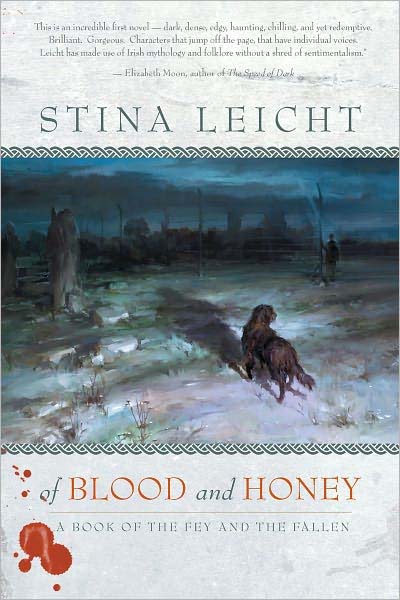
OF BLOOD AND HONEY by Stina Leicht

Of Blood and Honey

AuthorStina Leicht

Trade Paperback
Pages: 288
Publisher: Night Shade Books
Release Date: January 25, 2011
ISBN-10: 9781597802130
ISBN-13: 978-1597802130


“Urban Fantasy”

Is that a dirty phrase to your ears? Do you think of sexy vampires? Sassy heroines? Sex, tramp stamps and one-liners?

“Oh, I don’t like that stuff,” you say.

“Stina Leicht’s Of Blood and Honey is different,” I respond. It’s alive. It has a message. It’s violent because life is violent. There’s sex because the politics of it help define us as humans. More guns are loaded with rubber bullets than silver. No vampires are in sight, and the only werewolf is the shadow of the protagonist’s inner-demons. Throw your misconceptions aside, forget about Sookie Stackhouse and Anita Blake, and explore a whole other facet of the sub-genre.

Set in the early- to mid-seventies, Of Blood and Honey is told against the backdrop of the Troubles, the political warfare that plagued Northern Ireland from the 1960’s to as recently as 2010. As bloody, depraved, violent and twisted as any fictional war, this guerilla warfare between the Irish Republic Army, the British Army, the Ulster Defence Force, the Ulster Volunteer Force and many other forces is the perfect backdrop to tell the story of the mysterious Fey of Ireland as they struggle in a eerily similar battle against the fallen angels brought to the emerald isle when the Catholics settled.
Read More »

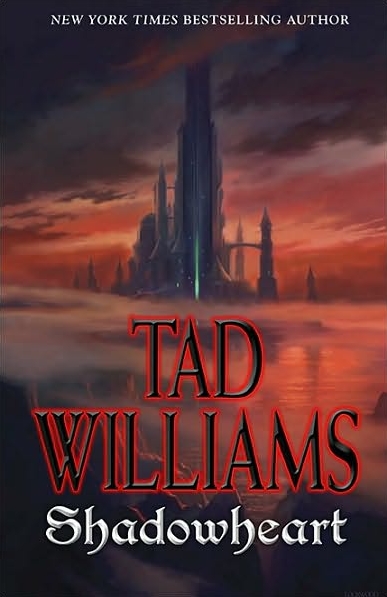
SHADOWHEART by Tad Williams

Shadowheart

AuthorTad Williams

Hardcover
Pages: 672
Publisher: DAW Books
Release Date: November 30, 2010
ISBN-10: 9780756406400
ISBN-13: 978-0756406400


To really understand Tad Williams’ Shadowmarch series, and my ultimate appreciation of it, one must look back to the rocky road of the original conceptualization and execution of its first novel, also titled Shadowmarch.

First conceived as a television show described by Williams as “Hill Street Blues meets Babylon 5 meets Lord of the Rings,” then as a free online serialization, Shadowmarch went through many forms in its infancy. Readers were finally introduced to the story when Williams released Shadowmarch on his website as a free-flowing piece-by-piece novel — an avenue that’s not unusual for aspiring writers hoping to catch the eye of a publisher, but an odd move for an author as well established as Williams. Eventually, due to a lack of readers willing to pony up the cash necessary to read beyond the first five chapters, the project changed course again and was converted into a full-fledged, traditionally published series. At this time, Shadowmarch was heavily re-written, added-to and even saw a shift from present tense to a more traditional third-person past-tense narrative.

Unfortunately, and despite the heavy revisions, these serialized roots left their mark all over the early volumes of the series. Though enjoyable (and the novel that finally convinced me of Williams as a novelist, after several failed attempts to read his classic Memory, Sorrow and Thorn trilogy), Shadowmarch felt much like a novel looking for a plot. Things happened, characters were introduced, a world was built, but it never quite felt like Williams knew where the road led or had an ultimate plan in mind for the series. The potential was there, the bones were there, but the series was searching for a proper heart and soul.
Read More »

My thoughts on GAME OF THRONES

Ahoy, spoilers ahead! If you haven’t watched the show yet, go do so. Otherwise, there are no spoilers for the series outside of those covered in the first two episodes.

So, so, it’s finally here. I’ve been a fan of A Song of Ice and Fire for nearly ten years. I’ve been waiting for the show with bated breath for three or four. And now that it’s aired, I thought I’d gather some rambling thoughts about the show, its characters and why it’s both stronger and weaker than I’d expected and hoped.

I won’t say much about the prologue. I’ve always thought it was a little out of place in the novels and feels even more out of place here. I understand that both Martin and HBO want to establish the Others for, presumably, their invasion in the later volumes of the series, but the prologue always seemed out of place in tone and subject matter compared to the rest of the novel. In any case, it’s creepy, so there’s that.

Winterfell, and all its characters and storylines, is wonderful. Robb is stiff-necked; Jon is brooding; Bran is feisty and Sansa is irritating and awkward. And Arya, oh Arya. Alongside Tyrion Lannister (who we’ll get to shortly) and his brother Jaime, Arya Stark is my favourite character in the series and Maisie Williams captures everything wonderful about the irascible little black sheep. She’s fiery as she shows up Bran with her bow; she’s charming and believable when Jon gifts her Needle; she’s perfectly loyal and determined as she defends Lady, despite Sansa’s betrayal.

I want to punch Joffrey in his stupid face. So, yeah, they nailed him.
Read More »

FUZZY NATION by John ScalziThrough my involvement with Tor.com Fantasy, Macmillan, the parent company of Tor Books, in part pays for the bread on my table, the beer in my fridge and the heat in my home. As such, consider this following article not a recommendation or formal review, but a collection of my subjective thoughts on the novel.

Stephen Donaldson once said, and I paraphrase, that releasing The Gap Cycle helped him realize that his success wasn’t necessarily built on the backs of Stephen Donaldson fans, but rather he had been lifted to stardom by Thomas Covenant fans. He suppose that a majority of readers grew attached to characters, stories and worlds, rather than to the authors themselves. I thought of this quote several times throughout my time with Fuzzy Nation, the latest novel from super-blogger John Scalzi.

You see, the more I read of his work, the more I realize that while I’m a slavering fanboy for John Perry, the protagonist and narrator of Scalzi’s award-nominated Old Man’s War, I’m only a mild fan of John Scalzi. To then further reduce that distinction, I’m nuts for Old Man’s War, which blew me away and proved itself a worthy 21st-century analogue to Starship Troopers and The Forever War, but, while enjoying each one in turn, have been somewhat let down by each Scalzi novel I’ve read since. So, in reality, I’m not so much a Scalzi, or a even John Perry fan, but a fan of Old Man’s War. And, at this point, I’m almost certain that Scalzi will have trouble ever reaching those heights again.
Read More »