Posts Categorized: Review

The Pastel City by M. John Harrison

The Pastel City

By M. John Harrison
Hardcover
Pages: 176
Publisher: Avon Books
Release Date: 1971
ISBN-10: 038000057

Every moment of a science fiction story must represent the triumph of writing over worldbuilding.

Worldbuilding is dull. Worldbuilding literalises the urge to invent. Worldbuilding gives an unnecessary permission for acts of writing (indeed, for acts of reading). Worldbuilding numbs the reader’s ability to fulfil their part of the bargain, because it believes that it has to do everything around here if anything is going to get done.

Above all, worldbuilding is not technically neccessary. It is the great clomping foot of nerdism. It is the attempt to exhaustively survey a place that isn’t there. A good writer would never try to do that, even with a place that is there. It isn’t possible, & if it was the results wouldn’t be readable: they would constitute not a book but the biggest library ever built, a hallowed place of dedication & lifelong study. This gives us a clue to the psychological type of the worldbuilder & the worldbuilder’s victim, & makes us very afraid.

It was the quote heard ’round the Nerddoom; it set the blogosphere aflame and rose the hackles of readers brought up on the likes of J.R.R. Tolkien, Robert Jordan and Stephen Donaldson. He is an utter, arrogant asshole. they yelled. Or, he probably realised he could never come close to Tolkien in worldbuilding [sic] and decided it was just unnecessary crap.. Whether in agreement or disagreement with Harrison, shouts were raised and batllelines drawn, all in the name of world-building and its importance to the genre.

And I’ll admit, I was one of those angry trolls. I turned up my nose at Harrison, shrugged off his fiction because of (what I considered) off-base comments made on his blog. So, then, it was with obvious, pride-threathening trepidation that I accepted a challenge from Sam Sykes, author of Tome of the Undergates, to tackle Harrison’s work. Along with several others, I was tasked with putting aside my preconceptions, and to broaden my horizons by reading a novel that was well off my radar. Sykes’ choice for me was The Pastel City, the first of Harrison’s many stories set in and around the city (or cities?) of Viriconium. My experience with The Pastel City showed me that, though I still might not wholly agree with his opinions on world-building, I, and many others, might have misunderstood what he was trying to say.
Read More »
The Last Page by Anthony Huso

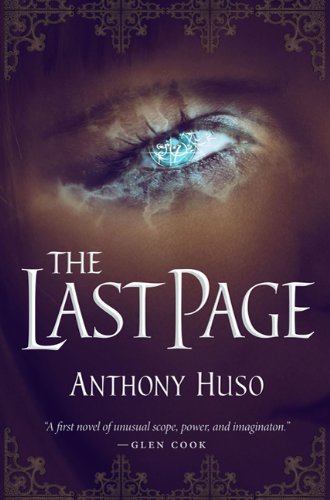
The Last Page

AuthorAnthony Huso

Hardcover
Pages: 432
Publisher: Tor Books
Release Date: August 17th, 2010
ISBN-10: 0765325160
ISBN-13: 978-0765325167

SYNOPSIS
READ AN EXCERPT


Every year, Fantasy is inundated with novels that promise to the be the ‘next big thing’, and they almost always seem to be familiar stories, harping on the successes of the genre’s classics. Sometimes they find the success they promise (like Patrick Rothfuss’ enormous hit The Name of the Wind), and other times they wither away and never live up to the hype heaped upon their shoulders (like Robert Newcomb’s lamentable The Fifth Sorcerer); then, there are novels like Anthony Huso’s The Last Page – they’re small, quiet releases that genuinely embrace the genre’s roots, but instead of imitating their influences, they set out to create something new, something fresh.

At its very heart, The Last Page is a love story. Sure, on the surface its got prophecy and grimoires, armies and sword fights, but the true strength and soul of the novel lies in the relationship between Sena Iilool and Caliph Howl. The whirlwind love of these two is like many real-world relationships, it never quite knows itself and often redefines its rules and expectations on a whim. Instead of setting them up with love-at-first-site, Huso builds a realistic, nuanced relationship between them, as caustic as it is lustful. Sena and Caliph are both powerful figures in their own right and hidden between the lines of their tryst are powerplays and hidden agendas which sometimes align, but often contradict. They use each other constantly, but always in the name of love and lust. Like many relationships, the true root of their love (if it even exists), lies deep at the bottom of their muddy emotions and greedy machinations. It’s a refreshing change of pace in a genre that so often has the kitchenboy falling madly in love with a princess by page three.
Read More »

The Alchemy of Stone by Ekaterina Sedia

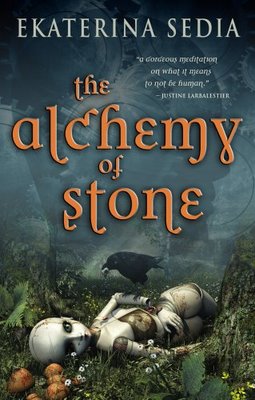
The Alchemy of Stone

AuthorEkaterina Sedia

Hardcover
Pages: 304
Publisher: Prime Books
Release Date: November 1st, 2009
ISBN-10: 1607012154
ISBN-13: 978-1607012153


I stumbled into reading Ekaterina Sedia’s The Alchemy of Stone via a twitter conversation between Paul Jessup and Matthew Delman. It wasn’t a conversation about the novel’s themes or its characterizations, nor was it even about the quality; rather, they debated tone and setting. Delman likened the setting to Eastern Europe, akin to medieval Prague or Moscow, but Jessup didn’t see the connection. Having travelled quite extensively through that part of the world (in modern times, not medieval, mind you), I was curious about the distinction, and so took the novel from the (proverbial) pile and jumped into it knowing very little about Sedia or her work.

With the tale behind me now, I’m not surprised that Delman and Jessup’s conversation so heavily leaned on atmosphere. The nameless city in which the novel’s set is as important a character as any of the other characters: human, automaton or otherwise. Through the living stone Gargoyles, Sedia gives the city a voice:

There is a house on the top of the hill – no man’s land, no-place, too steep for agriculture and too rocky for pasture, out-of-the-way and inconvenient for city dwellers and farmers both. This hill, the Ram’s Skull, the bald forehead of the once-mountain worn to a nub by time (slipping, slipping, faster and faster) is nothing but bedrock and loose stones. The house on the top sits lopsided already, its northern corner sinking with the decay of the slope under its supports

The mechanical girl and the Soul-Smoker enter the house – we hear the long squeal of a door as it opens and a slam as it closes behind them. We do not know what is happening inside, but we can guess – there is light in the fireplace and the gurgling of a kettle, and low, guilty voices. And we think of the souls and we count them – we had known every ghost in the city, and we can recall their names. We marvel at the cruelty of their fate without having the capacity to truly comprehend it – no more than to merely recognize it as grotesque. But, like the mechanical girl, we have no souls, and we are not afraid of the Soul-Smoker, we have no reason to worry that the souls inside him will somehow lure ours away and we will fall dead on the spot, abandoned by our animating essence. We think about the nature of souls and listen to the small domestic noises reaching us from the little house on top of the hill.

But the nameless city, and its gradual degradation and destruction as two warring factions wage war in its streets, isn’t the ultimate make-it-or-break-it facet of the novel. Rather, that’s Mattie, a mechanical girl, an automaton, as she’s coined in the novel, trying to break free from the shackles that society has placed on her. The reader’s willingness to buy into Mattie will likely determine their attachment to the novel. She’s a well drawn, sympathetic character, much moreso than many of the secondary human characters (the only one who comes close to her level of complexity is Loharri, who’s woefully under-explored), but, in the end… she’s also a mechanical construction with little explanation of how a gunpowder society is able to create a fully sentient, emotional and adaptable A.I. This is doubly hard to buy into when much of the crux of the novel’s plot (which happens around and despite Mattie, rather than because of her) centres around a massive computer (for lack of a better term) that is powered by coal and much less sophisticated than Mattie. I was often enthralled by her, but then she would do something too human, and I’d be whisked away from the story. Ironically, perhaps, her character would have been better served if she was more alien – Ted Chiang’s Exhalation is a brilliant example of how to draw a sympathetic but believable robotic character. Her struggles with trying to break away from the preconceptions cast on her by society were fascinating, but her emotional relationships with human characters are hard to empathize with. Ultimately, had Sedia pulled back the curtain on Mattie’s creation, and given reason for why she was so far ahead of the technology curve (and I believe there was a very ample opportunity to do this, if she’d just followed one plot string about a trio of young boys to a deeper conclusion), all of a sudden the dichotomy of Mattie’s personality and emotional abilities would have been worlds easier to accept.
Read More »

Stories of Your Life and Others by Ted Chiang

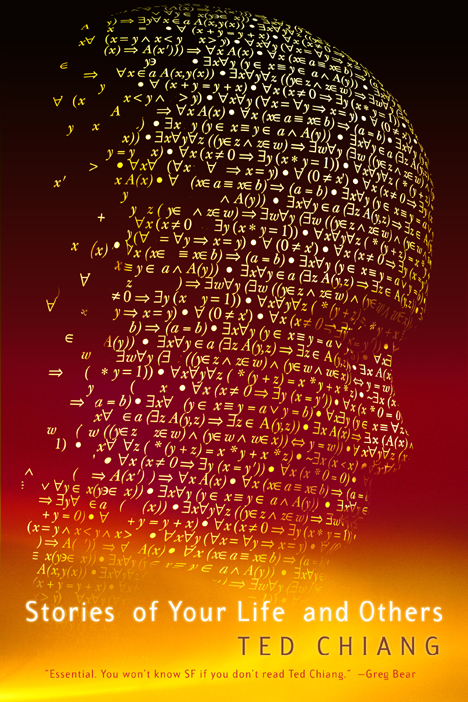
Of all the Short Fiction writers I’ve recently discovered, Ted Chiang is perhaps the highest regarded, but also the least prolific. He’s been nominated for the Hugo Award eight times; of those he won three. He’s won five Nebula Awards and been nominated for the World Fantasy Award. All those awards and nomination, yet only 12 pieces of fiction published in his 20 year career – all short fiction, no novels. Half the stories he’s written have won major literary awards. That’s a hell of a resume. The Merchant and the Alchemist’s Gate won both the Nebula Award and Hugo Award for Best Novelette, and, frankly it’s easy to see why.

Time travel stories are notoriously hard to tell with any success. Time paradoxes, physics being broken and non-linear timelines all lead to plot holes in the hands of an inexperienced author. Novels that pull off the conceit well, like The Anubis Gates by Tim Powers or Slaughterhouse-Five by Kurt Vonnegut are few and far between. Chiang, though, tackles the time travel motif with aplomb and challenges the reader by filling every plot hole just when they think they’ve found one. It’s at turns both clever and profound, full of smart twists and genuine insights into the compulsion we all have to live in the past, to regret turns not made or choices gone wrong. So often, time travel stories present fluid timelines, easily saved or ruined by the hero or antagonist, but Chiang plays with the idea that only the present is fluid and that what’s before us is every bit as defined as what’s passed us by. It’s a story of redemption and regret, with a melancholy air hiding just under the serpentine switchbacks of the puzzle-like time travel narrative.

A free audio version of The Merchant and the Alchemist’s Gate is available on StarShipSofa. It also collected, along with several of Chiang’s other stories, in Stories of Your Life and Others.

The Stable Master’s Tale by Rachel Swirsky is a modern parable, with echos of the bite found in the works of The Brothers Grimm. Though there’re no animals in sight, Swirsky has a point to make, a moral to bring to light, and she does so in a grim, honest way that reveals both the light and the dark in humanity. We’re neither good, nor bad. Rather, we’re both at once.

It’s painful to remember them–my brothers, my sisters, my parents, my cousins. When I do, a single memory dominates. It was summer and I was six summers old, standing in the corral with my eldest brother. The day was hot and golden, the air strong with the reek of flowers and horse droppings. My brother sat beside me, stealing a moment to practice the flute he’d wheedled from our nurse.

A great wind began to blow. My brother jumped to his feet. At first, I thought he was scared; my brother was as lazy as a housecat, and ordinarily nothing but a swat on the rear could make him move quickly. The horses panicked, tossing their heads, eyes wild. The rushing wind gained speed. Yet my brother laughed. He spread his arms to the sky.

“What? What is it?” I demanded.

He picked me up. I saw nothing. “Look toward the mountains,” he shouted.

Suddenly, I saw them: great, golden bodies extending enormous gossamer wings. There were half a dozen flying in a circle, chasing each other’s tails. Sunlight sparkled off their bodies. They were glorious and terrifying.

I whimpered and hid my eyes.

“Don’t worry,” my brother said. “They’re too far away to hurt you.”

The great golden bodies circled in the darkness behind my eyelids. They were terrifying. They were beautiful. By the time I opened my eyes, the dragons were gone.

I did not see a dragon again for many years.

Swirsky’s prose is suitable to the tone of the story, and the voice of her nameless narrator is lively, but never so overwhelming that it takes the focus away from the themes and plot of the novel. It’s a novel about both the relationship between a girl and a dragon, and the parallels in their respective imprisonments (her’s through choices she’s made, its through mutilation and literal captivity), and also explores the limits of the human propensity to allow greed and narrow-mindedness to lead to self-destruction. Swirsky never forgets the ultimate strength of the classic fables: though they’ve a lesson to tell, but they never forget that they’re supposed to be fun. Like the best stories, The Stable Master’s Tale could potentially be read, and enjoyed, by young and old alike, It’s never bogged down by overwrought prose or too heavy moralism. Even with the themes removed, it’s a classic bed time tale.

In recent years, Rachel Swirsky’s short fiction has shown up on ballots for the Hugo, Nebula and Locus awards (among other honours). Though The Stable Master’s Tale is not one of her nominated works (and likely won’t be, given that it treads very familiar ground, unlike works such as The Memory of Wind and Eros, Philia, Agape), it’s more than enough to convince me that Swirsky is more than capable of sitting alongside writers like Caitlin R. Kiernan and Saladin Ahmed atop my list of exciting young authors to keep an eye on.

You can read for free The Stable Master’s Tale on the Fantasy Magazine Website.