Posts Categorized: Review

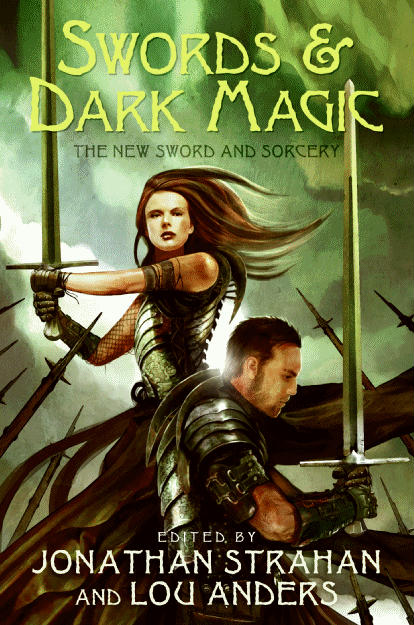
With the release of The Lies of Locke Lamora in 2006 (REVIEW), Scott Lynch made a lot of noise and quickly established himself as one of the most promising young writers in the genre. It was an impressive debut, mixing Sword & Sorcery with an Ocean’s Eleven-style heist, and was quickly followed by an entertaining (if slightly disappointing) sequel, Red Seas Under Red Skies. Since then, Lynch has been quiet, periodically popping online, but mostly working on the third volume of his series, The Republic of Theives, in silence. It’s been a hard wait; doubly so after reading Lynch’s contribution to Swords & Dark Magic. In the Stacks is an over-too-soon story that showcases Lynch’s best qualities as a writer – his wit, grasp on character and layered (but never too intricate) plotting.

In the Stacks is set in the High University of Hazar; more particularly in its library. The story follows three youths as they attempt to pass their year-end exam. Simply, they have to return a book to its place among the shelves. As expected of a Swords & Sorcery story, things are never quite so simple as they seem and the charming chaos that ensues forces the characters to stretch their magic and fight with a very unconventional weapon. The library is full of grimoire’s, and the creatures they spawn, that would like nothing less than to devour any outside presence, including the words spoken from mouths of errant students.

“Aspirant d’Courin, what is a grimoire?”

“Well,” she began, seemingly taken aback by the simplicity of the question. “As you said, a magician’s personal reference. Details of spells, and experiments–”

“A catalog of a magician’s private obsessions,” said Molnar.

“I suppose, sir.”

“More private than a diary, every page stained with a sorcerer’s hidden character, their private demons, their wildest ambitions. Some magicians produce collections, others produce only a single book, but nearly all of them produce something before they die. Chances are the four of you will produce something, in your time. Some of you have certainly begun them by now.

[…]

“Grimoires,” continued Molnar, “are firsthand witnesses to every triumph and every shame of their creators. They are left in laboratories, stored haphazardly next to untold powers, exposed to magical materials and energies for years. Their pages are saturated with arcane dust and residue, as well as deliberate sorceries. They are magical artifacts, uniquely infused with what can only be called the divine madness of individuals such as yourselves. They evolve, as many magical artifacts do, a faint quasi-intelligence. A distinct sort of low cunning that your run-of-the-mill chair or rock or library does not possess.

“Individually, this characteristic is harmless. But when you take grimoires … powerful grimoires, from the hands and minds of powerful magicians, and you store them together by the hundreds, by the thousands, by the tens of thousands, by the millions … “

[…]

“You need thick walls

It reads, well… like Scott Lynch writing Harry Potter. There’s bite to the dialogue (though it’s not as ribald as his Gentlemen Bastard Sequence), lots of action, and a suitably clever climax. The school setting, the camaraderie and even the magic system (light and nebulous as it is), are reminiscent of Blake Charlton’s recent Spellwright, but with more cheek, and a bit of a chip on their shoulder. The only low comes in the last pages, when Lynch throws an unnecessary (but, admittedly, well-established) twist at the reader that shines a different light on one of the characters. Still, it’s a small flaw amidst a wonderful story.

If there are connections to Lynch’s earlier work they are not easily noticed, but I couldn’t help but see shades of Locke Lamora and his gang of thieves among the students. Lynch’s clever prose and easy command of his characters will wrap you up, and rambunctiously steal you away to that mysterious library. In The Stacks is a strong addition to a heavyweight anthology, and promises of great things when The Republic of Thieves hits shelves in several months.
When Swords & Dark Magic was first announced, several names jumped out at me from the Table of Contents, but none more so than Joe Abercrombie. Known for writing doorstoppers, I’ve always felt that Abercrombie would benefit from writing in a more confined space, that limits his ability to wander off into conversational tangents, to offer restraint for a writer who fills his novels with characters who are unfamiliar with the word.

The Fool Jobs, the final story in the collection, features a band of mercenaries (some of whom are central to his upcoming novel, The Heroes), are hired by some mysterious woman to retrieve some mysterious thing from some dive in the middle of nowhere. That’s all they know about the job, and that’s all the reader knows about the job. Like all good Sword & Sorcery, The Fool Jobs is not about the destination, but rather the journey to get there. In typical Abercrombie fashion, the characters all seem to hate each other (or at least express their love with acerbic wit), raise some hell, botch even the simplest tasks, and then pull through with a charming twist of fate.

Perhaps it’s not surprising, but I found The Fool Jobs, to be just what I’ve come to expect from Abercrombie, short fiction or long. The characters are all well defined, with their own voices. They perhaps chatter too much (and everyone is clever, too clever), especially in the early pages of the story, when a large handful of names and personalities are introduced, which is somewhat hard to swallow in a short story. Abercrombie’s trademark cynicism is, oddly, kept to a minimum, despite the brutality of the story and the nature of the characters. There’s a lightness to the camaraderie, which is a nice change after the relentlessness of Best Served Cold, and he ends the story with a twist that’ll bring a smile to anyone’s face.

It might not make convert non-believers to the Cult of Abercrombie, but The Fool Jobs is everything his fans love. For this fan, it was a nice palate cleanser after a somewhat disappointed experience with Best Served Cold. I’m left more anxious than ever to get my hands on The Heroes and rejoin Craw, his group of bandits, and Whirrun’s many-named sword.

The Horrid Glory of Its Wings by Elizabeth Bear

At times horrifying, at times touching and sad, Elizabeth Bear’s The Horrid Glory of Its Wings is an intense testament to what the Fantasy genre can achieve when it sets out to explore some of the harsly human aspects of our own world. To say much about the plot and themes of the story (short, as it is) would be to ruin the potential emotional impact on the reader, but watching protagonist Desiree struggle with her demons — both psychological and physical — can be frustrating, uncomfortable, and left me feeling like a teenager watching a slasher flick, yelling advice at the page as Desiree struggles against her demons.

The story unfolds delicately, starting with Desiree speaking of the ‘Harpy’, whose tangibility is hard to grasp a hold of, and reveals each new layer of Desiree’s insecurities and the realities of her world at a perfect pace, painting a slow picture of a road with two forks, one light, the other dark. If it touches on melodramatic, it’s easy to forgive.

The Horrid Glory of Its Wings is a startling look at the human condition and our ability to shun help, support and success even when it stares us in the face. But through all this darkness, there is also that desire to overcome, to persevere and throw off our shackles and take what is rightfully ours. It is up to the reader to find the message in this story. Highly recommended.

You can read or download The Horrid Glory of Its Wings by Elizabeth Bear on Tor.com.

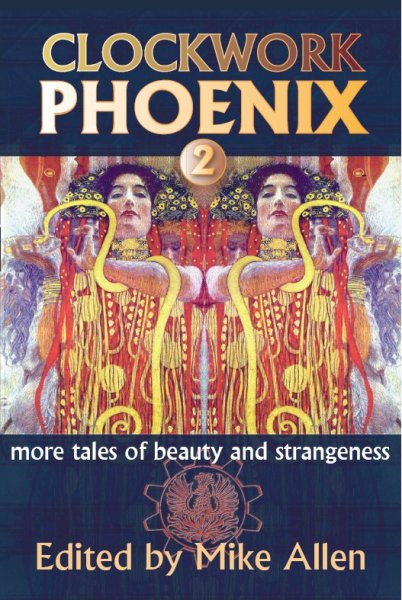
Clockwork Phoenix cover -- Includes 'Hooves and the Hovel of Abdel Jameela' by Saladin Ahmed

I first caught wind of Saladin Ahmed when he was interviewed by the charming Blake Charlton. I was impressed with the interview, and the things he said of embracing Muslim themes and mythology and integrating them into the sometimes stale Fantasy genre. When I saw that his short story Hooves and the Hovel of Abdel Jameela was on the ballot for the Nebula Award, I figured it was time to get my ass in gear and give his fiction a go.

As soon as I arrive in the village of Beit Zujaaj I begin to hear the mutters about Abdel Jameela, a strange old man supposedly unconnected to any of the local families. Two days into my stay the villagers fall over one another to share with me the rumors that Abdel Jameela is in fact distantly related to the esteemed Assad clan. By my third day in Beit Zujaaj, several of the Assads, omniscient as “important” families always are in these piles of cottages, have accosted me to deny the malicious whispers. No doubt they are worried about the bad impression such an association might make on me, favorite physicker of the Caliph’s own son.

The latest denial comes from Hajjar al-Assad himself, the middle-aged head of the clan and the sort of half-literate lout that passes for a Shaykh in these parts. Desperate for the approval of the young courtier whom he no doubt privately condemns as an overschooled sodomite, bristle-bearded Shaykh Hajjar has cornered me in the village’s only café—if the sitting room of a qat-chewing old woman can be called a café by anyone other than bumpkins.

I should not be so hard on Beit Zujaaj and its bumpkins. But when I look at the gray rock-heap houses, the withered gray vegetable-yards, and the stuporous gray lives that fill this village, I want to weep for the lost color of Baghdad.

Instead I sit and listen to the Shaykh.

As a writer, one of my goals is to transport not only myself to another place, another realm, but the readers as well. I could learn a thing or two from Ahmed. In Hooves and the Hovel of Abdel Jameela, Ahmed takes Iraq, removes any reference to time period, and paints a haunting, dusty picture of a world as alien as it is similar. The story of Abdel Jameela and his mysterious wife is curious and alarming, magical and unsettling. Ahmed has the ability to touch on all the reader’s senses, the psychedelic synesthesia during the climax (for lack of a better term) of the story being the most obvious and memorable example – he embraces those little details that so many authors ignore. For writing about something I am totally ignorant of (the Middle Eastern setting, the mythology, etc…), Ahmed, in the slim space provided by a short story, set me down in his world and made me forget, if only for a short time, of my own.

It’s nice to see a writer stepping outside of Fantaty’s typical faux-medieval politics or over-sexed vampires and draw fantasy from a mythology that is unusual but rooted deep in our world. Looking at the blockbuster releases and the bestselling authors, it’s easy to complain that the genre is getting stale, but with writers like Ahmed providing alternatives, it seems like a silly comment to make.

In short, Hooves and the Hovel of Abdel Jameela is only the first of what I hope to be many trips into the weird, wonderful world of Saladin Ahmed.

You can read Hooves and the Hovel of Abdel Jameela on Fantasy Book Critic. Alternatively, you can listen to Hooves and the Hovels of Abdel Jameela on Podcastle. It first appeared in Clockwork Phoenix 2, an anthology edited by Mike Allen.

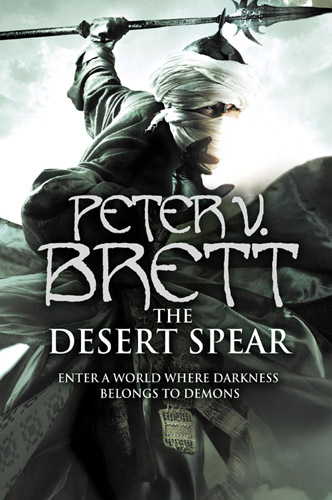
The Desert Spear

AuthorPeter V. Brett

Hardcover
Pages: 608
Publisher: Del Rey
Release Date: April 13, 2010
ISBN-10: 0345503813
ISBN-13: 978-0345503817

EXCERPT
Interview with Peter V. Brett


When buzz first began to build about Peter V. Brett, it wasn’t his debut novel, The Warded Man (REVIEW), everyone was talking about. Rather, it was about the Blackberry-like device he wrote the majority of the novel on, during his morning commute. Once readers got their hands on The Warded Man, the seriousness of Brett’s achievement became readily apparent – not only had he written a novel during his morning commute, using little more than his thumbs, he’d written a good novel during his morning commute. A damn good novel.

The Warded Man snuck its way onto my Best Novels of 2009 list. I was taken in by the strong characters, the easy pace and the imaginative magic system. The success of Brett’s debut was a surprise to everyone, but with that success comes a lot of pressure, placed squarely on the shoulders of The Desert Spear, Brett’s second novel and sequel to The Warded Man.

The opening chapters of The Desert Spear begin on the right foot, promising a novel that is everything The Warded Man was and more. Telling the life story of Jardir, a villanous character in The Warded Man, Brett pulls back the curtain on the absolutely brutal Krasian culture. A ruthless caste system, organized sodomy and rape, friends and family pit against each other in the name of honour, Krasia makes the lands predominantly featured in The Warded Man look tame in comparison. He takes Jardir, a character easy to hate, and pits him against a violent culture, creating empathy where I never thought I’d find any.

Easily the strongest part of the novel, Brett’s prose and language evolves, wrapping itself honestly about the storytelling and bringing a maturity to the novel that sets him in line with contemporaries like Joe Abercrombie and Richard Morgan. It’s after Jardir’s tale, when the tale catches up to the familiar tale of Leesha, Rojer and Arlen that things start to go south.
Read More »