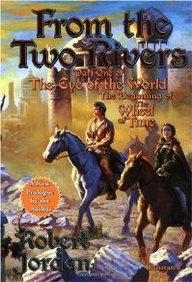
PLANESRUNNER by Ian McDonald

Planesrunner

By Ian McDonald
Hardcover
Pages: 296 pages
Publisher: Pyr Books
Release Date: 06/12/11
ISBN: 1616145412

EXCERPT

Ian McDonald, the many times award-nominated author of The Dervish House and Brasyl, has always been on my bucket list. I love near-future Science Fiction. I love speculative works set in cultures foreign to me. I love slim stand-alone novels. McDonald hits on all of these fronts and every time he releases a novel it seems to do a fair round of the awards circuit. Yet, I’d never read any of his work. Part of my hesitancy, I think, was due to McDonald’s reputation for writing labyrinthine, intertwining plots featuring dense prose and asking the reader to work for the story. It takes dedication to read fiction in that manner and, well, I’m often lazy. But when McDonald announced that his next novel, Planesrunner, the first volume in the Everness series, would be a world-hopping Young Adult (YA) novel set in an alternate London full of airships and sky pirates, I knew I finally had an opportunity to give his work a fair shake. And I’m bloody glad I did.

The prose in Planesrunner was simpler than I expected, likely due to the YA audience, but also doesn’t speak down to its younger readers, weaving some wonderful imagery and thoughtful themes through the narrative. Like all literature, the best YA respects its readers and Planesrunner embraces that mentality. In a recent interview, McDonald touches on the nature of YA literature:

I’ve never really called it YA, because it’s targeted at a younger age-group — I believe it’s Middle Grade, in the hair-splitting terminologies of this kind of writing. I had many reasons, all of them honest. Most of all, it was the story that could only be told with these characters, in this way. It was a story I wanted to tell this way, for this age-group. I’d done some research. Boys read pretty damn voraciously until they’re thirteen, then a lot fall off for various reasons — games, peer pressure, too cool for that kind of thing, lack of stuff to read… At the same time, the BBC did some research into who watches Doctor Who — and by that, I mean ‘appointment to view’ — who decides to turn the telly on and watch it, and they found it was fourteen year-old boys. So I thought, can I do something that gives the same eyekicks and the same level of complexity — it’s only adults who whine about plots being difficult because they lack the mental agility and ability to concentrate and be absorbed that kids have — as Doctor Who, in book form. But aim it at that age-gap: 13 year-old boys — not forgetting the girls as well. Make it’s smart, stretch imaginations a little, make it SF because there’s an awful lot of fantasy out there. Make it different and fresh — no, not another dystopia. Introduce the idea of learning how scientists think and look at the world — because it’s very different from what we think.

It’s clear that McDonald put a lot of effort into what really makes an appealing novel for younger readers, and in the process peels back the layers to examine what makes YA so much more enjoyable than a lot of ‘adult’ fiction. Most interesting is the idea that younger readers have an improved mental agility that allows them to jump around the story, absorbing different ideas, concepts and plot strings without needing the constant infodumps and explanations that bog down so much of adult Science Fiction and Fantasy. When a reader trusts the author, as McDonald suggests that younger readers are more capable of doing as compared to older readers, the author is freed up to concentrate on a fun, exciting story that’s able to develop its themes and characters rather than hand-holding its reader through a new world. Often you’re left just having to accept that things fall easily into place for Everett, the titular protagonist, but the reward is McDonald being free to throw him into some sticky situations without the reader losing their sense of reality.
Read More »
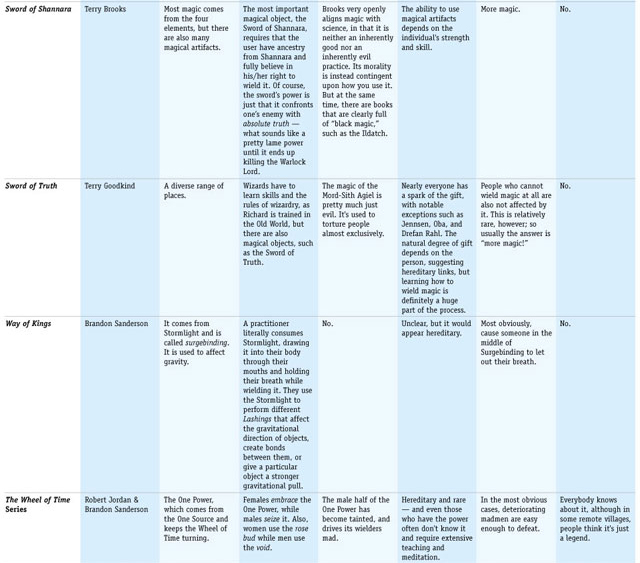

In a pure labour of love, io9 has compiled a table detailing the magic systems in nearly all of Fantasy’s most popular series and worlds.

From the blog post:

Magic is mysterious and ancient, and its workings are often beyond the understanding of mere mortals. But that doesn’t mean that magic doesn’t have rules.

Every fantasy saga has its own rules for magic, and its own explanations for how the magical arts work. Where does magic come from? Who can use magic, and how? Do regular muggles know magic exists? We dug through 50 or so of our favorite fantasy sagas, and compiled a complete list of the rules of magic in each of them.

And an excerpt:

io9's Epic 'Rules of Magic'

It’s fun to wander through all of these various world (especially the ones I haven’t visited in years) and compare and contrast all the imaginative ways that the genre’s authors have embraced the idea of otherworldly power. Looking more closely, though, it’s strange that Wheel of Time, known for having one of the most complex and nuanced magic systems in Fantasy has such a short entry, and the description of Brooks’ magic system in Shannara is flat-out wrong (the four elements? What?) Still a fun (and impressive) collection.

Paint Splatter Superheroes by Arian Noveir

Everybody has a favourite superhero. Whether you love the vulnerability of Batman, Superman’s struggle with what it means to be human, or Spider-Man’s fight for Mary Jane, it’s easy to connect with these super-powered humans (well, human in most cases!) and recognize that despite their superhuman abilities, they’re as damaged and vulnerable as the rest of us.

And that’s what makes these paint splatter portraits (which are actually produced digitally) by artist Arian Noveir so wonderful; not only do they look great, but they manage to capture that unguarded side that so many superheroes possess. They’re a beautiful, subversive look at the traditional hero-figure.

Paint Splatter Superheroes by Arian Noveir

More of Noveir’s art (including some more superheroes and a wonderful nod to Freddie Mercury of Queen) can be found on his DeviantArt Gallery page.

This post was originally published on Tor.com

Prologue to THE EYE OF THE WORLDMost Robert Jordan fans likely began their odyssey with his work by reading The Eye of the World, the first volume of his long-running Wheel of Time series. Despite being a Fantasy accessible to readers of all ages, The Eye of the World was released and marketed towards an adult market; of course, this didn’t hurt its success, but publisher Tor Books knew they were missing an opportunity to grow the audience among younger readers. In an effort to reach these readers, Tor released a split version of The Eye of the World in two volumes, titled From the Two River and To the Blight. Included in the first volume was a new prologue for the series, Earlier—Ravens that was designed to be more appealing to young readers than the misleading and ominous prologue that we’re all used to.

This prologue features a young Egwene and introduces readers to Emond’s Field years before the main plot of the series begins.

This far below Emond’s Field, halfway to the Waterwood, trees lined the banks of the Winespring Water. Mostly willows, their leafy branches made a shady canopy over the water near the bank. Summer was not far off, and the sun was climbing toward midday, yet here in the shadows a soft breeze made Egwene’s sweat feel cool on her skin. Tying the skirts of her brown wool dress up above her knees, she waded a little way into the river to fill her wooden bucket. The boys just waded in, not caring whether their snug breeches got wet. Some of the girls and boys filling buckets laughed and used their wooden dippers to fling water at one another, but Egwene settled for enjoying the stir of the current on her bare legs, and her toes wriggling on the sandy bottom as she climbed back out. She was not here to play. At nine, she was carrying water for the first time, but she was going to be the best water-carrier ever.

Pausing on the bank, she set down her bucket to unfasten her skirts and let them fall to her ankles. And to retie the dark green kerchief that gathered her hair at the nape of her neck. She wished she could cut it at her shoulders, or even shorter, like the boys. She would not need to have long hair for years yet, after all. Why did you have to keep doing something just because it had always been done that way? But she knew her mother, and she knew her hair was going to stay long.

Close to a hundred paces further down the river, men stood knee-deep in the water, washing the black-faced sheep that would later be sheared. They took great care getting the bleating animals into the river and back out safely. The Winespring Water did not flow as swiftly here as it did in Emond’s Field, yet it was not slow. A sheep that got swept away might drown before it could struggle ashore.

A large raven flew across the river to perch high in the branches of a whitewood near where the men were washing sheep. Almost immediately a redcrest began diving at the raven, a flash of scarlet that chattered noisily.

The redcrest must have a nest nearby. Instead of taking flight and maybe attacking the smaller bird, though, the raven just shuffled sideways on the limb to where a few smaller branches sheltered it a little. It peered down toward the working men.

Ravens sometimes bothered the sheep, but ignoring the redcrest’s attempts to frighten it away was more than unusual. More than that, she had the strange feeling that the black bird was watching the men, not the sheep. Which was silly, except . . . She had heard people say that ravens and crows were the Dark One’s eyes. That thought made goosebumps break out all down her arms and even on her back. It was a silly idea. What would the Dark One want to see in the Two Rivers? Nothing ever happened in the Two Rivers.

You can read the entirety of Earlier—Ravens via Wattpad; be warned, though, that it is certainly geared to young readers and begins the Wheel of Time with a decidedly different tone than the original prologue.