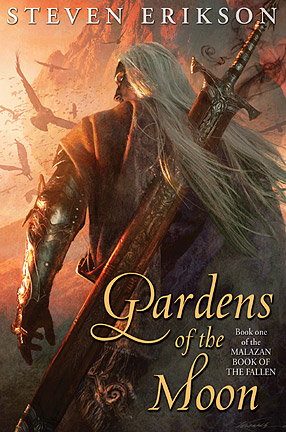
 Though he has no website of his own, Steven Erikson is in the midst of blogging over at Life as a Human. In the latest in his series of articles title Notes on a Crisis, Erikson digs deep into his craft.
What’s neat is that he does so by taking an excerpt from his upcoming novel, The Crippled God, the final volume of the Malazan Book of the Fallen series, and breaks down what one short scene can reveal about the structure and thought process necessary to build a much (much, much, much) longer piece of fiction.
In a general sense, I write elliptically. By that I mean I open sections with some detail I want to resonate throughout the entire section, and through the course of writing that section you can imagine me tapping that bell again and again. Until with the final few lines, I ring it one last time – sometimes hard, sometimes soft, depending on the effect I want, or feel is warranted. It’s become such a habit now that I often do it without conscious thought.
On a most basic level it shows up in paragraphs (and no, there’s nothing unique to me in any of this). Look two paragraphs upward on this screen. The opening line talks about multiple points of view; the last line describes the many ways of seeing the world. But that last line isn’t just reiterating the first one. Something is added (in this case, a personal comment on my desire to experience every one of them). It’s probably the only structural lesson I learned in school that I still use on occasion – the whole introductory and concluding sentences to frame a paragraph.
Anyway, extrapolating this pattern is how I write — within a scene, from section to section, from chapter to chapter, from novel to novel. While the narrative infers something linear, as in the advancement of time and a sequence of events, in fact the narrative loops back on itself again and again. And each time it returns, the timbre of that resonance has changed, sometimes subtly, sometimes fundamentally.
I read somewhere that Scott Bakker has recently complained that I’m repeating myself in my series, but he’s missing the point. It’s more that I return again and again to particular themes, from as many perspectives as I can. Maybe it still rates as a flaw in my writing, but it’s also my whole point in writing. Forget the conceit of hunting for the right answers – let’s start with trying to find the right questions. Personally, I doubt I will ever get past that stage; for me, the more ways I discover of looking at something, the more humbling the whole exercise becomes (Think you got the answers? Sorry, don’t believe you. Never will).
Elliptical. Looping back. It can be an image, a detail of setting, a mood or flavour, a particular action, or an idea. There’s countless ways of coming round back to where you started, and I admit I like the sly ones, though sometimes it pays to be more obvious.
Erikson’s comments on Bakker’s observations are interesting (in no small part due to the fact that Erikson was a large influence on Bakker first being published), and reveal a little bit about why his series encompasses ten massive volumes. As he says, some readers consider this repetition to be a flaw in his writing (which is somewhat my issue with the Malazan books, though I’ve only read two); but if it’s the point he’s trying to make, then how does one judge whether the Malazan books are a success? Do you care if he achieves his personal goals of recursive reflection if it gets in the way of proper storytelling? Do you like his novels because of the themes and the similarities in the characters’ internal battles? Or do you like it because even the weakest of his characters could rend the world in half on a cranky day?
Whatever the case, Erikson goes into a fairly in-depth analysis of the excerpt, picking apart the structure and language he uses and gives rather lucid and insightful consideration to the nitty-gritty decisions made by writers almost every day. Will it be useful to everybody? Maybe not, Erikson has a very defined style. But it’s certainly a revealing look at the process behind one of the most complex, convoluted and, well… huge fantasy series on the market today.
You can read the whole article, and the excerpt, HERE.