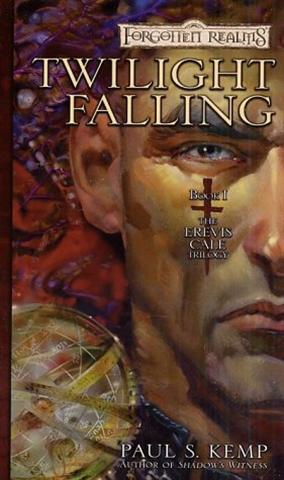
Twilight Falling by Paul S. KempPaul S. Kemp, a popular writer of Forgotten Realms novels, best known for The Chronicles of Erevis Cale, has announced, via his LiveJournal (via Fantasy Book News & Reviews), that he has parted ways with Wizards of the Coast and will not be finishing Godborn, the first book of the The Cycle of Night trilogy.

Normally, I would not write anything about this, but I feel obliged to let those of you awaiting the release of Godborn know that I have ended my relationship with Wizards of the Coast. As a result, I will not be writing Godborn and my contribution to the Forgotten Realms will end with The Twilight War. I sincerely apologize to those of you who were awaiting The Cycle of Night.

All that happened here is that Wizards made a decision that they thought was appropriate (and was, in fact, based on perfectly valid reasons), but that decision conflicted with what I thought was appropriate. We tried to resolve matters in good faith, but it just wasn’t to be. It’s unfortunate, but it goes that way sometimes. And that’s all I’ll have to say about it so please don’t ask for further details.

I remain grateful to Wizards for publishing my novels, and in particular have nothing but the highest of praise for my editor, Phil Athans. Honestly, my primary regret here is that I feel like I’ve let a lot of you down. So again, please accept my apologies if you were one of those awaiting Godborn.

Certainly it’s too bad to see Kemp leave the Forgotten Realms camp, as I understand that his novels were some of the best published in that world. From the sounds of it, the split between him and Wizards of the Coast was not pretty, so it should be interesting to see if Kemp continues to write in a different Shared-world or if he jumps ship and begins writing original fiction. If there’s any silver lining to this, it’s that Kemp is not leaving his publisher in the midst of a trilogy, but rather before even the first volume was published. Still, a let down for his fans, to be sure.

Best of luck to Paul.

Logo for David Gemmell Legend Award

Only a year old now, and the David Gemmell Legen Award is expanding its reach. SFScope points to an announcement detailing two new awards to be presented at next year’s ceremony:

The David Gemmell Morningstar Award for Best Newcomer will “give recognition to emerging talent in the field of fantasy fiction. As David Gemmell always took a keen interest in new writers, and helped many onto the path to publication, we regard this as an appropriate category to add, and one we feel sure David would have approved.”

The David Gemmell Ravenheart Award for Best Fantasy Cover Art will “honor the best fantasy book cover art. The importance of fantasy cover art deserves admiration, as do the artists who produce it, yet there is no major UK award acknowledging this. The Ravenheart Award will fulfill that role.”

Like the Legend Award, the winners of these new awards will be decided by popular vote. The first Legend Award was decided by a remarkable 11,000 voters from around the world, and Nicholls is “confident that the Morningstar and Ravenheart awards, which are being created with the full approval of the Gemmell family, will be greeted with no less enthusiasm.

An award for new authors is nothing to get terribly excited about, but it’s nice to see the artists and designers behind the covers of novels being awarded. We love to rant and rave about Cover Art (I do, at least), but there seems to be very little discussion about a facet of publishing that has such a huge affect on an authors success. As far as I’m concerend, this is Lou Anders‘ award to lose.

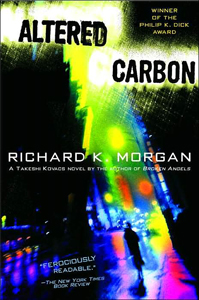
Richard Morgan’s best known for his balls-to-the-wall Takeshi Kovacs novels, beginning with Altered Carbon. Violent gunplay, moody set-pieces, breakneck pacing and visual artistry, Morgan is on the bleeding edge of contemporary Science Fiction. In what seems like a match made in heave, Morgan has been hired by Electronic Arts, the publisher behind Mass Effect, Mirror’s Edge and the newly released Dragon Age: Origins, to work on scripts for three of their upcoming games:
About a year ago, and out of the blue, I got an e-mail from one John Miles, an enforcer (okay, not really) for the British arm of EA Games. He had a proposition for me, was I interested? Interested, of course, was putting it mildly. Video gaming is the only thing in my life that I would fully qualify as an addiction. I like a fairly limited number of games (there’s an awful lot of dross out there), but those I like, I really like, and will play them until the game paths, enemy spawning points and scripted incidentals are graven into my synapses. Some game spaces I probably know better than the streets of the city I live in. And, as I’ve said once or twice on this site, I think the gaming medium has a potential for storytelling every bit as charged and exciting as literature or film. So was I interested? Yeah – just a little bit.

Well, John flew up to Glasgow to buy me lunch, and brought with him fellow enforcer Jeff Gamon and development capo Colin Robinson, who framed their proposition thus: was I interested in coming aboard with EA to write and script for a particular game project they had going, with a view to other game projects thereafter, and if so could I be in Berlin in a week’s time?

Talk about your offers you can’t refuse.

That was a year ago. Now, without breaking any Non-Disclosure Agreements, I can cautiously reveal that I’ve been pulled in to consult on three separate games, have spent more time on airplanes and in overseas hotels during the last year than in my entire previous life, and have hit one of the steeper learning curves of my creative existence. Gaming turns out not only to be exactly as fascinating a medium as you’d expect, it’s also a very young industry and its norms have yet to be fully formed. So while it shares some characteristics with the movie world, gaming has yet to produce its version of Story guru Robert McKee or the cut-and-dried writing formula requirements that have strangled so much creativity in places like Hollywood. What you can put into a big budget game is still very much up for grabs, and what’s more, with the breakneck pace of technological development backing the field, it’s constantly changing as well. One producer I’m working with at the moment likens what we’re doing to working in Hollywood circa 1920, when everyone was still working out what you could do with this wild, new medium called film; the only difference is that the rate of evolution in technique for video games is running at about a dozen times the speed it ever did for film. The field is open, the potential huge and, in story terms, only just beginning to be properly tapped

For a writer, that’s a pretty close definition of paradise.

And it hasn’t hurt that the projects I’m working on are all science fiction, so while I chisel patiently away in fantasy at The Dark Commands, my SF muscles are being kept in trim by the concepts at the heart of each game.

Source

What’s most intriguing is Morgan’s stance on videogames as a medium for storytelling. I’ve always felt similarily to Morgan, that Videogaming is still in its infancy, trying to figure itself out, and it’s nice to have a proven storyteller like Morgan involved in helping the medium find its legs. Morgan’s style of storytelling lends itself well to the Videogame medium, and it’s encouraging to see a souless huge company like EA reach out to snag him into their midst. Really, it’s hard to think of an author better suited to the job, and certainly it rings truer than Graham Joyce being chosen to pen Doom 4.

Though a little confusing to a book-loving luddite like me, some people are really into this E-book thing. Kindle-clutching Fantasy lovers are in luck, with Tor Books finally releasing electronic version of Robert Jordan’s Wheel of Time series. Shockingly, the first release just happened to coincide with the release of The Gathering Storm. Imagine that! Tor has now shored up the release schedule for the remaining novels.

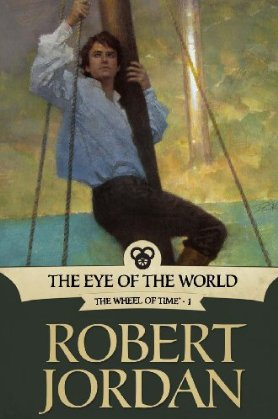
The Eye of the World by Robert Jordan

These electronic editions are being created from original page layout files, and are being updated with the latest copyedits and corrections from Robert Jordan and later, from Team Jordan. They also boast all-new covers designed by Jamie Stafford-Hill and featuring art from a variety of illustrators, including David Grove, Donato Giancola, Sam Weber, and Ketai Kotaki, all commissioned by Tor Books (and Tor.com) Art Director Irene Gallo.

Since these books are being put together basically from scratch, in many cases from new or updated files, Tor Books is putting them out at the rate of one per month. Below is a schedule of publication, for your handy reference:

October 27, 2009: The Eye of the World
November 17, 2009: The Great Hunt
December 15, 2009: The Dragon Reborn
January 19, 2010: The Shadow Rising
February 16, 2010: The Fires of Heaven
March 16, 2010: Lord of Chaos
April 20, 2010: A Crown of Swords
May 18, 2010: The Path of Daggers
June 22, 2010: Winter’s Heart
July 20, 2010: Crossroads of Twilight
August 24, 2010: Knife of Dreams
September 28, 2010: New Spring
November 2, 2010: The Gathering Storm

Also coming down the road (though lord knows why anyone would purchase them…) are the split volume version of The Eye of the World and The Great Hunt, respectively:

November 16, 2010: From Two Rivers
November 16, 2010: To The Blight
November 16, 2010: The Hunt Begins
November 16, 2010: New Threads in the Pattern

It’s hard to wrap my head aroun the fact that we’re going to have to wait an entire year for the series to be released in full (well, what’s been published previously, at least) and it seems strange that Tor is holding back on releasing The Gathering Storm until next year as well. I suppose the profit margin on Hardcovers must be higher than E-books, which is how Tor wants you to consume their biggest release of the year. In any case, for those of you on the bleeding edge of technology, there you go.

I normally stick to one story for each edition of Free Readin’, but this time I’m feeling generous! Paul Jessup (@pauljessup) and Jay Lake (jay_lake) are two of my favourite folk on Twitter and I wanted to point some of my readers to some of their (great) short fiction.

Ghost Technology From the Sun by Paul Jessup

Master told us that the earth was hollow, and that we lived on the inside of it, clinging to the top of the crust. Below us was another world, a world inside the world, a glowing bright sun of a place. What Master called the summerlands. That is where the dead live, he said. That is how we can talk to them, he said. They send us signals across the air, and the mediums pick them up and drink them in.

And when the words came in, we had to speak them. We cannot deny the dead our voices–the dead would be angry if we did. And nobody wanted the angry dead to fly their zeppelins up from the sun and attack us crust dwellers.

That wouldn’t do anyone any good.

Master knew this because he is an ambassador to the land of the dead. At night he walked through the door of the dead, and it beamed his body down above us, into the summer sun inside of the earth. That is where he talked to them, worked out trade between our two peoples.

The dead have a lot to offer the living.

He came back with schematics.

Ways of building circuit boards.

Ghost technology from the sun.

Ghost Technology From the Sun can be read in full HERE.

People of Leaf and Branch by Jay Lake

Maribel ran along the top boards. The planks went from roof to roof, along the ridges, with a jumping-space to reach the peaks of the round huts. She didn’t have the skill of a danseuse, nor the grace of the best of the girls from the stone city below her, but among the woodkin, she was often accounted the most lithe and best.

The Tower Wander was ahead, with Shrike House clinging to its neck like a collar. The old wall had long since been swallowed by the spread of the stone city, gone from defense to landmark to landform in the space of a few generations. The Duke of Copper Downs had forbidden the woodkin to enter the abandoned towers, but their exteriors had never been under such a rule.

So the seven surviving towers acquired names, and superstructures, and held the long, narrow village that ran from the Broken Gate to the Tower Harbor. The towers were part of the stone city, but the houses were the woodkin’s memory of another time and place.

She slipped through the roof of Shrike House, dropping to the floor in a shower of dust and straw.

There was no one there, of course. Shrike House had been empty since Maribel’s mother’s childhood. Seven towers, seven houses, but in every generation more went down to the stone and found lives among the city. None returned.

You can read People of Leaf and Branch in its entirety HERE.

Jessup and (in particular) Lake (a Multiple Hugo and World Fantasy Award nominee) are both well known for their short fiction, and there’s nowhere better to get introduced to them than through Ghost Technology From the Sun and People of Leaf and Branch.