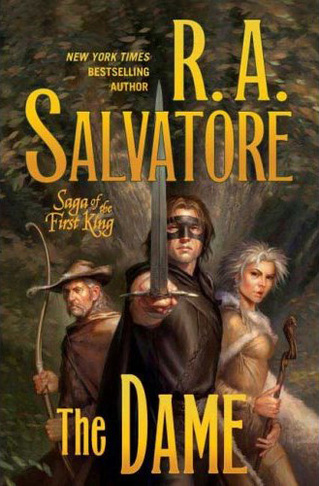
Suvudu gave us a glimpse at the near final version of the cover art for R.A. Salvatore’s The Dame, the newest volume in his Saga of the First King.

The Dame by R.A. Salvatore

Despite my disappointment in his previous effort in the Saga of the First King, I was a big fan of the novel that kicked of the saga, The Highwayman. I still hold out hope that the next volume, The Dame will recapture some of the heart and craft that was lost in The Ancient.

Comments closed

Neil Gaiman’s Coraline is one of my favourite novels. Not only is it a chillingly beautiful read, but it’s the perfect example of how YA can mix with adult fiction and appeal to readers of all ages. Surprisingly, the movie adaptation of the novel seems like it might just do justice to the source material.

From Gaiman’s blog:

It’s hard to promote a film that’s as much for adults as it is for kids, easy for something like this to bomb — or to be perceived as having bombed, which is not the same thing. The advertising is out there for another couple of weeks, and it’ll probably get more pervasive as we get closer to the 6th of February, and will not please your friends. And the run up to Coraline will take over this blog more or less completely, I expect, because it’s all I’ll be doing. And then, after Feb 6th, it will all trail off, and the advertising will die away completely, and it will fade from the blog with occasional splashes of mention if the film does something interesting, or if I go somewhere to help promote it.

I’m always wary about book to movie translations, but it’s hard not to get excited about a project when the author themselves seem to fully support the visual version of their story. Too often movies are more or less ignored by the authors whose work they’re based on, but Gaiman seems fully behind Coraline and that has me fully excited.

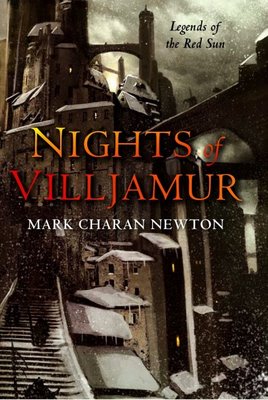
Courtesy of James over at Speculative Horizons, we have cover art and a synopsis for Mark Charan Newton’s debut novel, Nights of Villjamur.

Nights of Villjamur by Mark Charan Newton

Political intrigue and dark violence converge in a superb new action series of enthralling fantasy. An ice age strikes a chain of islands, and thousands come to seek sanctuary at the gates of Villjamur: a city of ancient spires and bridges, a place where banshees wail the deceased, cultists use forgotten technology for their own gain and where, further out, the dead have been seen walking across the tundra.

When the Emperor commits suicide, his elder daughter, Rika, is brought home to lead the Jamur Empire, but the sinister Chancellor plans to get rid of her and claim the throne for himself. Meanwhile a senior investigator in the city inquisition must solve the high-profile and savage murder of a city politician, whilst battling evils within his own life, and a handsome and serial womanizer manipulates his way into the imperial residence with a hidden agenda. When reports are received that tens of thousands of citizens are dying in a bizarre genocide on the northern islands of the Empire, members of the elite Night Guard are sent to investigate. It seems that, in this land under a red sun, the long winter is bringing more than just snow.

Mark’s a good friend of this blog and I expect big things from him and Nights of Villjamur!

Shamelessly stolen from Pat’s Fantasy Hotlist, a synopsis for Robin Hobb’s next novel, Dragon Keeper has come to light.

Return to the world of the Liveships Traders and journey along the Rain Wild River in this standalone adventure from the author of the internationally acclaimed Farseer trilogy. Tintaglia the blue dragon has lost interest in the stunted dragons that emerged from the cocoons of Maulkin’s Serpent Tangle. Dragons are fiercely practical about survival of the fittest, and now that she has produced her own batch of healthy hatching serpents Tintaglia no longer provides for the weak creatures abandoned near Trehaug, the main city of the Rain Wilds. The Rain Wild Council is as ruthless as Tintaglia: Deciding that the pack must be relocated they begin to recruit their least useful citizens to tend the beasts and escort them upriver to better hunting grounds. Because of their proximity to the acid waters and vapours of the Rain Wild River, Rain Wilders are born with deformities that shorten their life expectancy and must wed young and reproduce early if their family lines are to survive. Thymara is long past marriageable age. Having been born with too many abnormalities she should have been exposed as an infant, but her father chose to keep and raise her, against his wife’s wishes. When Thymara’s mother hears that the council is seeking tenders she grasps the chance to be rid of her wild, ugly daughter. But Thymara shows just as much enthusiasm at the prospect of adventure and grabs the opportunity to travel with the dragons. But the youngsters that will herd the dragons are as ignorant as the beasts themselves – both completely unaware that they are being sent into an exile rather than to a sanctuary.

I’m a big fan of Hobb’s work, and am really looking forward to getting back into the lands of the Rain Wilds. I’m not entirely sold on the premise of this novel, but if I know anything about Hobb, it’s that she has yet to let me down and I expect Dragon Keeper will be no different. I’m especially excited about seeing a stand alone novel from Hobb, which might fix some of pacing issues some of her other novels have had.

Cory Doctorow, well known scribe of craphound.com and author of critically acclaimed YA novel, Little Brother, has a fantastic article about how, even as someone intrinsically tied to the distraction riddled Internet, he has found little ways to make sure his productivity doesn’t drop in lieu of browsing the web, juggling family and friends, or just getting bored.

The single worst piece of writing advice I ever got was to stay away from the Internet because it would only waste my time and wouldn’t help my writing. This advice was wrong creatively, professionally, artistically, and personally, but I know where the writer who doled it out was coming from.

But the Internet has been very good to me. It’s informed my creativity and aesthetics, it’s benefited me professionally and personally, and for every moment it steals, it gives back a hundred delights. I’d no sooner give it up than I’d give up fiction or any other pleasurable vice.

I think I’ve managed to balance things out through a few simple techniques that I’ve been refining for years.

When I’m working on a story or novel, I set a modest daily goal — usually a page or two — and then I meet it every day, doing nothing else while I’m working on it.

When you hit your daily word-goal, stop.

When you come to a factual matter that you could google in a matter of seconds, don’t.

Forget advice about finding the right atmosphere to coax your muse into the room. Forget candles, music, silence, a good chair, a cigarette, or putting the kids to sleep.

Word, Google Office and OpenOffice all come with a bewildering array of typesetting and automation settings that you can play with forever. Forget it.

The biggest impediment to concentration is your computer’s ecosystem of interruption technologies: IM, email alerts, RSS alerts, Skype rings, etc.

Some of his advice might seem crazy (stop mid-sentence? don’t research?) , but when I can’t help but feel he’s right on the money when he explains why you should cut yourself off, even when you’re on a roll, or why the length of the Brooklyn Bridge doesn’t matter when you’re writing a scene about it. His advice might not work for every writer, but he’s certainly someone worth listening to.

You can read the whole article HERE.