Publisher: Scholastic Press -
Pages: 416 -
Buy: Book/eBook
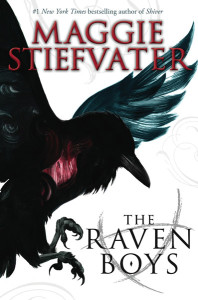
Set in Henrietta, Virginia, Maggie Stiefvater’s The Raven Boys exhibits characteristics of the “southern novel”, a form I associate strongly with Tom Wolfe or Harper Lee. Novels of the American South tend to focus on the gross inequalities that exist there, often couched in racial terms, but also the nature of inherited wealth juxtaposed with the lack of opportunity that exists in the more urban centers. In the case of The Raven Boys, Stiefvater creates that paradigm between Blue Sargent, daughter to a poor, but comfortable, and exceedingly proficient psychic, and four boys from Aglionby, a feeder high school for the Ivy League.
The Raven Boys is an examination of the power dynamics between people.
For all her life, Blue has been warned that Aglionby boys are trouble. They’re rich and live by a code that means the rules don’t apply to them. These Aglionby boys–Gansey, Adam, Ronan, and Noah–would be no different, except they can’t accept the lives they’ve been given. They want something more, for themselves and for each other. Bound up in a brotherhood dedicated to uncovering a measure of magic in the world, the boys come to Blue and her family for help. While the story is a quest, the novel is hardly about it at all. Not just about the unequal nature of the American South, The Raven Boys is an examination of the power dynamics between people. The power we give to others over us, and the power we reserve for ourselves. In other words, it’s a novel of character and the connections that bind them together. Read More »
Bring on the controversy, and strap in for a devil’s advocate view through some eye-opening history, because certain game-changing books were never ‘discovered spontaneously.’ Notably, the profile of these landmark fantasy authors share a profile of mature scope and depth, and stories that open with adult protagonists.
First, busting the myth that Tolkien was ‘discovered’ and broke out by readership word of mouth is not true: Betty Ballantine’s actual account relates how Tolkien’s career blossomed through a publishing scandal.
Allen Unwin first published Professor Tolkien in Great Britain in hardbound. At the time, copyright law in the USA protected up to 2000 unbound copies of a book to be imported as loose pages, to be bound and sold by a US firm. Houghton Mifflin handled Tolkien this way, in routine partnership with Allen Unwin. Nobody paid much attention, though Ian and Betty Ballantine loved the story and offered for paperback rights. Professor Tolkien declined, avoiding what he considered a tacky American edition. Over a period of ten years, when the British edition underwent reprint, repeated lots of unbound sheets of were brought in and sold by Houghton Mifflin in quiet obscurity. Enter a certain paperback publisher’s back room lawyers, who tracked publication records, trolling for the loophole that titles compiling more than the allotted 2,000 loose sheets slid into the public domain. On that legal technicality, Tolkien’s Lord of the Rings was reprinted as the very lurid paperback professor Tolkien had wished to avoid, and worse, with no royalties owed to the author. Read More »
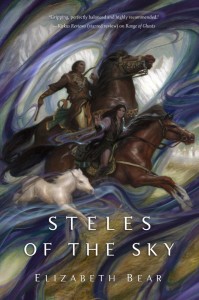
As anyone who followed my reviews in 2013 knows, I’m a slavering fan-boy for Elizabeth Bear’s Eternal Sky trilogy (Reviews: , Shattered Pillars, Steles of the Sky). Seriously. It’s the best completed fantasy trilogy I’ve read in a decade. Along with Kameron Hurley, I think that Bear is publishing some of the most progressive, interesting and important SFF today.
So, needless to say, I’m pretty excited to see that the first details about Bear’s next novel, Karen Memory, have been revealed. An I think you should be, too.
In conversation with Liz Bourke on Tor.com, Bear said:
Currently I’m working on a wild west Steampunk novel called Karen Memory, which is coming out from Tor in 2015. It involves heroic saloon girls, massive conspiracies, and at least one fascinating and oft-ignored historical character.
While fans of her fantasy trilogy might be disappointed to see Bear leaving the epic fantasy subgenre, I’m excited to see that she’s continuing to explore the boundaries of genre fiction. Bear is one of the genre’s more diverse and exploratory writers, and readers can expect the same level of care and thoughtfulness that she applied to epic fantasy to be shown towards Steampunk and its (very popular) tropes and traditions.
Karen Memory is slated for release in 2015 from Tor Books.
They were easy to spot: each was an accidental heroine, wholly unaware of her strengths, concerned to the point of obsession with her shortcomings.
In 1996 Helen Fielding burst onto the scene with Bridget Jones’ Diary, a novel-in-journal entries featuring a hapless, slightly overweight thirty-something struggling to land a boyfriend. The book went on to sell 2 million copies and, soon after, became a blockbuster film starring Colin Firth and Renee Zellweger. Predictably, in the years that followed, we began to see the “Bridget Jones” character everywhere. They were easy to spot: each was an accidental heroine, wholly unaware of her strengths, concerned to the point of obsession with her shortcomings.
From Twilight’s admittedly problematic Bella, to Game of Thrones’ ineffectual Sansa Stark [Editor’s Note: Just keep reading/watching, Anna. ;)], women who were the recipients, not the perpetrators of action began to overwhelm our fiction. And these women, often depicted as heroes, succeeded in spite of their insecurities: after encountering a guide or a mentor, each experienced a pivotal moment that guided her inner heroine out of the shadows and into the light. Read More »
For the past year or so, Terry Brooks has been teasing his fans with hints of a conclusion to his long-running Shannara series. Since some of its earliest volumes, the Shannara series has explored the results of growing science in a world once dominated by magic. Brooks has mentioned several times now that within the next several years he will be writing a trilogy that will tie-up this ongoing tug o’ war, calling the trilogy and “end” for Shannara. But, would Brooks, and his publishers, really be willing to step away from the long-standing (and reliable revenue generating) series? The answer, it appears, is no.
The the most recent instalment of “Ask Terry,” a monthly feature on Brooks’ website where the author answer fan questions, Gina Miller asked, “When I finished Measure of the Magic, it felt incomplete. We left everyone divided and leaderless, and it was an incomplete transition to the Shannara world. Will there be a bridge to make the transition complete?”
To which Brooks replied:
Yes, there will be a finish to the set. Just not for awhile. Probably not for as along as five years. I intend to write the end of the Shannara series first, then go back to the pre-history. Obviously, if I intend to keep my promise to all of you, I have to write from Measure up to the First Council of Druids. Let’s hope I live that long.
Colour me unsurprised (and a happy Shannara fan). While Shannara might receive a trilogy that concludes the war between science and magic, there are many more stories to tell in the world, and it wouldn’t surprise me to see Brooks turning to more standalone novels, similar to his upcoming novel, The High Druid’s Blade, set at various points along Shannara‘s lengthy timeline.
In addition to these upcoming novels, Brooks has also said that he has a new book (or series) planned that is entirely unrelated to his previous works.