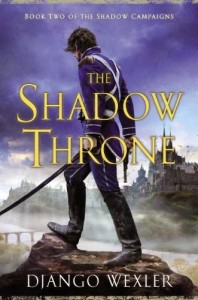
Cover Art for The Shadow Throne by Django Wexler

With the recent unveiling of the cover for Django Wexler’s The Shadow Throne, the sequel to his debut novel, The Thousand Names, I thought it would be a good time to catch up with Django, who has contributed to A Dribble of Ink in the past, about his upcoming work.

The Thousand Names impressed a lot of people when it was first revealed thanks to an attractive cover for both its North American and British releases. It’s tough to follow up a great cover, but the American edition of The Shadow Throne is attractive and uses a nice colour palette that separates itself from the more aggressive colouring found on many fantasy novels these days (See: Joe Abercrombie, Brent Weeks, Brian McClellan).

“I’m really happy with how it came out,” Django said when I asked him about the new cover. “The uniform has the right look, and there are a lot of neat little details. If you look closely at the background, the cathedral towers are topped with the double-circle of the Elysian Church, just like they should be!” Read More »

apocalypse-triptych-banner

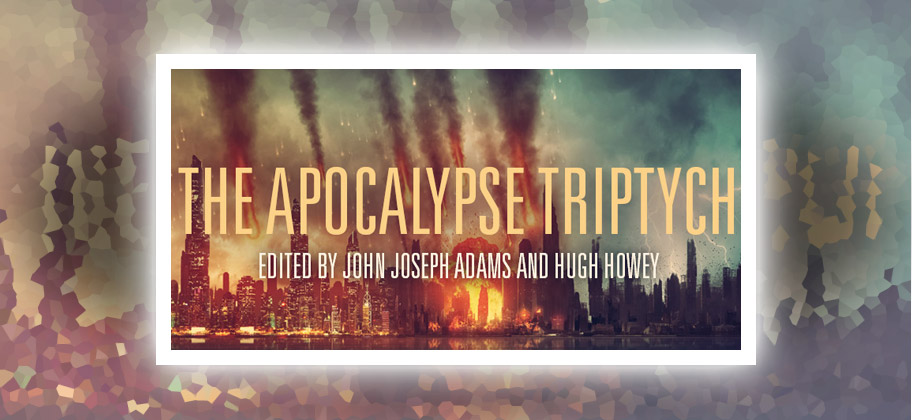
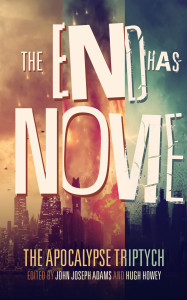
Via io9, John Joseph Adams and Hugh Howey announced a new anthology series called The Apocalypse Triptych. The three volumes in the trilogy are titled: The End is Nigh, The End is Now and The End Has Come. As the titles of the books suggest, each volume will focus on a particular period before, during and after an apocalyptic event.

Adams, editor of Lightspeed and Nightmare, is one of the most popular (and prolific) anthologies editors working today, and Howey is one of Science Fiction’s most successful stories of self-published-author-takes-over-the-world (before selling the print rights to Simon & Schuster, he sold half-a-million copies of his novella-collection Wool). I have trouble describing the magnitude impact of these two working together without degenerating into a series of weightless superlatives. These books are gonna sell a ton. Period.
The Apocalypse Triptych

Speaking with io9, Adams described the reasoning behind publishing a unique triptych of anthologies, rather than one large anthology covering all types of apocalyptic stories. “[T]here is a distinct vibe that each of these types of stories has,” he said, referring to end-of-the-world, the-world-hand-ended, and post-apocalyptic scenarios. “[A]nd I suspect that there are lots of readers who are interested in one mode of apocalypse fiction or another; some might prefer watching everything burn, while some might be more interested in seeing what happens after everything has burned, etc., and so I think anthologies like these can be valuable for that reason.”

Howey, on the other hand, has his own take on why the progressive nature of the triptych is important. He says, “The beauty of this triptych, for me, is the chance to read short stories with sequels, short stories that take us on a journey, that tie a single world together across time and space.”

The Triptych includes many of today’s most exciting short fiction authors, including Paolo Bacigalupi, Seanan McGuire, Ben H. Winters, Elizabeth Bear, Scott Sigler, Robin Wasserman. Adams made clear, however, that not all authors will appear in every volume. Wool fans are in luck, though, as Howey is confirmed to have a Wool story in each volume. As if these books weren’t going to sell enough copies already.

More information about The Apocalypse Triptych is available through the official website. The first volume, The End is Nigh will be released in June, 2014.
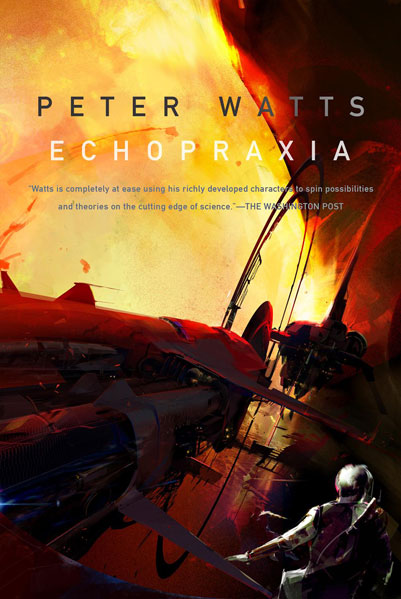
Echopraxia by Peter Watts

Peter Watts is the Hugo-winning Canadian author of Blindsight, described by The Globe and Mail as, “a hard science fiction writer through and through and one of the very best alive,” which is a reputation he has lived up to among fans of hard science fiction. Through their Spring/Summer catalog, Tor has revealed details about Echopraxia, his first novel since 2006.

Prepare for a different kind of singularity in this follow-up to the Hugo-nominated novel Blindsight.

It’s the eve of the twenty-second century: a world where the dearly departed send postcards back from Heaven and evangelicals make scientific breakthroughs by speaking in tongues; where genetically engineered vampires solve problems intractable to baseline humans and soldiers come with zombie switches that shut off self-awareness during combat. And it’s all under surveillance by an alien presence that refuses to show itself.

Daniel Bruks is a living fossil: a field biologist in a world where biology has turned computational, a cat’s-paw used by terrorists to kill thousands. Taking refuge in the Oregon desert, he’s turned his back on a humanity that shatters into strange new subspecies with every heartbeat. But he awakens one night to find himself at the center of a storm that will turn all of history inside-out.

Now he’s trapped on a ship bound for the center of the solar system. To his left is a grief-stricken soldier, obsessed by whispered messages from a dead son. To his right is a pilot who hasn’t yet found the man she’s sworn to kill on sight. A vampire and its entourage of zombie bodyguards lurk in the shadows behind. And dead ahead, a handful of rapture-stricken monks takes them all to a meeting with something they will only call “The Angels of the Asteroids.”

Their pilgrimage brings Dan Bruks, the fossil man, face-to-face with the biggest evolutionary breakpoint since the origin of thought itself.

Before becoming a writer, Watts acquired a PhD in Zoology and Resource Ecology from the University of British Columbia, which makes me even more curious to see that Echopraxia appears to deal with the merging of biology and technology. Watts is known as one of the best authors at weaving intelligent scientific exploration and debate into the narratives of his story, and everything about the synopsis for Echopraxia tugs at my interests. Peter Watts can be trusted with big ideas, and Echopraxia appears to be full of them.

echopraxia1echopraxia4echopraxia3echopraxia2

Watts’ most famous novel, Blindsight had, erm… less than inspiring cover art, so it’s nice to see Tor giving him the attention that a writer of his calibre deserves. There’s an obvious similarity to covers for James S.A. Corey’s enormously popular Expanse trilogy, but the clean typography separates the two and also brings to mind Tor’s equally impressive work on the John Harris covers for John C. Wright’s Count to the Eschaton Sequence. I’m not sure how anyone could pass this book in a bookstore and not pick it up.

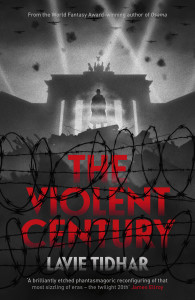
The Violent Century by Lavie Tidhar

Publisher: Hodder & Stoughton - Pages: 353 - Buy: Book/eBook
The Violent Century by Lavie Tidhar

Lavie Tidhar’s The Violent Century has done for World War II what The Watchmen did for the Cold War (and should have done for the Vietnam War). I make that comparison not because both feature humans with superpowers, but because they offer an opportunity to look at real events through a hyperbolic layer. Tidhar, like Alan Moore, is interrogating real events with the speculative fiction toolkit, looking not at how it happened historically, but at what about the human condition allowed it. The result, in Violent Century’s case isn’t just a great piece of superhero fiction, but a beautiful novel of cultural and literary merit.

[The Violent Century] is the kind of stilted romance built on repressed feelings and unspoken connections.

The jacket copy of the novel reads, “Fogg and Oblivion must face up a past of terrible war and unacknowledged heroism to answer one last, impossible question: what makes a hero” I’m loathe to sum it up so simply. While there are some notions of heroism throughout the novel, the quote describes what a fan reckons a superhero novel ought to be without a sense of the novel’s real themes. In the end, The Violent Century is a love story. Not a tale of heroism or social commentary, although it is those things too, Tidhar’s novel is the kind of stilted romance built on repressed feelings and unspoken connections.

For seventy years Oblivion and Fogg have guarded the British Empire with their abilities as arms of the opaque Retirement Bureau. Divided by a secret from decades past the pair is called back to answer for their actions. Fogg is a child of neglect, exploited for his ability, and asked to do things he finds incongruent with his morality. Oblivion, meanwhile, is more of a cipher, a mystery to solve. There’s also a woman named Klara who sits at the root of the conflict between the novel’s main characters and at the root of how Tidhar’s world is changed from our own. Read More »

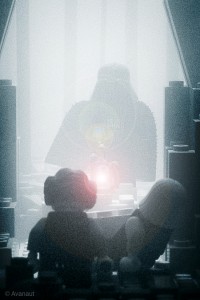
Lego Star Wars, photos by Vesa Lehtimäki

Via Entertainment Weekly, George Lucas has confirmed that Star Wars: Episode VII will be released to theatres on December 18th, 2015. EW reports:

Lucasfilm has announced the new date for the debut of the next Star Wars trilogy, and despite some script rewriting that is currently underway, the movie will not be pushed to later in 2016.

Fans can expect to revisit the galaxy far, far away on Dec. 18, 2015.

Also interesting to note is the recent change in the primary writers for the scrip. Replacing Michael Arndt, best known for his work on Little Miss Sunshine (which is a hilarious thought, given the quirky nature and humour of that film) are J.J. Abrams, director of the film, and Lawrence Kasdan, co-writer of The Empire Strikes Back (the best of the trilogy), Return of the Jedi and Raiders of the Lost Ark—that’s certainly a resume that Star Wars fans can be excited about. Entertainment Weekly says that this, “development [is] clearly not an ideal one, and it triggered questions about whether the story would be ready in time.” This 2015 release date ensures that the production will be given the necessary time it needs to be polished to the high level (*cough cough*) that Star Wars fans expect (though, perhaps, are not always used to receiving).

Pre-production for the film is already underway, with shooting scheduled to being in Spring 2014.

So, how many days to go? *Counts his fingers until he runs out.*