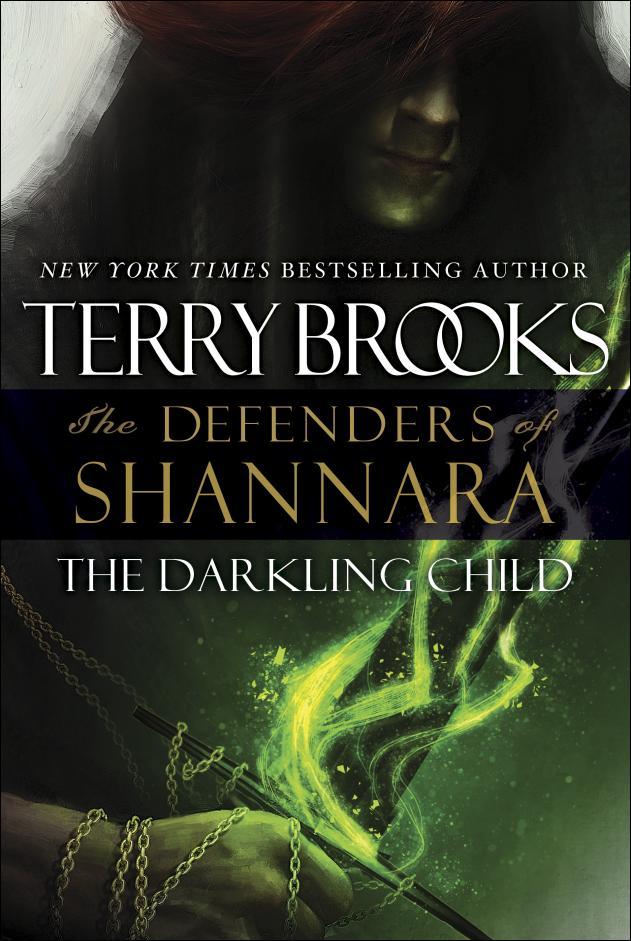
Terry Brooks’ next novel, The High Druid’s Blade, isn’t even out yet, but the cover for the follow-up novel, The Darkling Child, is already loosed on the world. (See what I did there? It’s like a demon from the Forbidding.) And, it’s just as pretty as the previous cover. I really like the rough, impressionistic quality of the painting they’ve used.
The Darkling Child is the second in The Defenders of Shannara, a loose trilogy of standalone Shannara novels that follow the events of Witch Wraith, Brooks’ most recently published novel. The High Druid’s Blade and The Darkling Child will be released in 2014.
I’ve recently been thinking of science fiction as literature of the moment, an examination of how we look at the world and all of the many changes that pass us by. Given the state of the world, military science fiction has long struck me as a way to make sense of the global impact of the ‘war on terror’ and other related actions across the world.
Rugged individualism and a sense the edge of the world is an opportunity, no matter who’s already there.
Predominantly, Military Science Fiction as a distinct subgenre comes out of works published in the 1950s by American science fiction authors, namely Robert Heinlein and Gordon R. Dickson, whose respective books Starship Troopers and Dorsai!, have spawned an entire industry of imitators. Steeped in the fears of the Cold War, these novels were written at a time when global annihilation appeared imminent, held back only by the raw power held by the United States Armed Forces and the inherent greatness of the American way. This lines up strongly with other trends one sees in American strains of Science Fiction: rugged individualism and a sense that the edge of the world is an opportunity, no matter who’s already there.
Science fiction tends to carry along its baggage for a long time. While there’s been an incredible evolution of outstanding stories, the genre’s frequently saddled with a pulp characterization; the incredible changes from the so-called Golden Age to the New Wave and beyond simply doesn’t register. Military SF, in many ways, has a similar history: it remains, in many people’s minds, a relic of the 1950s, when the Cold War raged between the politicians and armies of the US and USSR. In retrospect, it’s appears to be a simpler conflict than what we face today. Read More »
I can remove the poison from your body.
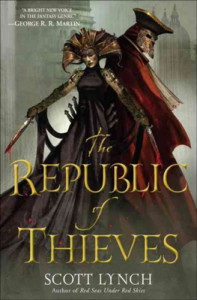
Poison kills. Locke Lamora knows this—poison courses through his veins, eating away his health, wasting away at his mind. Poison is killing Locke Lamora, but at what cost can it be removed from his body, and can even that be considered salvation? The Republic of Thieves, the long-awaited third volume in Scott Lynch’s Gentlemen Bastards series, answers those questions, but, as any good middle-volume should, it asks so many more.
Scott Lynch emerged onto the fantasy scene as an intense, bright-burning star. Almost overnight, he became one of the most exciting young novelists when he released his debut novel, The Lies of Locke Lamora, which engaged readers with its wit, intricate plotting, mile-a-minute dialogue and characters you knew immediately upon meeting them. It was one of the most impressive debut novels of the twenty first-century. And, as luck would have it, the sequel was just around the corner. Lynch promised a book-a-year, and delivered Red Seas Under Red Skies on that schedule. The Republic of Thieves was next on the list. That was six years ago. Read More »
Publisher: Night Shade Books -
Pages: 320 -
Buy: Book/eBook
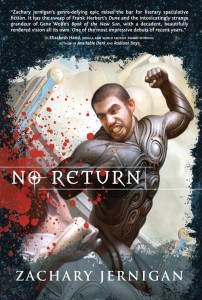
Books like Zachary Jernigan’s No Return are the primary reason why the Night Shade Books collapse was a crying shame. It is bold, edgy, daring, and uneven in spots, making it both exactly the kind of book that demands to be published and one that is likely to be passed over by larger houses. In all, No Return is a quirky mash-up of speculative genres drawn into a thoroughly compelling package before petering out in the last twenty pages. While that might sound damning with faint praise, I insist that it’s a book that should be read.
Despite exceptional writing and a mind blowingly original concept, the novel ends abruptly with little resolution.
The reality is Jernigan had no shortage of capable hands guiding him as he wrote No Return. Written mostly, if not in full, during his time in the Stonecoast MFA program, his advisers were Elizabeth Hand and David Anthony Durham. But, despite exceptional writing and a mind-blowingly original concept, the novel ends abruptly with little resolution (if any) of the two disparate plot lines. I say disparate because there’s a clear intent that the story lines connect, but they never do. Even as the novel winds to a close and the plot seems ready to stitch together, Jernigan abruptly snips the chain and carries the plot into the uncertain future of a second novel.
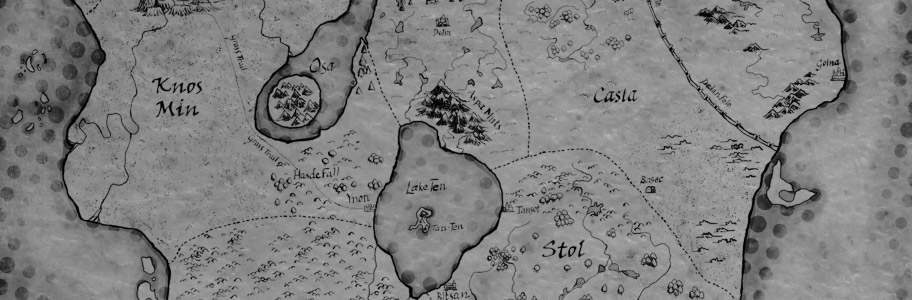
On the planet Jeroun, God (or Adrash if you prefer) is a vindictive son of a bitch watching from the heavens and occasionally hurtling metal meteors to the earth to punish his flock. Among the human population two ‘churches’ have emerged, the white and black suits, who oppose one another on the basis of whether God exists. One half of the plot leads up to a fighting tournament between these two factions, who have become accustomed to justifying the strength of their argument through strength of arms. This portion of No Return features Vedas, one of the black suits’ best bets to win the tournament. He travels across the countryside, joined by a female pit fighter, Churls, and an artificial man, Berun, who are heading to a secular companion tournament. Read More »
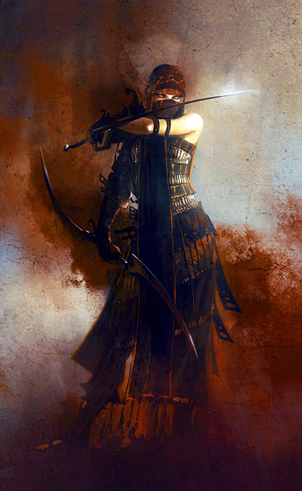
Bradley P. Beaulieu, sometimes contributor here at A Dribble of Ink and author of The Winds of Khalakovo, announced this week that he has completed work on the first volume of his upcoming trilogy, The Song of the Shattered Sands, for DAW Books. Beaulieu is known for his comprehensive, diverse world building, and Twelve Kings in Sharakhai looks no different. He’s established a Pinterest board that illustrates some of the imagery he’s used as inspiration for the series, and gives readers a taste of what we can expect from the series.
In the cramped west end of Sharakhai, the Amber Jewel of the Desert, Çeda fights in the pits to scrape a living. She, like so many in the city, pray for the downfall of the cruel, immortal Kings of Sharakhai, but she’s never been able to do anything about it. This all changes when she goes out on the night of Beht Zha’ir, the holy night when all are forbidden from walking the streets. It’s the night that the asirim, the powerful yet wretched creatures that protect the Kings from all who would stand against them, wander the city and take tribute. It is then that one of the asirim, a pitiful creature who wears a golden crown, stops Çeda and whispers long forgotten words into her ear. Çeda has heard those words before, in a book left to her by her mother, and it is through that one peculiar link that she begins to find hidden riddles left by her mother.
As Çeda begins to unlock the mysteries of that fateful night, she realizes that the very origin of the asirim and the dark bargain the Kings made with the gods of the desert to secure them may be the very key she needs to throw off the iron grip the Kings have had over Sharakhai. And yet the Kings are no fools—they’ve ruled the Shangazi for four hundred years for good reason, and they have not been idle. As Çeda digs into their past, and the Kings come closer and closer to unmasking her, Çeda must decide if she’s ready to face them once and for all.
While he admits the book is still early and ‘not perfect,’ it will be going through at least two more drafts after it has passed through hands on his editors, agent and beta readers.
He also illustrates the interesting draft structure that he uses for writing his novels, saying that the draft he completed is the first finished copy, despite having ‘finished’ a ‘zeroth’ draft a couple of months ago. The [zeroth] draft is filled with so many needed changes, that I wouldn’t (under normal circumstances) send it out for review. Why? Because of the simple fact that I know there are so many things wrong with it. If you’re going to have someone review your work, you want them focusing on the things that you can’t find, not wasting their time and yours on the things you already know need fixing,” he said.
Twelve Kings in Sharakhai is due for release in 2014 from DAW Books (North America) and Gollancz (United Kingdom).