Posts Tagged: Guest Post

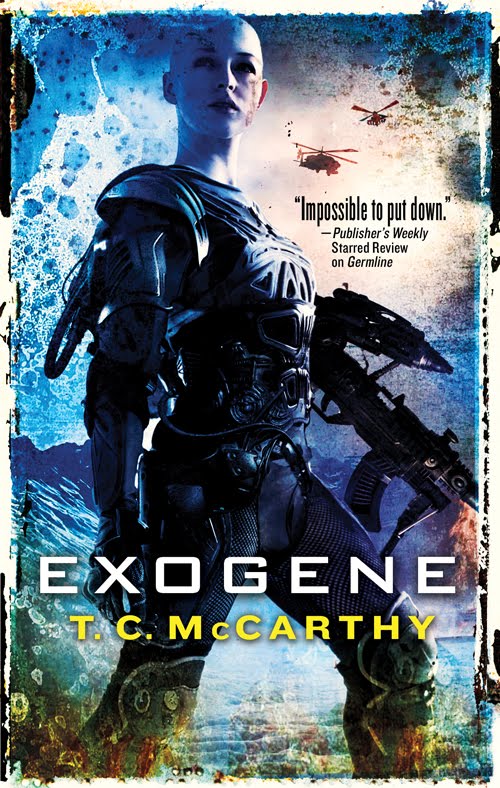
Exogene by TC McCarthySome people treat genre fiction as if it’s a dirty diaper – to be held at arms length and stuffed in a pail as soon as possible. At least that’s the impression I got on Friday, September 23rd. It all started when I went downtown to hand out fliers for my upcoming book signing and to let local representatives have free copies of my debut novel, Germline, because it seemed to me like civic organizations might want to help a local author. My expectations were a little unrealistic (see the moral of the story at the bottom)…

First stop: the Visitor’s Center, which my tax dollars support, and which I reasoned “would surely want to help a local author, especially considering not many local authors have had a shot at this kind of gig.” Not exactly. The lady behind the counter glared at me when I interrupted her knitting, and even my explanation that she could have a free copy of Germline if I could leave a few fliers for my book-signing did nothing to change her mood. She sighed and handed the book back. “Leave the flier with me,” she said, “I have no place to put them but maybe there’s room on the table outside.” OK, I thought, fine; so I tried to hand her a stack of fliers but she shook her head and went back to knitting; “I’ll only need one of those.”
Read More »
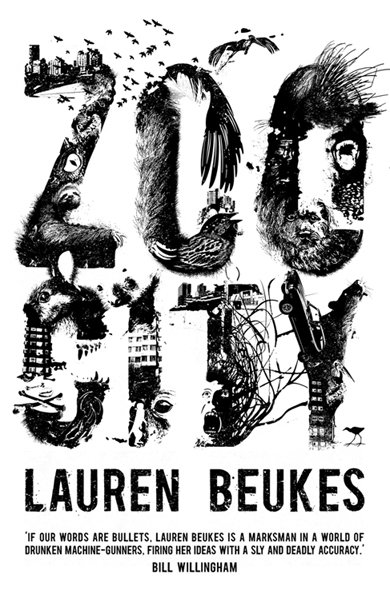
Zoo City by Lauren BeukesI’ve often joked about how much I need clones. But alas, like time machines and teleportation devices, photocopy-style human cloning just isn’t there yet (unless you believe the dubious claims of the Raelian cult). Luckily I’ve got something even better than an army of Laurenz: a collection of brilliant brains.

It would be neat if they were brains in jars, directly hooked up to word processors to churn out pages while I sleep, but I suspect that probably takes a lot of electricity and probably a mad scientist to maintain them – and mad scientists and their inevitable slobbering loathsome assistants cost a lot to feed.

So, nope. I’m talking the kind of brains that walk around in people casings – the kind that feed themselves because they have jobs and credit cards. And when it came to writing some of the additional materials for Zoo City, I was very happy to be able to raid those brains for their genius.
Read More »

Fabio FernandesWhen you write a story, what is the first thing that comes to your mind as an all-powerful, God-like creator? The world on which the action will take place or the characters?

Worldbuilding is both about the macro and the micro, you know – you must pay as much attention to one single person in your story as you would of the city you are creating or borrowing details from.

As I recently wrote for the Culture Share column in Juliette Wade’s blog, I have this recent story (still unpublished) called ‘The Remaker’. It’s based on a short story by Jorge Luis Borges, Pierre Menard, Author of The Quixote. My novelette basically tells the story of a researcher who discovers a future writer who revels in rewriting works by famous authors of the past, and how this can be done (and why someone even would do this) in the mid-21st Century.

One of the biggest challenges I faced in this story wasn’t creating the protagonist (a 60-year old scholar who still loves paper books in an all-digital era), not even his sort-of nemesis/antagonist (the Remaker of the title), but his girlfriend, who doesn’t appear in more than half a dozen pages, if that much.

Let me tell you what little the reader knows about her right in the beginning of the story: her name is Midori, she is a scholar on Gender Studies (a PhD), she met our protagonist in a conference in Canada, and they have a steady relationship, each one living in their own apartment in São Paulo.

She is also a transsexual.
Read More »

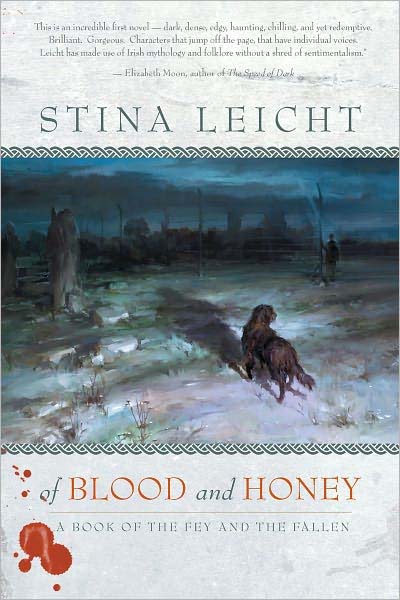
OF BLOOD AND HONEY by Stina LeichtAs much as I adore Fantasy, being a female and writing Fantasy has it’s drawbacks — particularly when you write Urban Fantasy. Conversations tend to go like this:

Party guest: “Oh? You’re a writer? What do you write?”

Me: “I write fiction. SciFi and Fantasy. Fantasy mainly.”

Party guest: “For kids?”

Me: “I write Fantasy for adults.”

Party guest: “Oh, you write erotica about tramp-stamped detective chicks and vampires.”

Me: “Um. No. I’m writing about Irish myth and the Troubles.”

Party guest: “Oh, you write erotica about tramp-stamped Irish chicks and fairies with butterfly wings.”

Me: [sigh]

I’ve never witnessed a conversation like the one above when the author in question is male. Writing for children is never brought up, let alone erotica. During my last signing at Barnes and Noble, I spent more than half my time explaining to customers that no, there aren’t any vampires in the book, the main character is male, and the only tattoos present on any character are prison tattoos. As much progress as has been made in SciFi and Fantasy circles* and in American society in general, we’ve still got a long way to go. So, let me get something off my chest here and now. As much as I’m okay with Romance’s interest in all things Fantasy, it can be, let’s just say, extremely frustrating for someone like me.

Because I don’t like Romance as a literary genre, and I never have.
Read More »

Of Blood and Honey by Stina Leicht

“It is one’s own daydreams that provide the mythopoeic power” – Joanna Russ

Last week I was fortunate to be part of an SF Signal panel that answered the question: “What was the last genre book that blew your mind?” There were a variety of titles chosen, and most of the discussion focused on telling other panelists and the listener what made each book “mind-blowing.” The books included Stina Leicht’s Of Blood and Honey, Paul Jessup’s Open Your Eyes, and Hannu Rajaniemi’s The Quantum Thief, each of which is a very different book from the others. As we discussed these books, I began to wonder how these books achieved this heightened status, and from there I began to contemplate the question: how does a work of literature “blow our mind?”

The concept that something can be “mind-blowing” is a recent one. The term became popular in the 1960s first to describe the experience of taking psychedelic drugs. As it proliferated in usage its application expanded, and eventually included anything that was startling or intensely affecting. It is now found in a variety of contexts, and has been used in fantastika in book titles, in discussions about the literature, and sometimes in relation to works that might not seem to fit the term. It is a term that relates to a type of encounter, but that is often subjective and used to communicate an intense personal experience to others in a way that sets them into a similar relationship to the source or effect that is “mind-blowing.”
Read More »