Posts Tagged: Science Fiction

Prisoners, Deserters,
and an Age of Heroes

I was a college freshman on 9/11. The events of that Tuesday morning kicked off the 21st century in the United States of America, and changed my life, as it changed the lives of so many young people of my generation in the USA and beyond.

9/11 started the “War on Terror,” two wars in the middle east, poured nitrous oxide into the burning engine of the United States’ national debt, and set the tone for the first decade of the 21st century in the USA, the first decade of my adulthood. I remember telling classmates that we needed to write to our representatives, ask that they not go and start a war over this, that we could do better.

I created an Individualized Major of Creative Mythology, with the aim of studying how myths and legends were structured, how the ur-stories of world cultures were formed.

When I arrived at Indiana University, I declared an East Asian Studies major. I wanted to learn more Japanese, study Japanese history, and go off and work for a video game company, or an anime company, or something involving that skill, and that interest. But after 9/11, I was flailing for meaning, desperate to find some way forward as the world very quickly spiralled away from the future I had expected. As members of my age cohort signed up for the armed services, to be analysts, anything to help, I looked back to Mythology, to hero legends, and in looking back, saw my path forward.

We make meaning out of stories – that’s what humans do. I needed to make meaning out of what was happening in my world, needed to imagine an alternative to the path that history was taking, to dream a brighter future. In spring of 2002, I created an Individualized Major of Creative Mythology, with the aim of studying how myths and legends were structured, how the ur-stories of world cultures were formed, so that I could make 21st century myths and legends to help point the way forward, to see through the cloud of ashes and confusion and anger left by the fall of the towers.

But 9/11 wasn’t the first time the WTC towers had loomed tall in my life, with their presence or their absence. Read More »
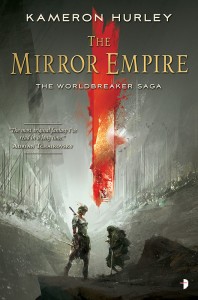
The Mirror Empire by Kameron Hurley

Publisher: Angry Robot Books - Pages: 544 - Buy: Book/eBook
Cover art for The Mirror Empire by Kameron Hurley

In the world of Kameron Hurley’s The Mirror Empire, where magic users draw their power from one of three heavenly satellites, a dark star is rising, one whose ascendance heralds a time of cataclysmic change and war between realities. For Lilia, who crossed from one world to another in childhood, fleeing the wrath of an alternate, militaristic version of the peaceful Dhai culture she now inhabits, this means discovering her mother’s hidden legacy before it can destroy her. For Akhio, the younger brother and now unexpected heir of Dhai’s deceased leader, Oma’s rise brings politicking and treachery, both from Dhai’s traditional enemies and from within his own state. For Zezili, the half-blood daijian general of matriarchal Dorinah, charged by her alien empress with exterminating the nation’s daijian population, it means an uneasy alliance with women from another world; women whose plans are built on blood and genocide. For Rohinmey, a novice parajista who dreams of adventure, Oma brings the promise of escape – but at a more terrible cost than he could ever have imagined. And for Taigan, a genderfluid assassin and powerful omajista bound in service to the Patron of imperial Saiduan, it means watching cities burn as invading armies walk between worlds with the aim of destroying his. How many realities are there? Who can travel between them? And who will survive Oma’s rise?

The Mirror Empire hooked me in from the very first page.

The Mirror Empire, the first volume of the Worldbreaker Saga, is Hugo Award-winning writer Kameron Hurley’s fourth novel, and from the minute I first saw the blurb, I knew I had to read it. The entire concept – backstabbing politics, polyamorous pacifists, violent matriarchs, sentient plant-monsters, doors between worlds – is basically my personal catnip, and when you throw in my enjoyment of Hurley’s first novel, God’s War, my expectations at the outset were understandably high. Which is ordinarily a risk factor: the more I invest in a story beforehand, the more likely I am to wind up disappointed. But The Mirror Empire, with its sprawling, fascinating mix of original cultures, political wrangling – both within the narrative and as cultural commentary – and vivid, brilliant worldbuilding, hooked me in from the very first page. The only reason it took me so long to read, in fact, was a personal reticence to have the story end: I’ve been drawing it out over weeks and months, prolonging the inevitable.

Read More »

Conversations with
My Favorite Author

“Guess how long the space ships are in this book!”

“Guess how long the space ships are in this book!”

The conversation often starts something like this. Sometimes it’s, “Guess how many different genders are in this world!” or, “Guess what Gwenna just discovered about Annick!”

I’m not the person asking. My husband poses these questions, and it is my job to answer them. If I don’t guess correctly, I’ll get another opportunity in a few minutes, a few hours, a day or two. When he’s reading a new book, each masterful bit of world-building is fodder for a conversation like this one. When he’s writing a new scene, each plot point or moment of character development is an opportunity for a pop-quiz.

“I don’t know,” I reply. “Half a galaxy long?” I think this is a plausibly impressive size, given his enthusiasm, given the volume and intensity with which he has asked the question. He knows that I cannot tell a furlong from a parsec, but he refuses to believe that a person can live in the world without understanding basic measurement and scale. Read More »

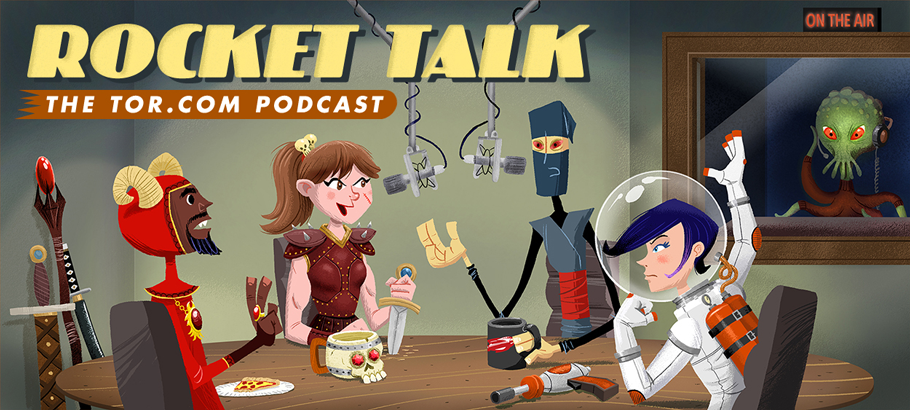
rocket-talk-banner

This week, I had the opportunity to join two good friends and fellow Hugo-nominees, Foz Meadows and Justin Landon (host), on Episode 24 of Rocket Talk. The three of us spent a lot of time together at LonCon 3, so we take the opportunity to discuss the convention, diversity in the fan community, the Hugo Awards, and even make a few book recommendations!

In this episode of Rocket Talk, Justin invites Hugo-nominated blogger Foz Meadows and Hugo-winning blogger Aidan Moher on the show to talk about their experience at Loncon3 and the Hugo Awards ceremony. Their conversation covers the convention itself, the winners and losers of the Hugo Award, the nature of fandom, how fandom is evolving, and finishes with a few book recommendations for the voracious genre reader.

Listen to Episode 24 of Rocket Talk on Tor.com

or

Subscribe on iTunes

Near the end of the episode, Justin, Foz, and I all recommended some novels. My recommendations were:

  • City of Stairs by Robert Jackson Bennett (my favourite novel of 2014 so far)
  • The Eternal Sky Trilogy (beginning with Range of Ghosts) by Elizabeth Bear

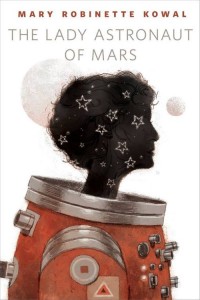
The Lady Astronaut of Mars by Mary Robinette Kowal

Publisher: Tor.com - Pages: 31 - Buy: Book/eBook

Editor’s Note: This review is spoiler-heavy. If this bothers you, please go read “The Lady Astronaut of Mars” on Tor.com, then return. Spoilers: it’s worth it.

Science fiction offers many things to readers. It allows them to be transported to another time, to wonder about the future, to see sights and visit worlds that are currently out of human reach. To writers, it provides a canvas that begs for speculation, to take issues that challenge us individually and as a society and examine them through a lens warped by time, imagination, and creative license.

Mary Robinette Kowal’s “The Lady Astronaut of Mars”, which recently won the Hugo Award for Best Novelette, is, on the surface, a wonderful and charming tale of an alternate history where NASA reached Mars during the ’50s. Peel back the layers, however, and Kowal’s Martian colony is alive with questions of aging, loyalty and family. Though she never quite provides answers, Kowal challenges readers to contemplate these themes that run through all our lives. Read More »