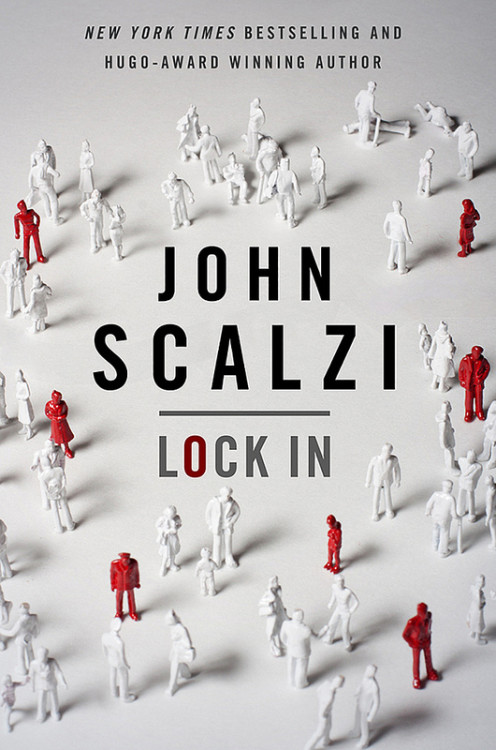
Say one thing for John Scalzi, he gets some damn fine covers from his publisher. Scalzi describes the book as ‘a near-future thriller involving a disease that causes people to be “locked in” inside their own bodies,’ and indicates that he feels the cover captures this essence. Irene Gallo, Art Director at Tor Books, describes the creation of the cover, ‘You can often describe an art director’s job as being a match-maker for author and designer and the John/Peter pairing has been a good for us. […] Peter [Lutjen] created a cover that expressed both their isolation and connectivity by painting tiny train model people.’
Tor.com has the first official synopsis of the novel:
Fifteen years from now, a new virus sweeps the globe. 95% of those afflicted experience nothing worse than fever and headaches. Four per cent suffer acute meningitis, creating the largest medical crisis in history. And one percent find themselves “locked in”—fully awake and aware, but unable to move or respond to Stimulus.
One per cent doesn’t seem like a lot. But in the United States, that’s 1.7 million people “locked in” …including the President’s wife and daughter. Spurred by grief and the sheer magnitude of the suffering, America undertakes a massive scientific initiative. Nothing can restore to the “locked in” the ability to control their own bodies. But two new technologies emerge. One is a virtual reality environment, “The Agora,” in which the locked-in can interact with other humans, both locked-in and not. The other is the discovery that a few rare individuals have brains that are receptive to being controlled by others, meaning that from time to time, those who are locked in can “ride” these people and use their bodies as if they were their own.
This skill is quickly regulated, licensed, bonded, and controlled. Nothing can go wrong. Certainly nobody would be tempted to misuse it, for murder, for political power, or worse…
Lock In, which Scalzi is in the processing of completing at the time this cover was revealed, is due for publication on August 26th, 2014.

Today, Tor.com announced Some of the Best From Tor.com, 2013 Edition, a collection of fiction published on Tor.com over the past year. In a statement about the release, Tor.com said:
We are thrilled to announce the 2013 edition of Some of the Best from Tor.com, an anthology of twenty-one of our favorite stories, selected from the sixty-plus stories we published this year. This anthology is available world-wide through all major ebook retailers.
These stories were acquired and edited for Tor.com by Patrick Nielsen Hayden, Ellen Datlow, Ann VanderMeer, Liz Gorinsky, George R. R. Martin, Noa Wheeler, Melissa Frain, and Claire Eddy. Each story is accompanied by an original illustration.
This is the second volume in Tor.com’s anthology series, the first of which covers the entirety of the site’s first five years. It’s one of the most impressive short fiction collections available.
The table of contents, all of which are available to read for free on Tor.com:
Table of Contents
It’s my opinion that Tor.com is one of the finest publishers of genre short fiction, in print or electronically, and a curated collection of some of their best stories is sure to be full of quality. Get Some of the Best From Tor.com, 2013 Edition: eBook
On a rural, backwater ice planet, the individual known as Breq is searching for a weapon that shouldn’t exist when her quest yields an unexpected find: Seivarden, a former lieutenant aboard the Radchaai ship Justice of Toren, dying alone in the snow. But Seivarden ought to have been dead for centuries – and Breq should know, as she used to be Justice of Toren, a powerful AI controlling not only a warship, but thousands of once-human ancillary bodies repurposed as Radchaai soldiers. Now, confined to just one body, Breq has a single plan: to take her vengeance on Anaander Mianaai, the many-bodied leader of the Imperial Radch. But when she takes Seivarden under her wing, the decision proves to have dangerous consequences for both of them: for Seivarden is an addict, untrustworthy and desperate, and Breq is pitting herself against the most powerful person in the galaxy.
Sometimes, books sneak up on you. They’re like papery leopards lurking in the darkness, unseen and unheard, until – WHAM! Suddenly you’re pinned to the lounge beneath several hundred pages’ worth of sleek, muscular prose gloved in velvet plotting and set off by a hypnotic, staring premise. This is what happened to me with Ancillary Justice, a book I bought – rather oddly, in hindsight – after seeing it given a rare double ten out of ten by The Book Smugglers, but without having actually read the review itself, meaning that I came to it with an expectation of quality, but lacking any notion of what it was actually about. Read More »
I’ve recently been thinking of science fiction as literature of the moment, an examination of how we look at the world and all of the many changes that pass us by. Given the state of the world, military science fiction has long struck me as a way to make sense of the global impact of the ‘war on terror’ and other related actions across the world.
Rugged individualism and a sense the edge of the world is an opportunity, no matter who’s already there.
Predominantly, Military Science Fiction as a distinct subgenre comes out of works published in the 1950s by American science fiction authors, namely Robert Heinlein and Gordon R. Dickson, whose respective books Starship Troopers and Dorsai!, have spawned an entire industry of imitators. Steeped in the fears of the Cold War, these novels were written at a time when global annihilation appeared imminent, held back only by the raw power held by the United States Armed Forces and the inherent greatness of the American way. This lines up strongly with other trends one sees in American strains of Science Fiction: rugged individualism and a sense that the edge of the world is an opportunity, no matter who’s already there.
Science fiction tends to carry along its baggage for a long time. While there’s been an incredible evolution of outstanding stories, the genre’s frequently saddled with a pulp characterization; the incredible changes from the so-called Golden Age to the New Wave and beyond simply doesn’t register. Military SF, in many ways, has a similar history: it remains, in many people’s minds, a relic of the 1950s, when the Cold War raged between the politicians and armies of the US and USSR. In retrospect, it’s appears to be a simpler conflict than what we face today. Read More »
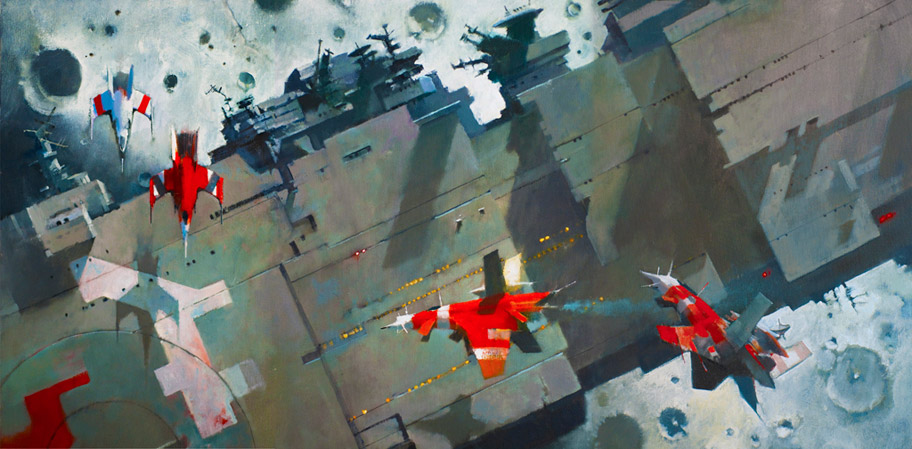
Ancillary Justice, the debut novel from Ann Leckie, first caught my attention thanks to its gorgeous John Harris cover art. It was hard to escape, and, frankly, antithetical to the idea that one shouldn’t judge a book by its cover. With a cover this good, it’s hard not to be immediately interested. Skip forward a few weeks, and Orbit Books, publisher of Ancillary Justice, noticed a trend on twitter: everybody loves Leckie’s book. And, by golly, they’re right.
So, naturally, I had to see what all the fuss was about, and picked up Ancillary Justice myself. They were right, they were so, so right. I’ll withhold my full opinion for a review, but Ancillary Justice is a bold, mind-twistingly adventurous SF tale with big ideas and so much confidence that it’s hard to believe it’s Leckie’s first novel. Come award season, I wouldn’t be surprised to see Leckie and Ancillary Justice all over the ballots. It’s that good.
So, I’ve gathered together some of the early reviews that nail exactly why I’m so excited about this book (and why I think you should be, too. Orbit’s had huge success with James S.A. Corey’s Expanse series, and it looks like they’re about to add another heavyweight to the mix with Leckie. It’s a damn good time to be an SF fan. Read More »