Posts Tagged: Science Fiction

FirstbornDefendingElysium

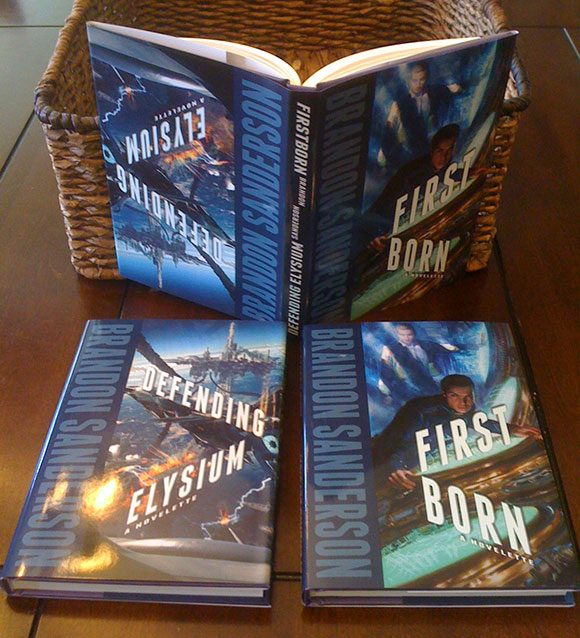
Brandon Sanderson’s a pretty cool guy. He’s generous with his time. Writes at a pace envied even by court transcribers. And writes some pretty cool books. On top of this, he’s a passionate Science Fiction and Fantasy fan, and he’s showing these roots with a new project that he’s put together for his fans. It’s a tête-bêche collection of two novellas, Defending Elysium and Firstborn, doubled up in the style of the old Ace Doubles series: two novels, back-to-back. And, man, it’s sexy.

It’s also interesting for fans of Sanderson, who is best known for his Epic Fantasy, to experience his take on Science Fiction. Firstborn is available to read for free on Tor.com. Sanderson explains why he chose such a unique format for his novellas:

The technical term for this kind of book layout is tête-bêche meaning “head-to-toe,” which indicates that the book has two front covers and no back cover; flip the book upside down to get the other story. When you reach the end of one story, the next page is the last page of the other story, upside-down.

Anyway, I’ve been wanting to get these novelettes out in print form for a while, and due to their length putting them together seemed like the best idea. Plus I’ve always thought Ace Doubles were cool. (These were classic SF novels put out in tête-bêche paperbacks by the publisher Ace.)

The “Firstborn” cover reprises Donato Giancola’s excellent illustration that he painted for the Tor.com version, and the “Defending Elysium” cover features an illustration by Dragos Jieanu (check out his website and his DeviantArt profile). (If you like his stuff, consider donating to the Chance for Life Foundation, a Romanian charity he supports.) The cover design is by Isaac Stewart, and the book design is by Peter Ahlstrom.

It’s terrific to see Sanderson using the freedom afforded to him by his success and popularity to assemble such a great keepsake for his fans. He promises to make them available on his website, for $17.99, but only if there are copies left after his run through the convention circuit. Good odds on them not lasting so long. I’d love to get my hands on a copy, but, well, I doubt it’s in the cards. Really lovely idea.
Star Wars

According to The Verge, Disney is planning to release a new Star Wars film every summer for five years. This schedule will begin with Episode VII in 2015, VIII in 2017, and IX in 2019. Sandwiched between these releases will be standalone films, presumably starring some of the series’ more popular characters (Yoda, Han Solo and Boba Fett have all been rumoured.

Thoughts?

You Are Reading an Essay: How Metafiction Can Alienate Readers by Adam Callaway

The birth was messy. Sweat, blood, tears, and cerebrospinal fluid slicked the white tile. Dirty forceps, scalpels, and fountain pens were strewn haphazardly. In a pail of ink, a half-formed idea wailed. The thought-doctors could only guess if it would make it.
–From Skull Born, the very first (and thankfully unpublished) Lacuna story

Metafiction, at its most basic, is fiction about fiction. This can take a variety of forms. Everything from John Barth’s Lost in the Funhouse to Carlos Ruiz Zafon’s Shadow of the Wind, can be considered metafiction.

Stories about storytelling have always interested me. An early influence on my writing were Walter Moers’ Zamonia books, specifically The City of Dreaming Books. In it, he imagined a decadent, surreal wonderland of writers, publishers, and booklovers. Books and stories literally came alive and posed serious dangers to the citizens of Bookholm.

The first Lacuna story was more-or-less Bookholmian fan fiction as seen through the eyes of China Mieville. It was very metafictional, with book ideas being torn from the skulls of writers in a bizarre send-off of a birthing ritual. These idea-babies were fed books, poems, emotions; anything to make them more robust. Literary devices manifested as physical deformities on the idea-husk. They would develop into golemic mandrake roots of pulp and story. Once they became large enough, the authors would consume the idea, go into a trance-like state, and write an entire manuscript in one sitting. Read More »

Hugo Awards LogoOn the back of Justin Landon’s provocative thoughts on the 2013 Hugo ballot, the past 48 hours has produced several thoughtful responses, some in favour, some against and some carving their own path to find answers to the Hugo ‘problem’ (if such even exists). My thoughts are here. Here I’ve gathered together some of the responses complement and balance out Landon’s article and the resulting discussion (nearing a staggering 200 comments at the time of writing this).

In particular, Vixyish and Lavie Tidhar both encouragingly suggest that we should not be focussing on the issues of blockvoting and ‘the old guard’ (as the SMOF crowd is sometimes affectionately called), but rather on the ethnic and gender diversity that is beginning to appear on the ballot of what has traditionally been a very staid and conservatively white/male award. Lots of food for thought.

So, onward. Read More »

Hugo Awards LogoSo, Hugo Award nominations. Every year, it seems to be both an invitation to bellyaching among those who want the award to take itself more seriously, to again become a fair and trustworthy snapshot of the genre’s best year-in-and-year-out, and an everybody-hug-circlejerk-ignore-the-trolls-you-deserve-this-i-voted-for-you twitter fun factory between nominees. Fun times, especially for frustrated Internet pundits like myself. This year’s ballot was particularly blah, though. I won’t go through each category because, well… I don’t have an opinion on a lot of it. But there are a few spots I’d like to explore.

My first thought on the list of nominations for the ‘Best Novel’ was a tepid lack of inspiration. The inclusion of Ahmed’s Throne of the Crescent Moon (REVIEW) is the lone bright spot, and also the only novel from my list of nominations to appear on the final ballot. Redshirts (REVIEW) is entertaining, but no more worthy of a Hugo than a fourth-or-fifth episode of Dr. Who appear in the ‘Best Dramatic Presentation (Short Form)’ category; I’m not surprised to see it there, but I am disappointed that another of Scalzi’s wash, rinse, repeat efforts was rewarded with a nomination. The novels from Bujold and Grant are included, for all intents and purposes, because of the name on their cover, rather than the text inside. I’m sure they’re both fine novels, but neither made waves in fandom or genre discussion this year. Kim Stanley Robinson is another Hugo darling, and 2312 was at least a significant release in Science Fiction, which, alongside David Brin’s Existence (a novel that some will should have been included instead of Robinson’s), reopened a style of hard Science Fiction that has a long legacy in the genre but little recent activity. Read More »