Posts Tagged: Short Fiction

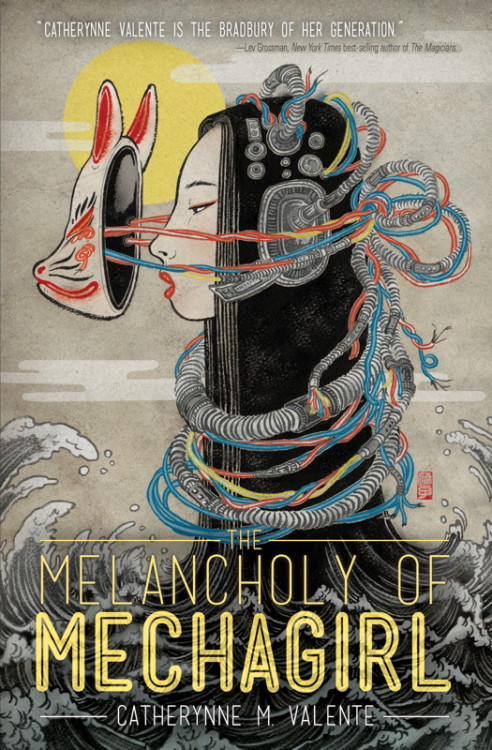
The Melancholy of Mechagirl features fantasy-inspired short fiction by Valente about Japan, including the Hugo Award-nominated novella Silently and Very Fast and “Thirteen Ways of Looking at Space/Time,’ both of which were originally published in Clarkesworld Magazine. She described ‘The Melancholy of Mechagirl’ as ‘a philosophical confessional poem about anime and giant robots.’ Fans of The Melancholy of Haruhi Suzumiya, a popular anime, will recognize the name. You can read it in Issue 26 of Mythic Delirium. Valente lived in Japan for a number of years, and the people and stories of the country are deeply rooted in much of her fiction. She discussed her relationship with Japanese culture in a 2006 interview with Bookslut:

How did living in Japan affect your writing and your life?

Oh, that’s a big question! I think Yume no Hon is probably one long answer to it, but I’ll give it a shot here.

Japan was very hard for me — my husband, a naval officer, was gone for 19 out of the 25 months we lived there. I was alone in an extremely alien culture, unable to speak the language, without friends or family. I lived alone with my dog and wrote. It was as close to a garret as you can get in the 21st century. I had never experienced loneliness like that before, and I’ll probably be processing it for awhile yet.

However, I came to interact with Japanese culture on my own terms, relatively stripped of the assumptions fostered stateside by anime and other memetic exports. I found my own way to loving it, and though it is a hard-won love, I won’t lose it soon. I lived like a hermit for a year and a half — if you don’t come out of that with some kind of zen, you go crazy.

So instead I wrote. And a lot of what I wrote in that time involves Japanese culture, because that was what I lived with every day. I wrote a novel about a lonely woman slowly losing her mind — not a very subtle allegory, I’ll admit — and another about the Shinto creation myth, and quite a lot of poetry. As a white woman living there, my relationship to Shinto was divided at best — I felt very strongly about it, and traveled all over to visit shrines, yet I always felt like an outsider, which is perhaps appropriate. The gaze of the outsider is part of all of my work, I think.

Part of me will probably always be in Japan, but it will be awhile before I write another Japanese novel. There are always new worlds to devour.

She speaks further about Japan, and particularly the Shinto religion, in an interview with Clarkesworld:

The mythology of Japan will always be with me—the Shinto faith, the syncretic culture, the jungle right up close to the urban sprawl. Some part of me will always be there, always looking for fox-statues in the forest, watching the jellyfish suck at the sides of boats in the harbor. I will never stop being fascinated by it, and processing what it means in relation to me and my work and my internal landscape. It was a hermitage, and I learned all the things good hermits are supposed to learn: how to be alone, how to quiet demons, how to sweep the halls and keep the wolves at the door.

Japanese history and mythology is rife with many stories and themes that resonate through the Fantasy genre. It’s wonderful to see authors like Valente, and collections like this in particular, celebrate a facet of myth and Fantasy that isn’t so beaten to death as the Euro-American stuff, particularly faux-Medieval England. Since learning as a kid that a lot of videogames came from Japan, I’ve been mildly obsessed ever since. This is right up my alley.

And, good golly, that cover art. I said that Joey Hi-Fi should take home an Inky Tentacle for his cover for The Lowest Heaven. He’s not eligible, so, damnit, let’s give the award to The Melancholy of Mechagirl, shall we? Artist Yuko Shimizu certainly deserves some applause for her body of work. Absolutely stunning stuff.

The Melancholy of Mechagirl will be released on July 16th, 2013 by VIZ Media LLC. It is currently available for preorder.

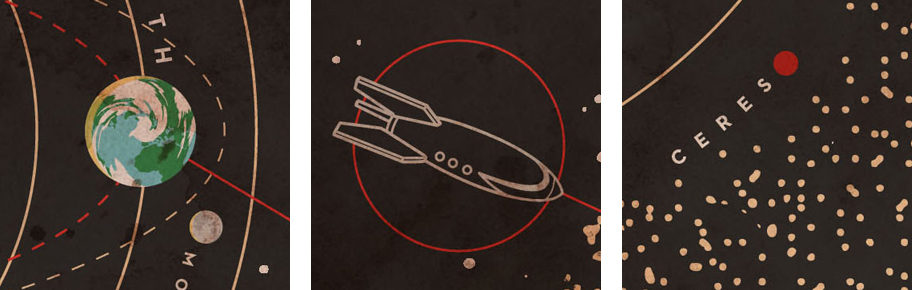
The Lowest Heaven, edited by Anne Perry and Jared Shurin The Lowest Heaven Details, art by Joey Hifi

Each story in The Lowest Heaven is themed around a body in the Solar System, from the Sun to Halley’s Comet. Contributors include Alastair Reynolds, Kaaron Warren, S.L. Grey, Lavie Tidhar, Jon Courtenay Grimwood, Sophia McDougall, Maria Dahvana Headley, Adam Roberts, E.J. Swift, Kameron Hurley and Doctor Who’s Matt Jones.

The stories are illustrated with photographs and artwork selected from our world-class collection, while the book’s cover and overall design are the work of award-winning South African illustrator Joey Hi-Fi. Joey has provided us with an exclusive Q&A about how he created the design for the cover artwork.

In collaboration with Royal Museums Greenwich, Jurassic London is publishing this anthology on June 13th, 2013 to celebrate the mysteries of our solar system. I’m a great fan of what Perry and Shurin are doing at Jurassic London, and this appears to be one of their most accomplished publications yet. In discussion with the, artist Joey Hi-Fi, explains where the idea for map-styled art originated,

With The Lowest Heaven being an anthology, the brief was to create a piece of artwork that would tie all the stories together. Since the book features stories based on various celestial bodies in our Solar System – creating a bespoke solar system map seemed like an interesting way to do that.
Plus, having a fascination with all things cosmic (bordering on Kosmikophilia), I couldn’t resist. I used to draw maps of alien solar systems as a kid – peppered with space battles of course. So this is a childhood dream come true.

I was inspired by the wall hangings in the National Maritime Museum collection. These were produced by the Working Men’s Educational Union in the 1850s and based on astronomical themes. The hangings were printed lithographically on cotton, which gives them an interesting appearance. I liked their simple, yet striking design. One in particular (see jpeg) formed the basis of my design.
I just took a more modern approach – if you can call it that. My map has more of a 1950s aesthetic as opposed to one reminiscent of the 1850s.

It’s… gorgeous. Ethereal, mysterious, adventurous and worthy of hanging on a wall. Now, the big question is, can The Lowest Heaven, published by Jurassic London, which is co-founded by Jared Shurin and Anne Perry, the same duo behind the Kitschies, win an Inky Tentacle at the Kitschies for ‘Best Cover Art’? ‘Cause, well, there’s a damn good chance that it’ll deserve it. I’ve said it before recently, and I’ll say it again, I’d be hard-pressed to find a current cover artist who’s doing better, more consistent, and astonishing work than Joey Hi-Fi. Everything the guy touches is golden.

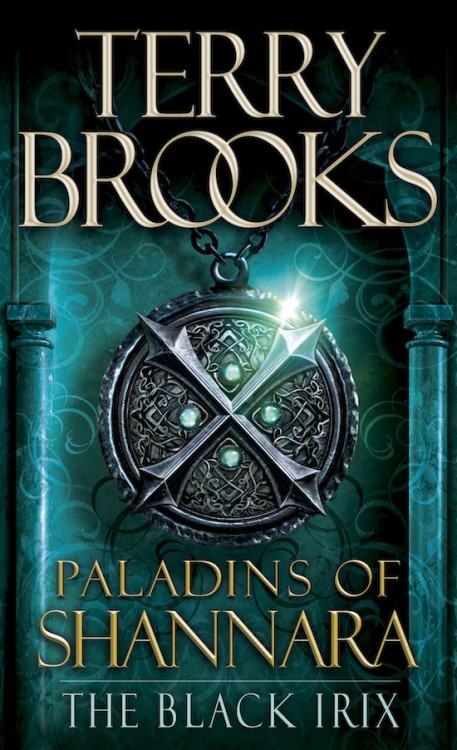
The Black Irix by Terry Brooks

Shea Ohmsford has had quite enough of quests. A year after surviving a harrowing odyssey, he is still plagued by troubling memories and dreams. A mysterious trafficker in spells and potions provides a restorative nostrum for the stricken Shea . . . along with a warning: Shea will break his vow to never again leave Shady Vale. And then the potion-maker’s prophecy comes to pass.

A thief, adventurer, and notoriously charismatic rogue, Panamon Creel unexpectedly appears in the Vale with a request for his long-time friend, Shea—journey into the untamed Northland, infiltrate the stronghold of a sinister dealer in stolen goods, and capture a precious artifact: the sacred Black Irix. Creel wishes to return this treasure to its rightful owners. Shea cannot refuse such a just cause. But what lies behind the black castle walls they must breach? And will this quest truly be their last?

This sounds kind of fun. Especially for Brooks fans who have stuck it out with his novels, through all the ups-and-downs, since his 35-year-old debut, The Sword of Shannara, which ‘The Black Irix’ is a direct sequel to. As Brooks returns to fan-favourites to tell a series of short stories set in his Shannara world, the Four Lands, it has been an enjoyable opportunity to rejoin old characters who Brooks hasn’t written of in years. Panamon Creel is one of the high points of The Sword of Shannara, and revisiting him on a crazy adventure is something fans have looked forward to for years. And this adventure seems kinda crazy. I mean, Creel’s decision to enlist Shea Ohmsford who, even after the end of The Sword of Shannara, is still a fairly typical and inexperienced inn-keeper’s son, is questionable, but the dynamic between Creel and Ohmsford has always been fun.

It’s also interesting to see that Brooks is exploring an area that is often left untouched by Fantasy writers: the repercussions, especially emotional, of untrained civilians (esentially) being thrust into dangerous, traumatic experiences. Myke Cole recently wrote a terrific essay on PTSD, and I think it’s encouraging to see someone like Brooks set a story in the uncomfortable aftermath of his hero’s ‘victory.’ It’s also somewhat amusing to see, after all the criticisms of Brooks’ first novel, that post-Sword of Shannara Shea Ohmsford suffers from something of the same ailment that eventually led Frodo Baggins to seek the Undying Lands at the end of Lord of the Rings. I guess Brooks just can’t get away from that story, no matter how hard he tries.

In all, I’ve been pleasantly surprised by the first two volumes in Brooks’ Paladins of Shannara collection, particularly ‘The Weapon Master’s Choice,’ and look to ‘The Black Irix’ with some excitement and disappointment. I’ll be sorry to see Brooks leave this concept behind. It’s been nice to revisit old friends from my youth.

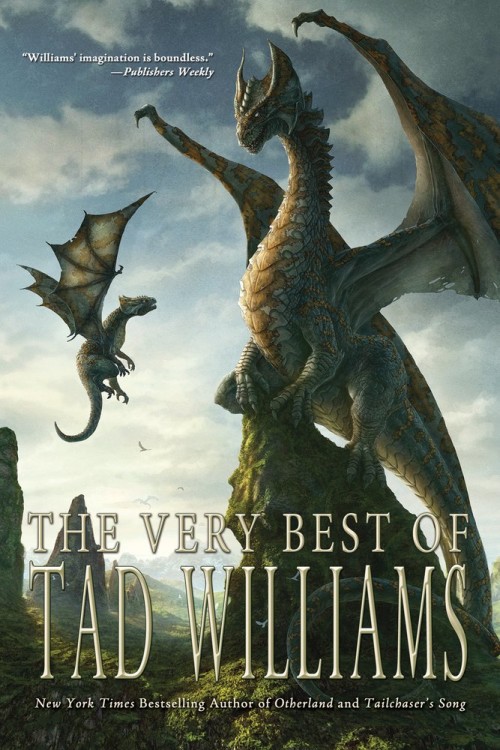
Cover Art for The Very Best of Tad Williams Art by Kerem Beyit

If you’re read this blog for any length of time, you’ll know that I’m something of an unabashed Tad Williams fanboy. He’s best known for his long (long, long, long) fiction, like Memory, Sorrow and Thorn or Otherland, multi-volume epics that would make most other authors weep at their length, but it’s often overlooked that some of his most finely crafted and powerful fiction is actually found among his shorter works. If this collection, coming from Tachyon, is, indeed, the ‘very best’ of his work, readers are in for a treat. The art on the cover is by Kerem Beyit, and is just lovely.

Clarkesworld40500On Friday, February 22nd, it was announced my Neil Clarke, editor of Clarkesworld Magazine, that the well-regarded Speculative Fiction magazine will be adding a new reprint section, headed by Gardener Dozois, an equally well-regarded anthologist.

The official press release details the additions:

Clarkesworld Magazine, a leading science fiction and fantasy magazine, has named award-winning editor Gardner Dozois (pronounced “doe-zwa”) to helm its new reprint department. In his role as reprint editor, every month Gardner will draw upon forty years of experience to select two exemplary science fiction stories published during the last three decades. The first of these stories are scheduled to appear in the April 2013 issue of the magazine’s online, digital and print editions.

“Since my heart attack last year, when readers responded with encouragement and support, I’ve been trying to find a way to say ‘thank you’,” said Neil Clarke, Clarkesworld Editor-in-Chief. “The reprint department had been on our wish list for some time and when the opportunity to work with someone of Gardner’s caliber arose, I knew I had found the perfect way to express my gratitude.”

Clarkesworld has long been one of my favourite SF magazines and it’s wonderful to see them joining together with someone like Dozois. With John Joseph Adams at Lightspeed, Ann VanderMeer and Ellen Datlow at Tor.com, and Johnathan Strahan at Eclipse, it’s interesting to see some of today’s best short fiction editors continuing to become as important to online markets as they are to the long-running tradition of print anthologies.