Posts Tagged: Tor Books

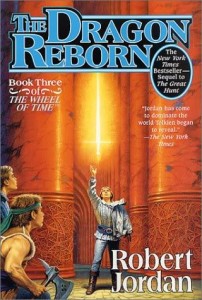
The Dragon Reborn by Robert Jordan

Publisher: Tor Books - Pages: 704 - Buy: Book/eBook

One of the interesting things about this re-reading project of mine is discovering how I have changed as a fiction reader and, to a lesser extent, as a critic over the course of the past decade or so. As I remarked in my reviews of The Eye of the World and The Great Hunt, some of the elements that used to irritate me greatly were not as noticeable this time around, while other plot and characterization issues that I had dismissed during my first few reads of the series seemed to be more visible during this current re-read.

One thing that I focused on as soon as I began this re-read was the notion that this massive twelve-volume series (and counting) could be divided into distinct narrative arcs. In particular, I was curious to see if the first three volumes might differ in their plot structures and presentation from succeeding volumes. To an extent, there is indeed an interesting interplay between these three early novels that I have not seen during my current re-reading of the fourth volume.

Seeing [Rand] struggle to fight for control of his double-edged magical powers through his actions and failures […] was a refreshing change.

The Dragon Reborn opens several weeks, if not months, after the Battle of Toman Head that concluded The Great Hunt. Rand al’Thor, who has now successfully fought off the EVIL Ba’alzamon, the presumed Dark One in this Manichean-style cosmos, twice in the previous two volumes, is still struggling to deal with the revelations of the past year. Born gifted/cursed with awesome power that is tainted for males, Rand constantly frets in the early chapters about his “destiny” as the reincarnated Dragon Reborn and the belief that the apocalyptic Last Battle was drawing nigh. Although Jordan continues to lapse into lengthy descriptive passages that fail to let the characters illustrate their conflicts through their actions, I found myself being more drawn into Rand’s plight that I ever remembered being when I last read this book a decade ago. Seeing him struggle to fight for control of his double-edged magical powers through his actions and failures more than through his internal monologues was a refreshing change. Read More »
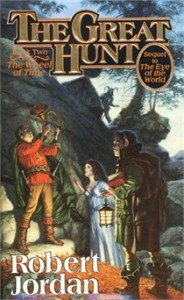
The Great Hunt by Robert Jordan

Publisher: Tor Books - Pages: 705 - Buy: Book/eBook

Last week, I prefaced my commentary-like review of the first Wheel of Time book, The Eye of the World, with explanations as to why I was embarking on this re-read project after a decade-long break. It would be redundant to repeat all of that, so if you have not yet read the original review, I suggest you start with that before reading this second, shorter review of the second volume in the series, The Great Hunt.

When I first read this book back in November 1997, I found it to be a major step backwards from the first novel. In the few re-reads I did between then and the autumn of 2000, I recall that my opinion of the book (and the third volume, The Dragon Reborn) did not improve at all. But what impressions would I take after reading it nearly ten years later?

Several of the same problems that I felt plagued the first volume were pretty much repeated in this second volume[, yet] despite this, in some ways, this story was more enjoyable than I had remembered it being a decade ago.

On the whole, I would still argue that The Great Hunt was a less enjoyable reading experience than was The Eye of the World. Several of the same problems that I felt plagued the first volume (too lengthy personal descriptions of minor characters, an uneven pace to the plot(s), the thin characterizations of the major characters and even more importantly, the enemies, the rather pedestrian prose) were pretty much repeated in this second volume, with a few curious additions. Yet despite this, in some ways, this story was more enjoyable than I had remembered it being a decade ago.

The story picks up roughly one month after the conclusion to the first novel. Rand al’Thor, one of three adolescent males from the backwater village of Emond’s Field, has discovered that he can touch the magical, tainted male side to the magical One Power (which runs the universe, in a way that I wonder might be analogous to the “dark matter” that makes up most of the universe’s mass). Furthermore, he may be the reincarnated soul of the dreaded Dragon Reborn, who in madness helped destroy civilization after a ten-year battle with the forces of evil. Rand is the hero (villain?) of prophecy, a mantle he does not want and makes quite clear, in both internal monologues and in conversations with characters, on numerous times. As I was reading this, I kept wondering to myself if perhaps the author went a little overboard with utilizing repetitive comments to reinforce the centrality of Rand’s conflict. It felt a bit forced at times to me and I cannot help but to speculate how differently (and perhaps, how much more powerfully) a reduction in the times Rand (and to a lesser extent, the other character and their own personal crosses which they bear quite vociferously) has to put voice to his conflicted thoughts. Read More »

A Journey From the West by Max Gladstone

Fantasy should be the broadest genre in existence. Fantasy writers get to create and transform to our hearts’ content. Not even the laws of thermodynamics bind us. Our imaginations are our only limits.

The problem is, the imagination’s limits are often harder than physical law. Writers are formed by experience, and interpret that experience into story using instincts developed reading, and hearing, stories, from early childhood. So, when a lot of Western folks turn to writing fantasy, Arthurian and Greek and Norse myths are the seeds they use to people and structure their imaginative worlds.

Which is fine! Each generation needs to remake the myths received from the previous generation. But sometimes writers and readers feel the limits of their traditions, and wonder, what else is out there, other than kings and earls?

In this three-part series I’m going to be writing about stories I think all fantasy writers and fans should know, other than the standard Celtic, Greek, and Norse sources. If you know these stories already, then good! I hope there’ll be something cool for you here anyway. If these stories are new to you, maybe these few posts will expose you to some amazing worlds. Read More »

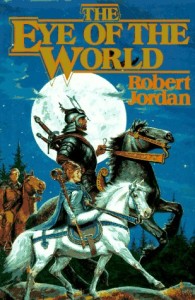
The Eye of the World by Robert Jordan

Publisher: Tor Books - Pages: 832 - Buy: Book/eBook

Editor’s Note: The release of A Memory of Light by Robert Jordan and Brandon Sanderson brings to conclusion the long-running, much-lauded and oft-criticized Wheel of Time series. To mark this event, I’ve invited Larry Nolen, editor of The OF Blog, to republish his reviews of the entire series, one a week for fifteen weeks, on A Dribble of Ink. I consider Nolen to be one of the best online reviewers of Fantasy and Science Fiction, and his reviews of Wheel of Time, in the form of a ’10 Years Later’ re-read leading up to the release of The Gathering Storm, to be some of the most lucid and fair critical analyses of the series available online. You might not always agree with his reviews, but I think you’ll find yourself thinking about the Wheel of Time in ways that might surprise you. So, enjoy. -Aidan Moher

The Wheel of Time turns, and Ages come and pass, leaving memories that become legend. Legend fades to myth, and even myth is long forgotten when the Age that gave it birth comes again. In one Age, called the Third Age by some, an Age yet to come, an Age long past, a wind rose in the Mountains of Mist. The wind was not the beginning. There are neither beginnings nor endings to the turning of the Wheel of Time. But it was a beginning. (p. 1)

For tens of millions of readers, the above passage will be quite familiar. For the past twenty years, Robert Jordan’s Wheel of Time series has been one of the most popular epic fantasy series to be released, with sales of well over forty million copies for the thirteen main volumes, one novel-length prequel, and a related encyclopedia/artbook. It is a series that has legions of devoted fans, tens of thousands of whom have created websites, argued passionately (and some might wonder, pointlessly?) over various minutiae found within this sprawling multi-volume work, and several hundred at least who have named babies after characters or who have had tattoos of emblems found within its pages. However, this series perhaps has drawn one of the largest anti-fan crowds in a subgenre that is littered with negativity and borderline psychotic outbursts directed toward those who do not share in the perpetrator’s hatred for that series (or most any other series). Various forums devoted to discussing epic fantasy series have seen thousands of threads over the years devoted to the question of whether or not Jordan was a “sellout” and to analyzing (sometimes focusing more on ad hominem comments than actual constructive criticism) just where the series jumped the shark and why.

I certainly was no fan of the author’s prose, his characterizations, and my interest in the setting he created dissipated the more I considered the structure behind his constructed mythologies.

I myself began reading the series in November 1997 as a way of relaxing my mind during the brutal written and oral exams for my MA in History. I read the first seven volumes in paperback that year and proceeded to re-read them a few times over the next three years. Read the eighth volume, The Path of Daggers, upon its October 1998 release and I began to wonder what was actually transpiring here. Purchased the ninth volume, Winter’s Heart, upon its November 2000 release and I was so disinterested by the time that I read it that I never read any of the first volumes since then and have read the latest three volumes only fairly recently (2006 for the tenth volume, which was read more so I could write a series of satirical posts rather than because I actually wanted to know what was transpiring there, and 2009 for the last two volumes, since I was receiving a review copy of the latest volume a week before the official review date). While I was not a rabid detractor, I certainly was no fan of the author’s prose, his characterizations, and my interest in the setting he created dissipated the more I considered the structure behind his constructed mythologies. Read More »

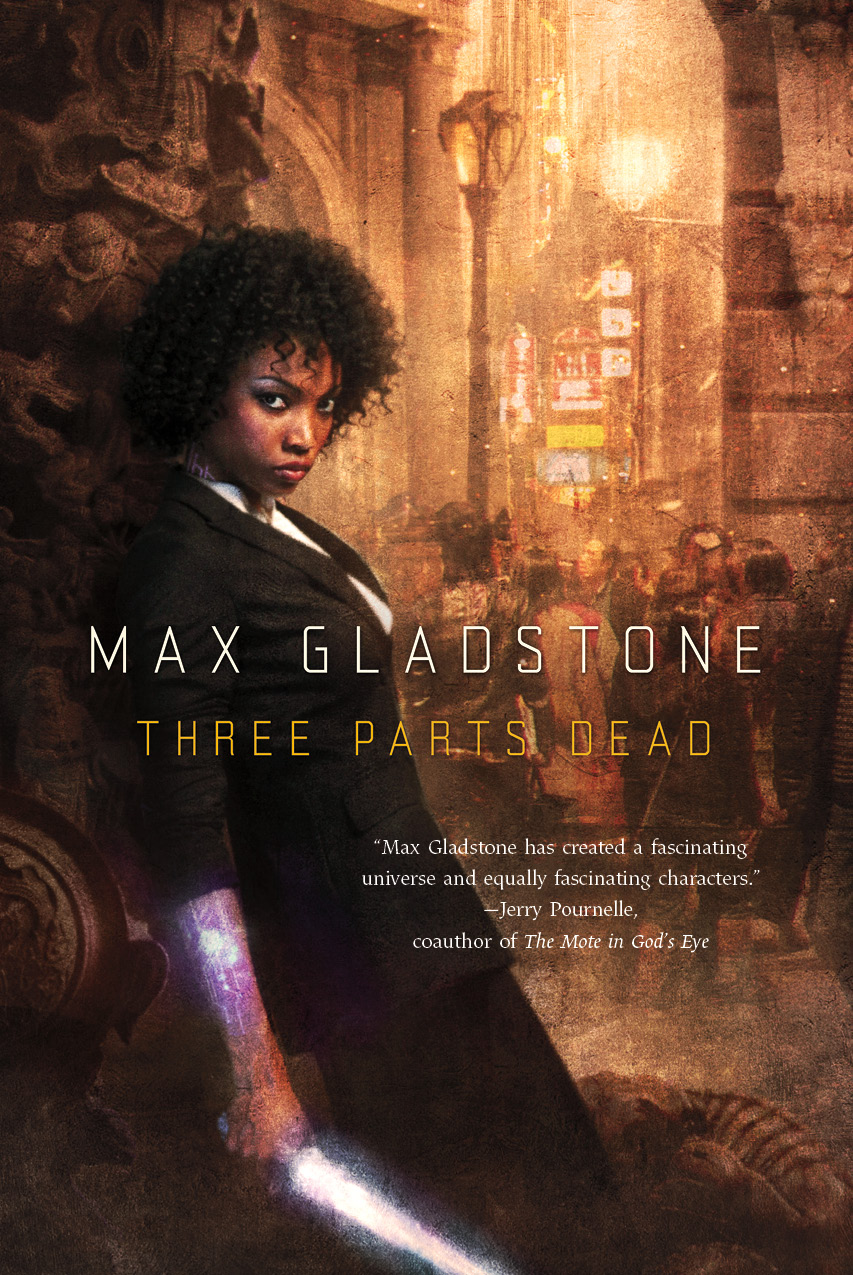
Three Parts Dead by Max GladstoneA few weeks ago, when I asked Justin Landon for a review to run on A Dribble of Ink, he offered me two. The first, which I ran, was for The City’s Son by Tom Pollock. It had great cover art, sounded intriguing and didn’t look like just another gritty Urban Fantasy novel. The other was Three Parts Dead by Max Gladstone, which I’d never heard of.

Justin Landon, Staffer’s Book Review:

Gladstone’s uses dynamic prose and a unique voice to communicate that intent. It’s poetic at times, and laconic at others, switching between the two, and in between, depending on the point of view from whence the story is told.

[…]

For fans of the legal thriller, and they are legion in the fiction marketplace, Three Parts Dead is an intriguing starting position for a fantasy enfilade. Elements of mystery, verbal fencing, and suspenseful confrontations stand tall throughout, set neatly into a fantasy world. I have concerns that traditional fans of fantasy may feel some frustration about the lack of development in Gladstone’s setting, but his excellent characters and interesting plot carry the day, making it a novel I can easily recommend.

Read More »