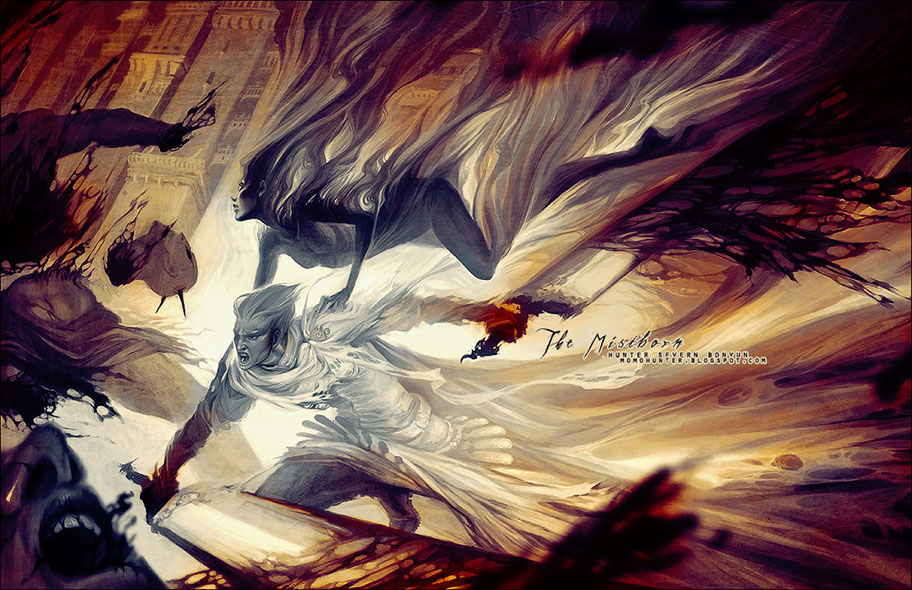
In an email from Sanderson (who has a very good reputation about communicating directly with his fans), the author confirmed that there are still plans for two more Mistborn trilogies. He suggests that the series will eventually be a ‘trilogy of trilogies.’ These do not include the “Wax and Wayne” books, though there are more of those coming, too. He says, “they’re not so much ‘prequel’ as they are a side venture into life between the first and second trilogies, but they will be used to provide some foreshadowing for the second trilogy.”
For the first time (I believe), Sanderson also described some early plot elements and setup for the next Mistborn trilogy:
As I envision it now, the second Mistborn trilogy, take place in a more technologically advanced version of the world, several hundred years later. They’ve progressed beyond steam technology to combustion engine technology, are building skyscrapers and that level of technology. It will follow the exploits of a team of Allomancers who are kind of like an Allomantic SWAT team, group of hybrid mercenary/deputized individuals who are brought in by the police to take out Allomancer criminals. The first book will deal with when they are called in to deal with a Mistborn serial killer. That’s how it starts. It will go bizarre from there, of course, but think guns, cars, skyscrapers, and Allomancers.
It’s amusing, and likely intentional, to see that Sanderson has swapped out the crooked band of criminals from the first Mistborn trilogy with a law enforcement-type group of mercenaries. Fans of Sanderson know that he’s halfway decent at writing enjoyable group chemistry, but the true selling point, in addition to his complex plotting, will be to see how he utilizes Allomancy in a semi-modern era. Readers had a taste of how Allomancy, a magic system that can manipulate metals, can affect and be affected by guns in The Alloy of Law, and it sounds like Sanderson plans to take this concept even further with the upcoming trilogies, as he advances the technology level in the world. in The Alloy of LawThe appearance of a mysterious character event at the end of The Alloy of Law is likely the first of these ‘foreshadowing’ moments that provide hints about the overall story arc of the upcoming trilogies.
There is no known release date for any of these novels.
Publisher: Tor Books -
Pages: 912 -
Buy: Book/eBook
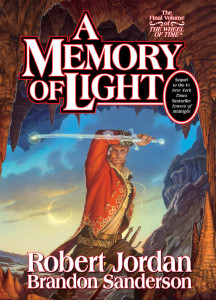
After nearly twenty three years and countless millions of words vomited out upon thousands of pages, Robert Jordan’s The Wheel of Time series finally concludes with its fourteenth volume, A Memory of Light. It has been a memorable series for those who’ve read, it albeit for some such as myself, it has become more an exercise in patience and restraint, waiting to see if the payoff justifies to any extent the laborious parsing of repetitive descriptions, redundant sentences, clothing and furniture porn, hackneyed villain motivations, etc. My own opinion of the series has fluctuated between a diversion during my last semester of grad school in the Fall of 1997 (it was a change of pace from reading Hitler’s memoirs and speeches for my grad seminar/research) toward it being a repetitive, poorly structured (and written) clunker of a novel/series. I wrote a series of posts on re-reading the Jordan-penned books, most of them for the first time since the release of the ninth book back in November 2000, and the re-reads did little to improve my deepening dislike for the series. Yet the first semi-posthumous release, co-written by Brandon Sanderson, I thought at first was a marked improvement. That was before I began to understand while reading the second co-written volume, Towers of Midnight, that the planned three-volume conclusion to the Wheel of Time series was terribly flawed in terms of narrative structure, characterization development, and prose. Therefore, it was with some trepidation that I ordered A Memory of Light and read it. Unfortunately, it is one of the worst-written books in a series renowned for its mediocre, bloated prose. Read More »
Publisher: Tor Books -
Pages: 861 -
Buy: Book/eBook
The Wheel of Time turns, and Ages come and pass, leaving memories that become legend. Legends fade to myth, and even myth is long forgotten when the Age that gave it birth comes again.
This quote, which opens the main sequence of every single The Wheel of Time book, can, with some alterations be applied to reading, memory, and the impressions formed (and altered) from the commingling of the above. I am not by nature someone who trusts wholeheartedly my first impressions; too often they change with time and further reflection. I have found this to be the case with this now-thirteen-volume epic fantasy series. When I reviewed the twelfth volume (and the first where Brandon Sanderson wrote most of the material in place of the deceased Robert Jordan), The Gathering Storm, I perhaps was a bit too forgiving of that book’s shortcomings because I reviewed the book after not having read most of the other volumes since 2000. Certainly my memory did not jibe too well with my experiences re-reading the first eleven volumes this past spring and writing commentaries on my impressions. In short, it was a slog re-reading this series. Not merely because of the myriad subplots nor because there were repetitive and yet shallow social commentaries, but also due to the creaky, non-graceful prose and uneven characterizations that often left me feeling cold. Despite the change in authors and the plot developments that one might expect in the penultimate volume of such a ponderous multi-volume series, Towers of Midnight, after some reflection, is a flawed volume in a very flawed series. Read More »
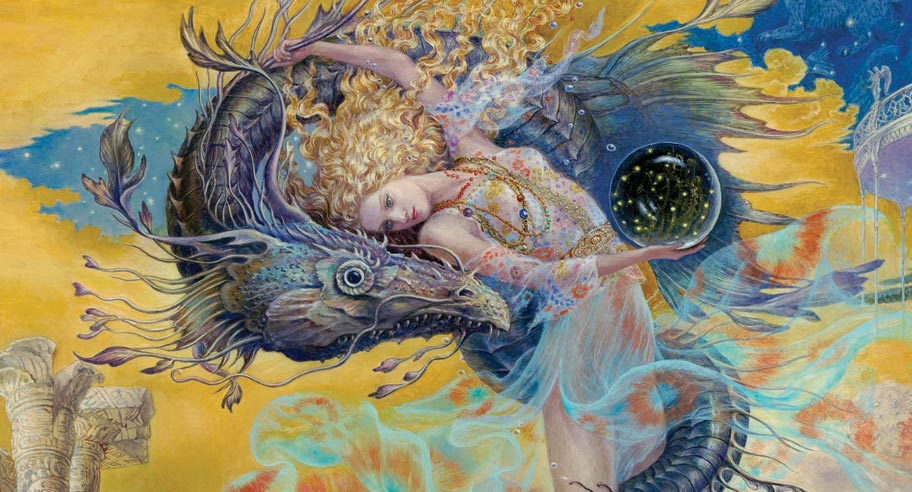
The idea behind my recent series, the Aetherial Tales, is simple: I wanted to write my own version of the “other-race living among us” trope, but in my own individual way. Although each novel can be read as a stand-alone, the most recent volume, Grail of the Summer Stars, completes a bigger story arc that was simmering in the background of Elfland and Midsummer Night. And that set me thinking about the themes – conscious or otherwise – that keep cropping up in an author’s work.
For years I had this idea in my head that every new book I wrote had to be completely different from the last, different from anything else that’s ever been written! Sigh. It took a while, but eventually I accepted that this is impossible. Well – at least incredibly rare and not always desirable. (Readers often want “more of the same”, and why not?) Virtually everything that can be written about already has been, and will be again, over and over. And that’s fine: many themes are universal because we can all relate to them. Love, birth, death, survival, finding the place we truly belong, war, crime and justice, the hero’s journey, and so on, are timeless and resonant. They don’t have to become clichés, as long as the author can bring an individual voice, pull something fresh from a well of compassion, wit or wisdom that engages the reader. Read More »
Publisher: Tor Books -
Pages: 784 -
Buy: Book/eBook
Robert Jordan’s Wheel of Time series has been one of the most sprawling, character-intensive epic fantasies of the past twenty years. Spanning millions of words, this series, now reaching its twelfth volume out of a planned fourteen, has spawned dozens of fansites over the years, as well as engendering heated debates over matters ranging from how well (or not) the author managed to portray female characters to questions of character identities and motivations to even a fictional murder-mystery that still remains unresolved seven volumes after its occurrence. Some view passages, such as the (in)famous “wind passage” that opens the first chapter of each book, as being hallmarks of a great talent. Others read the same lines and wonder how the story ever managed to become even more turgid and bloated than the previous volume.
One of the most sprawling, character-intensive epic fantasies of the past twenty years.
Debates such as these point to some intrinsic quality of the series that barely allows for there to be a middle ground. There is something for almost everyone, depending if one likes an action/adventure tale, political intrigue, social commentary, or even elements of a puzzle novel. Sometimes, there is too much of it all, and readers who enjoyed the earlier volumes might end up finding the past few volumes to be rather plodding, tedious affairs. After reading the eighth and ninth volumes, The Path of Daggers and Winter’s Heart, I found myself going years before even thinking of picking up the tenth volume, Crossroads of Twilight, which was perhaps the most difficult book to complete reading of them all at the time. Read More »