Posts Categorized: Feature Article

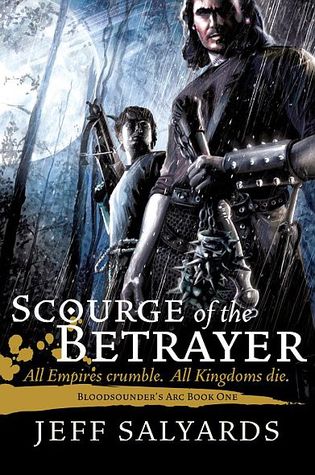
Scourge of the Betrayer by Jeff SalyardsI’ve always been fascinated by embedded journalists. Chronicling a military campaign right in the middle of the action rather than second- or third-hand, at a safe remove. It’s hard to get more visceral than that—dust in the face, grit in the teeth, adrenaline thumping, shadows jumping, blood splattering immediacy, all while trying to just stay alive long enough to somehow give what happened some kind of coherency. Whether book or article, writing is often a solitary, quiet affair, but writing front and center on a military endeavor changes the whole ball game.

Being a self-professed geek (at least 12th level), I naturally take observations like this and start plugging them into a fantasy scenario. How would this play out with a quill and ink on a different world, and how could I complicate it to make such a chronicler’s life even more hellish than anything your modern embedded journalist might endure? I’m a cruel bastard like that.

Now, that phrase “embedded journalist” is a recent invention, but the notion isn’t—Jean de Joinville was a crusader groupie 700 years ago. And Glen Cook cooked up a ripping yarn about a chronicler in a mercenary company—you might have heard of it—so the idea isn’t unique to fantasy either. I had to figure out how to differentiate my take, so I resorted to that most ancient and venerable of writerly tactics, the “what if” game… Read More »
Women in SF&FSince the beginning of April, Fantasy Cafe has been running a wonderful series of articles for Women in SF&F Month, with the hopes of exploring and celebrating the impact that women (as authors and characters) have had on our favourite genre. In addition to this, there is some discussion of the politics in the genre, gender equality and reviewer bias.

Kristen, editor of Fantasy Cafe, explains the driving force behind Women in SF&F Month:

This particular subject is one I’ve felt pretty strongly about for a while now. A few years ago, I noticed that most of the fantasy and science fiction books being talked about on many blogs and forums were written by men and started questioning whether or not there was a significant number of women writing these genres. Since then, I’ve of course found that there are many female authors of fantasy and science fiction books and it’s become very important to me to make sure their work is recognized and discussed. Usually I just do this quietly by reading and reviewing a lot of books written by women, but after the topic came up again I decided I wanted to do more to showcase the many women who are writing and reviewing all kinds of different types of fantasy and science fiction. So I started asking around to see if there was any interest in being a part of this and have spent the past 2 or 3 weeks gathering volunteers and posts.

So, here are some of the articles from the series that have caught my eye:

Vanishing the Elephant by Stina Leicht:

Addressing touchy subjects with story is one of Science Fiction and Fantasy’s best traditions. Sure, not all Sci-fi and Fantasy does this. (Some novels are intended to be fluffy and they do have their place.) However, I feel the main thing that sets Sci-fi and Fantasy apart from other genres is its capacity to make the reader think, in addition to SFF readers’ willingness (perhaps even eagerness) to contemplate complex subjects.

Elizabeth Bear, author of Range of Ghosts, on how you can support women who write SF&F:

[T]he problem is not that women are not writing science fiction, or that science fiction by women is not being published. It’s that a certain segment of fandom doesn’t pay enough attention to notice.

As you might imagine, I find this intensely frustrating. It’s as if one or two women in each generation of writers are anointed to become token representatives of our gender in the general critical discourse, and the rest–somehow never get talked about very much.

The good news is, this is easy to fix.

Read More »

Hugo Awards LogoI might be late to the party here, but a few people have asked for my thoughts on this year’s Hugo ballot. A similar article last year inspired much conversation, particularly with regards to “Best Fanzine” and “Best Fan Writer.” So, then, here goes:

Bold is my choice of winner
Asterisk (*) indicates that they were included on my ballot

Best Novel

  • Leviathan Wakes by James S. A. Corey
  • Deadline by Mira Grant
  • A Dance With Dragons by George R. R. Martin*
  • Embassytown by China Miéville
  • Among Others by Jo Walton*

I’m happy to see Leviathan Wakes on the list. It didn’t make my nominations, but only because of the last minute addition of The Night Circus by Erin Morgenstern (which I’m sorry, but not surprised, to see miss the final ballot). It’s a fun science fiction adventure with noir undertones. Daniel Abraham and Ty Franck are both great guys and I’m excited for the work they’ve been doing recently. I wouldn’t be upset to see this win, despite it just missing my own ballot. Also interesting to note is that before Leviathan Wakes, Franck was best known as the personal assistant of George R.R. Martin, who also has a novel on the list. Has there ever been a case of an author and their PA being nominated in the same category at the Hugos? I’d love to be at breakfast the morning after the awards if “Corey” wins the award. Talk about awkward. ;)
Read More »

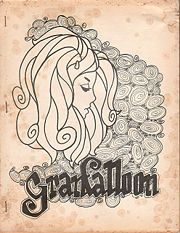
Cover for GranfalloonIn the beginning, there were zines. Shortly after fish crawled out of the primordial ooze, and were greeted by First Fandom, zines started to appear. Science Fiction fandom wasn’t even invented when folks started doing the earliest things we’d call fanzines. Mostly, they were related to sports at first, and later to film stars and the like. Science Fiction fandom evolved and became the group most strongly associated with fanzines, largely because we popularized the name ‘fanzine’. Over the years, zines became the primary way that fans communicated when they couldn’t be in the same place physically. Over the years, this was slowly replaced, first by more frequent cons and ever-growing clubs, later by electronic bulletin boards, then USENET, then CompuServe, then AOL, and nowadays we’re up to blogs and such. Zines themselves evolved, first in the technology used to create them, later in the way they were presented. Most fanzines today are either done completely electronic or have a PDF version that echoes a printed version. And there are a few that have no electronic version at all. Not a lot, but there are some. We’ll get into that later.

I came into fanzines twice. My Dad loved ‘em. He had a fairly good little collection that he had for years. I used to color in them, but I learned how to read from issues of Granfalloon and Niekas. Over the years, I drifted out of fandom, only to return around 2004, finally starting my own zine, The Drink Tank, on January 31st, 2005. Over the last seven years, I’ve expanded the number of zines I’ve done, have got myself nominated a few times for the Hugo, managed to somehow win one of the things, and have made friends from around the world. That’s what zines have done for me.
Read More »

The Hunger Games by Suzanne CollinsTo follow up on my recent review of The Hunger Games, I wanted to point out a handful of articles that touch on some of the issues that I juggled about, concerning specifically the politics of the novel, Katniss’ place in society and her role in sparking political upheval, and the likelihood of an event like the Hunger Games ever becoming an reality.

The first of the articles is called “The Missing Hunger Games Line” and concerns a single line of dialogue that was left out of the film adaptation, a line that the author, Marcy Kennedy, feels is important to the overarching themes of the series:

Even though I loved The Hunger Games movie that released Friday, I couldn’t help but notice that the screenwriters left out one of the most important lines in the book.

The night before the Games begin, Katniss finds Peeta on the roof of their hotel, watching the Capitol celebrate.

Peeta tells her, “I keep wishing I could think of a way to…to show the Capitol they don’t own me. That I’m more than just a piece in their Games.”

This makes no sense to Katniss.

[…]

Katniss didn’t set out to change the world. She just did what was right and change followed. She had no idea of the chain of events her seemingly small actions would cause.

It works the same way in real life.

When I was twelve, the boy who sat behind me in class would ask me to explain all our school work to him. I dreaded feeling that pesky tap-tap on my shoulder. When I finally lost my temper, he confessed—he couldn’t read. Somehow he’d slipped through the cracks, dismissed as either stupid or lazy, when he wasn’t either.

So I taught him (and felt guilty about snapping at him). At the time, I didn’t think it was anything important, but a couple years later, I overheard him telling a teacher how much I’d helped him and how much it meant to him.

I treasure that memory.

Kennedy examines what makes Katniss a catalyst for change in her world and has me thinking about some of my concerns regarding her passive role in the novel, and whether she’s not something of an unreliable narrator who unintentionally plays down her role in events or is just plainly blind to the effect she has on other people. The ideas presented by Kennedy have me reconsidering many of the opinions I originally formed after reading the novel.
Read More »