Dreadnought by Cherie PriestGanymede by Cherie Priest UK

In a bubble, I don’t mind them. They match up somewhat well stylistically with the original cover for Boneshaker (which is used in both North America and the United Kingdom), even if the technique is a different and not nearly as appealing. I also appreciate that they feature strong heroines that haven’t been over-sexualized. But, compared against the covers for the North American editions, including the fourth volume, The Inexplicables, Dreadnought and Ganymede can’t hold a candle. Another case of the pendulum swinging slowly in favour of North America when it comes to covers.

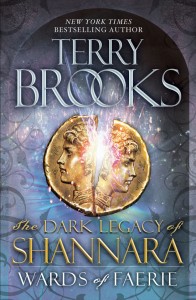
Wards of Faerie by Terry Brooks

Wards of Faerie

by Terry Brooks
Hardcover
Pages: 384 pages
Publisher: Del Rey
Release Date: August 21, 2012
ISBN-10: 0345523474
Buy: Book/eBook

In the interest of full disclosure, I’m a moderator at the Official Terry Brooks Forums, a role which I take seriously and indicates my level of fandom for Brooks, but which has not coloured the following review.

In my review of Bearers of the Black Staff, the first volume of Brooks’ The Legends of Shannara duology, his most recent published work, I wrote:

[T]he real meat of Bearers of the Black Staff is in the familiar elements that begin to rear their heads. The Trolls, a race that’s played a maligned roll in many of Brooks other novels, are the stars of the show here, and much of their history is revealed to the reader, for the first time in the series. Their origin story, involving characters from The Genesis of Shannara is heavy-handed and would have been better left hinted at, but this is something Brooks fans should be used to by now. Astute readers will also begin piecing together hints of the Knights of the Word and their eventual transformation into the Druids that manipulate the world in later Shannara novels.

Ultimately, though, these familiar elements are also the novel’s (and Brooks’) weakest link. Terry Brooks has a vocabulary that he’s built up through his career. Not a vocabulary in the sense that you’d find it in a dictionary (though his prose isn’t exactly a bastion of variety, it’s serviceable and easy to read), but rather in elements, archetypes and plot devices that he uses to construct his stories. There’s next to nothing in Bearers of the Black Staff that we haven’t seen before in any of Brooks’ previous novel.

This dissatisfaction extended into the sequel, The Measure of Magic, and grew, leaving me with a bitter taste in my mouth as a longtime Shannara fan. I didn’t review The Measure of Magic, for fear of just repeating the exact same points I made in the first, with only a small measure of irony. Fast forward a year and I approached the release of Wards of Faerie with no little amount of trepidation. Since Brooks concluded The Voyage of the Jerle Shannara 10 years ago, with the exception of Armageddon’s Children, I felt disappointment with each of his novels, from mild to severe. Where was the Brooks I fell in love with as a boy, first discovering Fantasy? Was he gone? Or was I simply grown up, better read and unable to appreciate the type of fiction that Brooks writes? Read More »

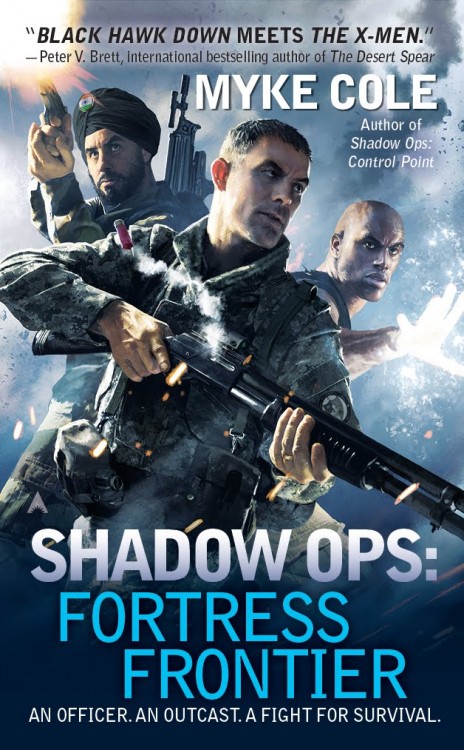
Control Point: Fortress Frontier by Myke Cole

The Great Reawakening did not come quietly. Across the country and in every nation, people began to develop terrifying powers—summoning storms, raising the dead, and setting everything they touch ablaze. Overnight the rules changed… but not for everyone.

Colonel Alan Bookbinder is an army bureaucrat whose worst war wound is a paper-cut. But after he develops magical powers, he is torn from everything he knows and thrown onto the front-lines.

Drafted into the Supernatural Operations Corps in a new and dangerous world, Bookbinder finds himself in command of Forward Operating Base Frontier—cut off, surrounded by monsters, and on the brink of being overrun.

Now, he must find the will to lead the people of FOB Frontier out of hell, even if the one hope of salvation lies in teaming up with the man whose own magical powers put the base in such grave danger in the first place—Oscar Britton, public enemy number one…

I still haven’t read Cole’s work, despite hearing great things about it from many readers, but I like this cover, so I wanted to post it anyway. Sure, it’s cheezy and overloaded with testosterone, but it’s great to see Ace Books not shy away from the ethnic diversity in Cole’s novels. Are genre marketing departments finally starting to wake up? Let’s hope so.

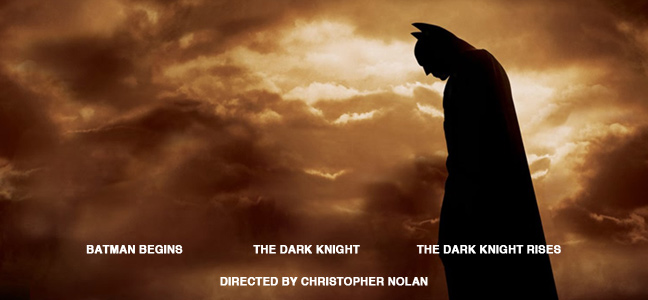
The Batman Trilogy, directed by Christopher Nolan

“Hey man, you seen The Dark Knight Rises yet?”

“Nah,” I replied, “I haven’t seen it. Been hearing good things about it, though.”

“You gotta see it. We should go this weekend.”

“Actually, I haven’t even seen The Dark Knight yet…”

“You haven’t seen The Dark Knight?” Incredulity.

“Nah,” I’d say. “Haven’t seen it.

The whole conversation sounded like a broken record.

In the circles I run in, the cross-over between geek and pop culture runs strong. Between the guys I work with, my one brother who lives with a comic book-obsessed illustrator, and my other brother who works in the film industry, the cultural and social impact of a film like The Dark Knight Rises is akin to a tempest. It is on the tongues and in the conversations of nearly everyone I associate with on a daily basis. It’s impossible to ignore, let alone hide from.

So, then, with a long weekend alone with my wife out of the house, I chose to join the crowd, to give into the rising, whirling winds. One a day, I watched the Batman Trilogy, immersing myself in Nolan’s envisioning of one of literature’s most tragic heroes.

[He’s] little more than a rich man with a lot of toys.

I’ve long been a fan of Batman, first inspired by reading through my mom’s old comics from the late sixties and early seventies. Hell, I was even in love with the old Adam West Batman, wall-climbing, homoeroticism, paunch and all. Growing up, however, I rarely considered him to be my favourite superhero, usually citing Spiderman (who I could, you know, relate to, because I thought of myself as a bit of a nerd), or, oddly, Aquaman, and, if we really want to stretch it outside of Golden Age American superheroes, Astro Boy. I liked Batman, but was never impressed with the idea that he was little more than a rich man with a lot of toys.

An adult now, I see how I misinterpreted Batman’s strength and the true source of his ‘super’ powers. Like Astro Boy, Batman’s origins lie in tragedy, in trying to recover what was lost by refusing to let it drift away into memory. In vengeance. In anger. Sure, he has gadgets, and his near limitless pool of money gives him the ability to become a superhero, but its his inner emotional turmoil and utter belief in justice that gives him the power to accomplish amazing things. Read More »


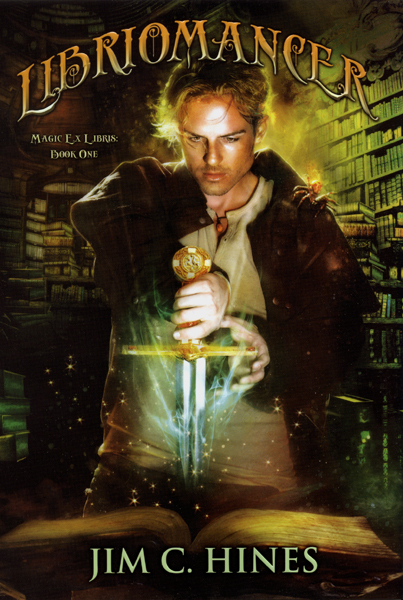
Libriomancer by Jim C. Hines

Libriomancer

By Jim C. Hines
Hardcover
Pages: 400 pages
Publisher: DAW
Release Date: 08/07/12
ISBN: 0756407397

It’s interesting to be reviewing a professional author who is also the prohibitive favorite to take home the Best Fan Writer Hugo Award next month. It seems counter intuitive, although it shouldn’t be given the outstanding blog Jim C. Hines maintains. It’s so good, in fact, that I wouldn’t be surprised if many of his blog’s readers have never read his fiction, a category that I certainly fell into before reading Libriomancer.

Hines’ protagonist, and in grand urban fantasy style, first person narrator, Isaac Vainio has the ability to “reach” into books and pull out whatever he touches. Excalibur? Sure. Neutron bomb? Knock yourself out. Get your hand bit by a vampire? Well, there might be some complications.

There were no wands, no fancy spells, no ancient incantations. No hand-waving or runes. Nothing but the words on the page, the collective belief of the readers, and the Libriomancer‘s love of the story.

It all began five hundred years ago when Johannes Gutenberg (yes, that Gutenberg) started a project to control magic. He founded a secret organization known as Die Zwelf Portenaere who “took an oath to preserve the secrecy of magic, protect the world from magical threats, and work to expand our knowledge of magic’s power and potential.” Read More »