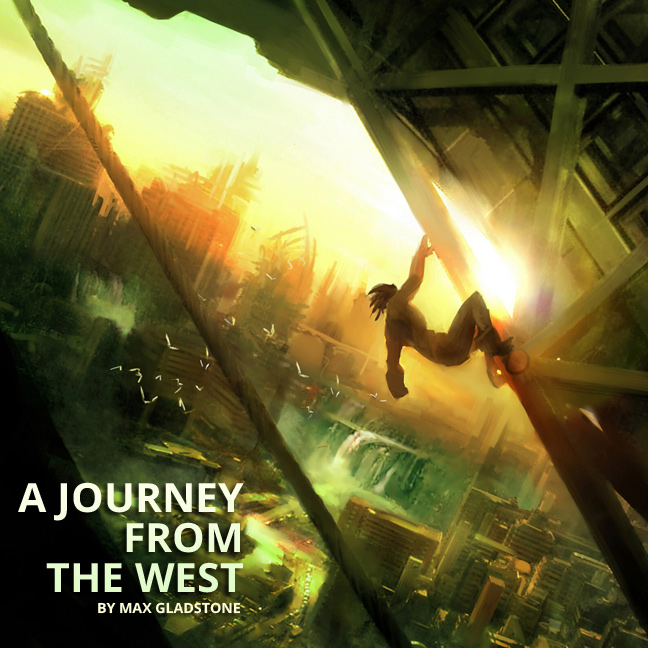
A Journey From the West by Max Gladstone

Fantasy should be the broadest genre in existence. Fantasy writers get to create and transform to our hearts’ content. Not even the laws of thermodynamics bind us. Our imaginations are our only limits.

The problem is, the imagination’s limits are often harder than physical law. Writers are formed by experience, and interpret that experience into story using instincts developed reading, and hearing, stories, from early childhood. So, when a lot of Western folks turn to writing fantasy, Arthurian and Greek and Norse myths are the seeds they use to people and structure their imaginative worlds.

Which is fine! Each generation needs to remake the myths received from the previous generation. But sometimes writers and readers feel the limits of their traditions, and wonder, what else is out there, other than kings and earls?

In this three-part series I’m going to be writing about stories I think all fantasy writers and fans should know, other than the standard Celtic, Greek, and Norse sources. If you know these stories already, then good! I hope there’ll be something cool for you here anyway. If these stories are new to you, maybe these few posts will expose you to some amazing worlds. Read More »

Tor.com, one of the most respected short fiction publishers on the web, announced today that it will be increasing its short fiction publication to a weekly format. At four stories a month, this puts the magazine on par with other short fiction venues like Clarkesworld and Lightspeed in terms of volume. Great news for readers.

Since our launch in 2008, Tor.com has always been a competitive market for original short sci-fi and fantasy fiction. We’ve been able to work outside of conventional publishing boundaries, create original illustrations for the stories, and have now garnered both Nebula and Hugo Awards! By the end of last year, Tor.com doubled our editorial staff, both in acquiring editors and first readers for our open submissions file. Our fiction team consisting of Patrick Nielsen Hayden, Liz Gorinsky, Ann VanderMeer, Ellen Datlow, Bridget Smith, and Carl Engle-Laird are working harder than ever to bring you the best of what’s on the cutting edge of new speculative fiction! We’ve always been proud of our stories and now we’re proud to offer new ones once a week! Expect forthcoming new stories from Genevieve Valentine, Harry Turtledove, Cory Doctorow, and many, many more.

Irene Gallo, Creative Director for Tor.com and Tor Books, also confirmed to me that this indicates a turn-around/response time for short fiction submissions to the site, saying that the short fiction editors have been, “catching up on the back-log.” It’s good news for those with submissions in the queue, which is infamously long, and those who’re simply looking for new, good SFF short fiction. Though, given Tor.com’s previous track record, I expect that the short fiction will continue to favour established long- and short-fiction writers, and remain almost impenetrable to emerging writers who submit to the site.

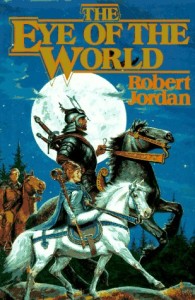
The Eye of the World by Robert Jordan

Publisher: Tor Books - Pages: 832 - Buy: Book/eBook

Editor’s Note: The release of A Memory of Light by Robert Jordan and Brandon Sanderson brings to conclusion the long-running, much-lauded and oft-criticized Wheel of Time series. To mark this event, I’ve invited Larry Nolen, editor of The OF Blog, to republish his reviews of the entire series, one a week for fifteen weeks, on A Dribble of Ink. I consider Nolen to be one of the best online reviewers of Fantasy and Science Fiction, and his reviews of Wheel of Time, in the form of a ’10 Years Later’ re-read leading up to the release of The Gathering Storm, to be some of the most lucid and fair critical analyses of the series available online. You might not always agree with his reviews, but I think you’ll find yourself thinking about the Wheel of Time in ways that might surprise you. So, enjoy. -Aidan Moher

The Wheel of Time turns, and Ages come and pass, leaving memories that become legend. Legend fades to myth, and even myth is long forgotten when the Age that gave it birth comes again. In one Age, called the Third Age by some, an Age yet to come, an Age long past, a wind rose in the Mountains of Mist. The wind was not the beginning. There are neither beginnings nor endings to the turning of the Wheel of Time. But it was a beginning. (p. 1)

For tens of millions of readers, the above passage will be quite familiar. For the past twenty years, Robert Jordan’s Wheel of Time series has been one of the most popular epic fantasy series to be released, with sales of well over forty million copies for the thirteen main volumes, one novel-length prequel, and a related encyclopedia/artbook. It is a series that has legions of devoted fans, tens of thousands of whom have created websites, argued passionately (and some might wonder, pointlessly?) over various minutiae found within this sprawling multi-volume work, and several hundred at least who have named babies after characters or who have had tattoos of emblems found within its pages. However, this series perhaps has drawn one of the largest anti-fan crowds in a subgenre that is littered with negativity and borderline psychotic outbursts directed toward those who do not share in the perpetrator’s hatred for that series (or most any other series). Various forums devoted to discussing epic fantasy series have seen thousands of threads over the years devoted to the question of whether or not Jordan was a “sellout” and to analyzing (sometimes focusing more on ad hominem comments than actual constructive criticism) just where the series jumped the shark and why.

I certainly was no fan of the author’s prose, his characterizations, and my interest in the setting he created dissipated the more I considered the structure behind his constructed mythologies.

I myself began reading the series in November 1997 as a way of relaxing my mind during the brutal written and oral exams for my MA in History. I read the first seven volumes in paperback that year and proceeded to re-read them a few times over the next three years. Read the eighth volume, The Path of Daggers, upon its October 1998 release and I began to wonder what was actually transpiring here. Purchased the ninth volume, Winter’s Heart, upon its November 2000 release and I was so disinterested by the time that I read it that I never read any of the first volumes since then and have read the latest three volumes only fairly recently (2006 for the tenth volume, which was read more so I could write a series of satirical posts rather than because I actually wanted to know what was transpiring there, and 2009 for the last two volumes, since I was receiving a review copy of the latest volume a week before the official review date). While I was not a rabid detractor, I certainly was no fan of the author’s prose, his characterizations, and my interest in the setting he created dissipated the more I considered the structure behind his constructed mythologies. Read More »
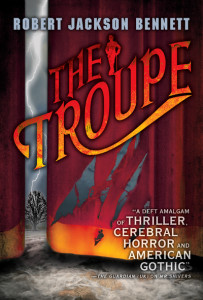
The Troupe by Robert Jackson Bennett

Publisher: Orbit Books - Pages: 512 - Buy: Book/eBook

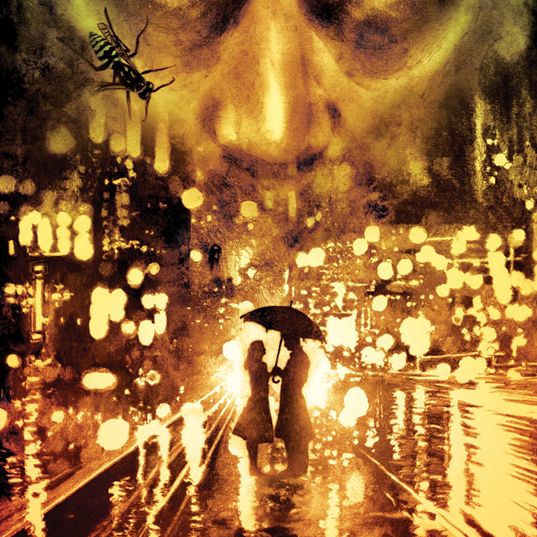
I admit, prior to reading The Troupe, I had no idea what vaudeville was all about. I had an idea in my head, based on implied fuzzy cultural memory, but it’s not something I’d ever taken a moment to actually look into. Having read Erin Morgenstern’s The Night Circus and paged through Mechanique: A Tale of the Circus Tresaulti by Genevieve Valentine, two circus-themed novels from 2011, I classified Bennett’s novel in my mind as another entrant in this newly popularized subgenre. Vaudville isn’t the same as a circus, but I was expecting a similar type of novel where the setting is as much a character as the people that populate it. The Troupe shattered those notions. Plot and character driven, set against a vaudville background, Bennett’s novel calls to mind the stylings of Neil Gaiman and lives up to the comparison.

Sixteen-year-old pianist George Carole has joined vaudeville to find Heironomo Silenus, the man he suspects to be his father. As he chases down Silenus’s troupe, he begins to understand that their performances are unique even for vaudeville and strange happenings follow in their wake. It’s not until after he joins them that George realizes the troupe isn’t simply touring, and Silenus is hiding a secret as old as time itself. Told in a tight third person voice, The Troupe follows George through his experience as a vaudeville act, a lost young man searching for direction, and a chess piece in an endless metaphysical war. Not surprisingly, the novel is divided into three parts that roughly correspond to each of those story arcs, although none are entirely resolved until the final pages. Read More »

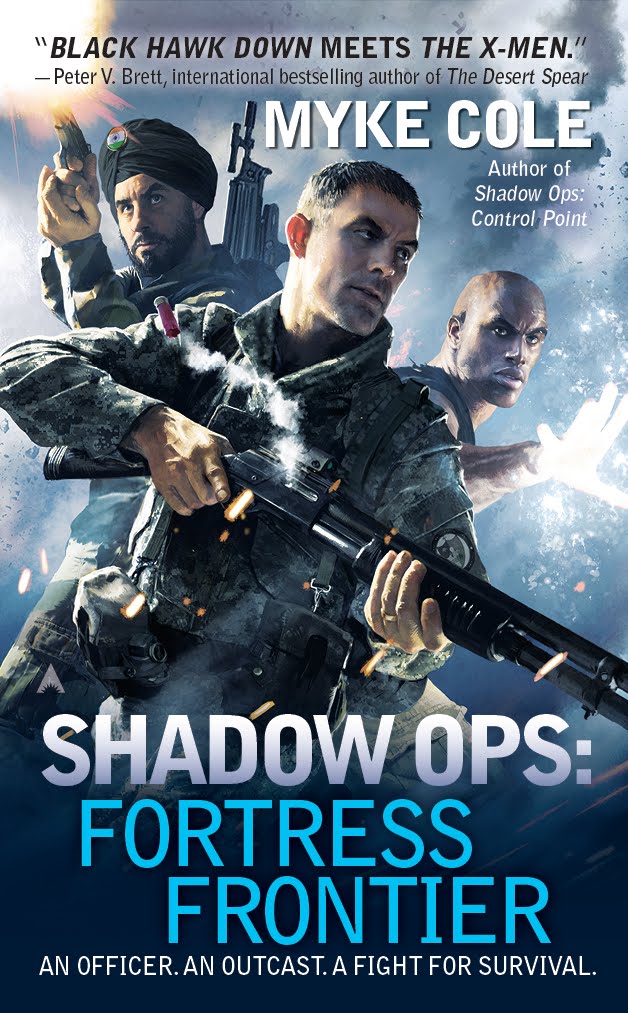
Shadow Ops: Fortress Frontier by Myke Cole“Urban Fantasy” is a hot term these days. You hear it used to describe everything from Charlaine Harris’ Sookie Stackhouse books to Jim Butcher’s Dresden Files. It encompasses the work of authors from Patricia Briggs to Kim Harrison, from Ilona Andrews to Kevin Hearne. With such a diverse range of talent, the definition quickly loses meaning. There isn’t a whole lot that’s urban about the sleepy, small town of Bon Temps.

But that’s okay. Because urban fantasy has never been about urban settings. It’s about *contemporary* settings. It does a very simple thing: it takes the modern world, the one we live in every day, and ask the question, “What would this be like if magic were real?”

If the genre’s popularity is any indicator, that question has traction. Fantasy has, for much of its lifespan, been dominated by ancient and medieval settings. Many of the most enduring works in the genre, from Tolkien to Brooks to Feist, are set in pre-gunpowder, pre-industrial revolution worlds. But readers don’t ride to work on horses, hunt deer for dinner, or carry a sword to fend off the occasional Orc raid. Contemporary fantasy’s popularity suggests that many readers like to dream about the impossible right in their own backyard.

And here’s where you can run into trouble writing contemporary stories. The same thing that makes a contemporary setting resonate so strongly with the reader may also piss them off: Ownership. Read More »