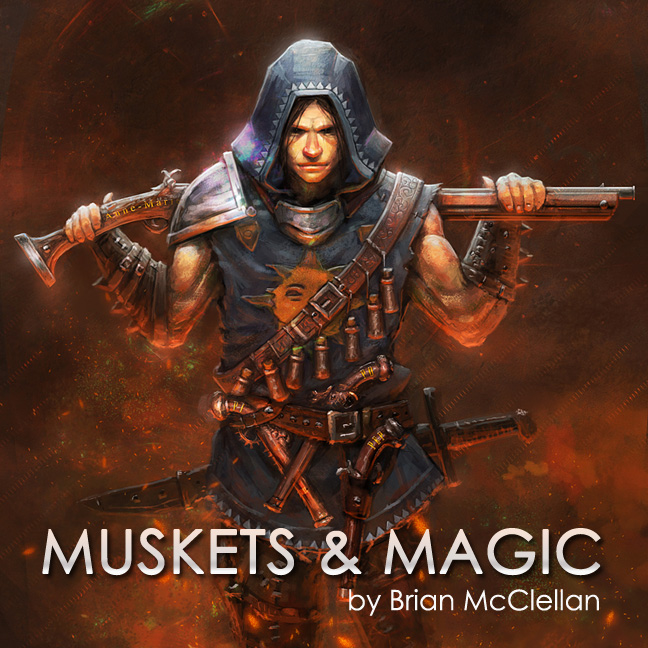
Magic is often used to keep the status quo, until it becomes accessible to the common man and suddenly turns the world upside down.

You don’t see a lot of gunpowder in fantasy.

It’s there, especially in historical fantasy. But it’s not as common as one might think. Most fantasy seems to take place in a pre-gunpowder period despite gunpowder having been around in our own world since the middle ages. I think this has a lot to do with what we read when we were kids. Many of us grew up on medieval fantasy. Tolkien and C.S. Lewis dominated my childhood. When I was old enough to go looking for books at the library, I read David Eddings, Tracy Hickman, and Robert E. Howard. None of the stuff I read had any gunpowder in it and when I first started writing all my settings were medieval.

So beyond mere habit, why don’t we see much gunpowder in fantasy? I think that magic, in a lot of ways, fills in for gunpowder. It’s something mysterious. Perhaps it can be used by the common man, but the common man doesn’t know the secrets behind it. Only a few people can master those. It can be volatile and dangerous, used for both good and evil. Magic is often used to keep the status quo, until it becomes accessible to the common man and suddenly turns the world upside down. Read More »

The Winds of Khalakovo by Bradley P. Beaulieu

[I’ve] closed a deal with Betsy Wollheim for a new epic fantasy trilogy called The Song of the Shattered Sands. It’s a story set in a powerful desert city that controls the flow of trade and spice through otherwise impassable terrain. There are echoes of both A Thousand and One Nights and Thieves’ World.

It’s a story about Çeda, a woman who fights in the pits to scrape a living from the cruel but beautiful city she calls home. As the story opens, she discovers that the book her mother left her before she died holds the clues to the unraveling the mystery of her mother’s death, which was tangled up in the story of the Twelve Kings of Sharakhai, men who have ruled the desert with an iron fist for nearly two hundred years. As Çeda begins to unlock the secrets hidden within the poems in the book—as well as what her mother was trying to do before she died—the Kings learn of her, and they will stop at nothing to keep those secrets buried in the desert where they belong. And so the chase is on. Çeda must unlock the hidden riddles of her mother’s book before the Kings find her. She had better hope she does, for she is the last hope for the people of the desert.

It’s great to see Beaulieu take the critical success he received for his first trilogy, The Lays of Anuskaya, published by Night Shade Books, and parlay it into a deal with a larger publisher. Daw is home to some of the best (traditional/epic/secondary world) Fantasy writers working today, including Patrick Rothfuss and Saladin Ahmed. Beaulieu’s Arabian Nights-inspired trilogy sounds like it will be a good fit. It’s great to see more Fantasy written that features a setting inspired by something other than Medieval Western Europe. After Beaulieu’s first trilogy, with a Russian-inspired setting, he’s quickly asserting himself as one of the most interesting world builders in the genre. I’m quite looking forward to this.

Last week, news spread that George R.R. Martin, author of A Song of Ice and Fire, signed a new two-year contract with HBO, including his continued participation in their ASOIAF adaptation, Game of Thrones and the development of new projects. On February 10th, in response to a question from a fan on his personal blog, Martin confirmed details about those ‘projects,’ including a potential prequel series to Game of Thrones.

Tuf would be fun. Dunk and Egg are being discussed. Robert’s Rebellion is part of Ice & Fire, won’t be a separate series. Sandkings was done by the OUTER LIMITS; I retain feature film rights, but television rights are gone.

While he speculates about his other properties, he admits specifically that discussion has taken place regarding Dunk and Egg, the heroes of his A Song of Ice and Fire off-shoot novella series. They would be a fun concept for a show, but I wonder if there is proper mass appeal for two characters that most fans of the series likely don’t even know exist. As he says, Robert’s Rebellion would be perfect, but nearly as big a production as Game of Thrones itself, and it’s integrally tied to the events in the series and might be redundant by the time the series/show ends. Non-A Song of Ice and Fire properties is an interesting idea, but, again, I wonder about the mass appeal. Me? I’m curious where the rights to the Wild Cards series rest.

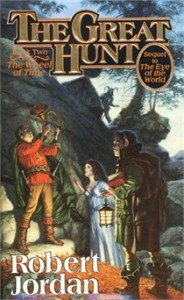
The Great Hunt by Robert Jordan

Publisher: Tor Books - Pages: 705 - Buy: Book/eBook

Last week, I prefaced my commentary-like review of the first Wheel of Time book, The Eye of the World, with explanations as to why I was embarking on this re-read project after a decade-long break. It would be redundant to repeat all of that, so if you have not yet read the original review, I suggest you start with that before reading this second, shorter review of the second volume in the series, The Great Hunt.

When I first read this book back in November 1997, I found it to be a major step backwards from the first novel. In the few re-reads I did between then and the autumn of 2000, I recall that my opinion of the book (and the third volume, The Dragon Reborn) did not improve at all. But what impressions would I take after reading it nearly ten years later?

Several of the same problems that I felt plagued the first volume were pretty much repeated in this second volume[, yet] despite this, in some ways, this story was more enjoyable than I had remembered it being a decade ago.

On the whole, I would still argue that The Great Hunt was a less enjoyable reading experience than was The Eye of the World. Several of the same problems that I felt plagued the first volume (too lengthy personal descriptions of minor characters, an uneven pace to the plot(s), the thin characterizations of the major characters and even more importantly, the enemies, the rather pedestrian prose) were pretty much repeated in this second volume, with a few curious additions. Yet despite this, in some ways, this story was more enjoyable than I had remembered it being a decade ago.

The story picks up roughly one month after the conclusion to the first novel. Rand al’Thor, one of three adolescent males from the backwater village of Emond’s Field, has discovered that he can touch the magical, tainted male side to the magical One Power (which runs the universe, in a way that I wonder might be analogous to the “dark matter” that makes up most of the universe’s mass). Furthermore, he may be the reincarnated soul of the dreaded Dragon Reborn, who in madness helped destroy civilization after a ten-year battle with the forces of evil. Rand is the hero (villain?) of prophecy, a mantle he does not want and makes quite clear, in both internal monologues and in conversations with characters, on numerous times. As I was reading this, I kept wondering to myself if perhaps the author went a little overboard with utilizing repetitive comments to reinforce the centrality of Rand’s conflict. It felt a bit forced at times to me and I cannot help but to speculate how differently (and perhaps, how much more powerfully) a reduction in the times Rand (and to a lesser extent, the other character and their own personal crosses which they bear quite vociferously) has to put voice to his conflicted thoughts. Read More »
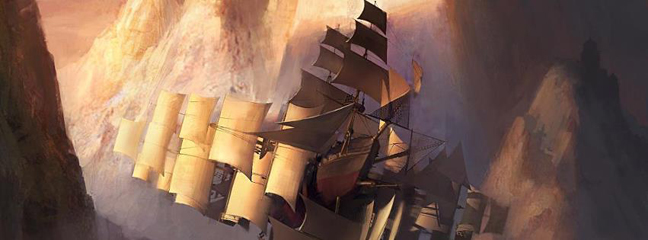
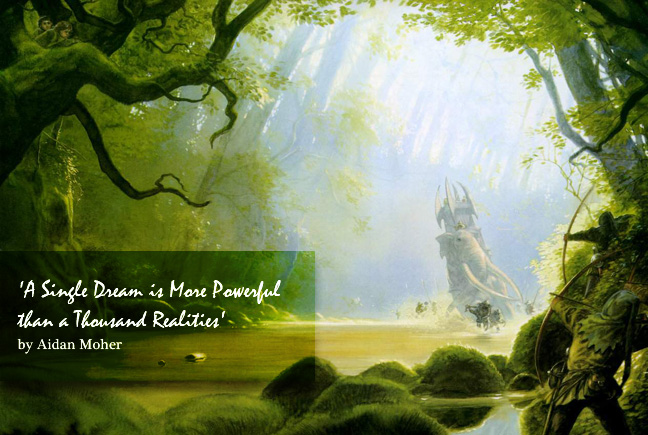
On the Power of Fantasy Fiction: ‘A Single Dream is More Powerful than a Thousand Realities’

Art by John Howe

One evening, I had the chance to sit down with Steven Erikson and several other people over a glass of wine and dinner. It was a wonderful evening, full of laughs, camaraderie and discussion. Despite what you might think, me being a book blogger and Steve being a popular author, only a small portion of the evening was spent discussing fiction, books or writing. However, one short conversation, not with Mr. Erikson but with one of his friends, led me to think a lot about why I read, and when I read.

The conversation began with a question, “Do you read before bed?”

Some of us answered no, others, including myself, said, “Yes, I can’t fall asleep otherwise.” Those who answered “no,” had some interesting reasons, though they escape me now, but one of the other diners, a woman whose name I’m sorry to say I can’t remember, began talking about why she reads before bed. She made an observation that has stuck with me since. You see, she reads before bed because it allows her to put aside the events of her day, the events that might be coming the next day, and immerse herself in the emotions, problems and triumphs of the people living in the fiction she holds in her hands. Instead of falling asleep thinking about what needs doing tomorrow, or how her exam went poorly, she falls asleep wrapped in thoughts of these characters, wandering through these other landscapes. Read More »