Why did Shakespeare write fantasies? Why not mainstream topics, such as histories and romantic comedies?
Before we examine this question, let us examine a few others first: Fantasies are fun! Why doesn’t everybody read them? What is mainstream? Why is a story about ordinary life considered mainstream, while an equally charming fantasy is relegated to the back of the bookstore?
I had a bit of insight into this many years ago, when I first became a writer. Through a mutual friend, I connected with a fellow writer who was hard at work on a mystery. I was writing a fantasy with a great deal of mystery elements, so this sounded like a great meeting of minds. We exchanged manuscripts and then met for coffee.
How could a staff be magical? It caused a person to teleport? How does that work? The reader isn’t going to be able to follow this without an explanation.
I pointed out a few inconsistencies in her otherwise well-appointed story. She thanked me. Then, frowning over her drink, she pointed to my manuscript and said, “In this scene here, your character uses a ‘magic staff?’ You don’t explain what a ‘magic staff’ is. How could a staff be magical? It caused a person to teleport? How does that work? The reader isn’t going to be able to follow this without an explanation.”
In that moment, I learned a tremendous amount about writing and human nature.
I learned that my novel would never be a mainstream novel, that people who lived their lives only concerned about daily life wanted to read about the issues they encountered in said daily life, and that the ideas that we fantasy and science fiction readers take for granted are extraordinary and intimidating to the ordinary reader. I was writing a novel for fantasy fans. People who already understood what a magic item was. Such people did not need explanations about the basics. They were already familiar with these concepts.
Mainstream readers are not. Read More »
 Ken Liu, World Fantasy Award-winning author of The Paper Menagerie, announced yesterday the sale of his first novel, The Chrysanthemum and the Dandelion, and its sequels. The Chrysanthemum and the Dandelion is the first volume of The Dandelion Dynasty. A full synopsis of the series was provided on io9:
The Dandelion Dynasty follows Kuni Garu, a charming bandit, and Mata Zyndu, the son of a deposed duke. At first, the two seem like polar opposites. Yet, in the uprising against the emperor, they quickly become the best of friends after a series of adventures. The scope of the series is epic, involving gods, massive armies, diverse cultures, multiple plotlines, numerous characters, politics, war, courtly intrigue, and love.
He describes the series as “a loose retelling of the historical legends surrounding the the founding and early years of the Han Dynasty.” Liu further explains the impact that these legends have had on Chinese culture and literature, likening them to Homer’s Iliad and Odyssey. They’ve “been an important part of the mythic imagination of people in the Sinosphere for millennia,” he says. The Chrysanthemum and the Dandelion is Liu’s attempt at address an issue that he sees in contemporary narrative. He says:
Most of my stories are reactions against something I don’t like: a popular narrative leaves something out that I feel is crucial, a set of assumptions and myths being told and retold that I feel is damaging and limiting, or the kind of story I want to read isn’t being written. This series is no exception. I wanted to write a novel that told these stories that I loved to a readership that might be unfamiliar with them, but I didn’t want to write a straight historical novel or a “magic China” fantasy series — these approaches are fraught with the kind of appropriation issues that I find so problematic.
So I decided to do something different. I wanted to retell the stories in a new setting, with new cultures, new peoples, new technologies and magic that are not tied to their Chinese roots directly.
Read More »
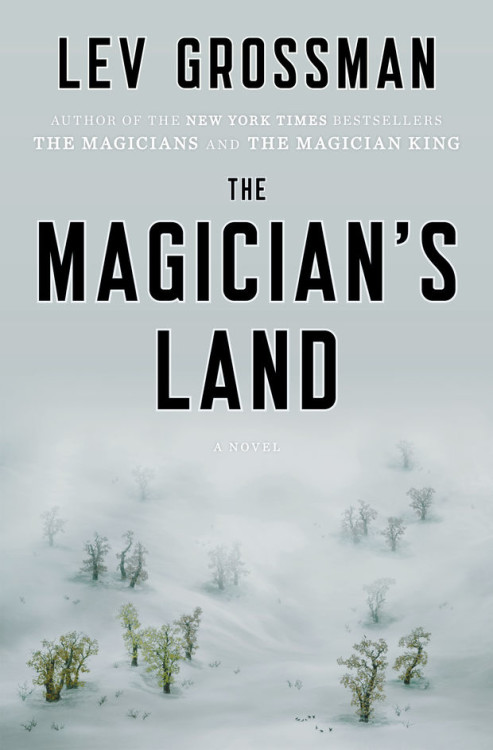
Via The AVClub, Lev Grossman revealed the cover and first details about The Magician’s Land. Grossman won over fans with the release of The Magicians, a twisted and grown-up mix of Harry Potter-meets-Narnia, and continued to cement himself as one of the most interesting young contemporary fantasists with the release of the sequel, The Magician King. The Magician’s Land is the third and final volume of the trilogy and, as the title suggests, it focusses heavily on the magical land of Fillory (Grossman’s Narnia analogue).
Spoilers below, for those who haven’t read the first two volumes.
Quentin Coldwater has been cast out of Fillory, the secret magical land of his childhood dreams. With nothing left to lose he returns to where his story began, the Brakebills Preparatory College of Magic. But he can’t hide from his past, and it’s not long before it comes looking for him.
Along with Plum, a brilliant young undergraduate with a dark secret of her own, Quentin sets out on a crooked path through a magical demimonde of gray magic and desperate characters. But all roads lead back to Fillory, and his new life takes him to old haunts, like Antarctica, and to buried secrets and old friends he thought were lost forever. He uncovers the key to a sorcery masterwork, a spell that could create magical utopia, a new Fillory—but casting it will set in motion a chain of events that will bring Earth and Fillory crashing together. To save them he will have to risk sacrificing everything.
The Magician’s Land is an intricate thriller, a fantastical epic, and an epic of love and redemption that brings the Magicians trilogy to a magnificent conclusion, confirming it as one of the great achievements in modern fantasy. It’s the story of a boy becoming a man, an apprentice becoming a master, and a broken land finally becoming whole.
Like its predecessors before it, The Magician’s Land features a gorgeous cover with art from photographer Didier Massard. The Magician’s Land will be available on August 4th, 2014.

IGN has learned that Telltale Games, award-winning developer of the acclaimed videogame series based on Robert Kirkman’s The Walking Dead (considered by many to be one of the finest examples of videogame narrative), is working on a videogame adaptation of George R.R. Martin’s A Song of Ice and Fire. Based on their previous work, which includes games set in the universes of Fables, Jurassic Park, and Back to the Future, it is likely that the game will tell a new story in Martin’s universe, rather than directly cover the events of the novels and/or television show. “It’s currently unclear what title Telltale will be using for its game,” IGN reports, “and whether the storyline will be based on the show, books, or something entirely new.”
Details about the story of the game are murky, however. IGN is confident it’s in development despite no confirmation from the developer. They have reports from ‘multuple sources’ confirming its existence. Expect an official announcement in the coming months.
Publisher: Hodder & Stoughton -
Pages: 353 -
Buy: Book/eBook
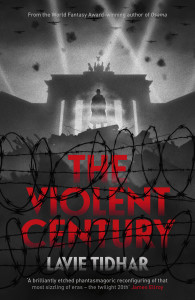
Lavie Tidhar’s The Violent Century has done for World War II what The Watchmen did for the Cold War (and should have done for the Vietnam War). I make that comparison not because both feature humans with superpowers, but because they offer an opportunity to look at real events through a hyperbolic layer. Tidhar, like Alan Moore, is interrogating real events with the speculative fiction toolkit, looking not at how it happened historically, but at what about the human condition allowed it. The result, in Violent Century’s case isn’t just a great piece of superhero fiction, but a beautiful novel of cultural and literary merit.
[The Violent Century] is the kind of stilted romance built on repressed feelings and unspoken connections.
The jacket copy of the novel reads, “Fogg and Oblivion must face up a past of terrible war and unacknowledged heroism to answer one last, impossible question: what makes a hero” I’m loathe to sum it up so simply. While there are some notions of heroism throughout the novel, the quote describes what a fan reckons a superhero novel ought to be without a sense of the novel’s real themes. In the end, The Violent Century is a love story. Not a tale of heroism or social commentary, although it is those things too, Tidhar’s novel is the kind of stilted romance built on repressed feelings and unspoken connections.
For seventy years Oblivion and Fogg have guarded the British Empire with their abilities as arms of the opaque Retirement Bureau. Divided by a secret from decades past the pair is called back to answer for their actions. Fogg is a child of neglect, exploited for his ability, and asked to do things he finds incongruent with his morality. Oblivion, meanwhile, is more of a cipher, a mystery to solve. There’s also a woman named Klara who sits at the root of the conflict between the novel’s main characters and at the root of how Tidhar’s world is changed from our own. Read More »