Posts Tagged: Fantasy

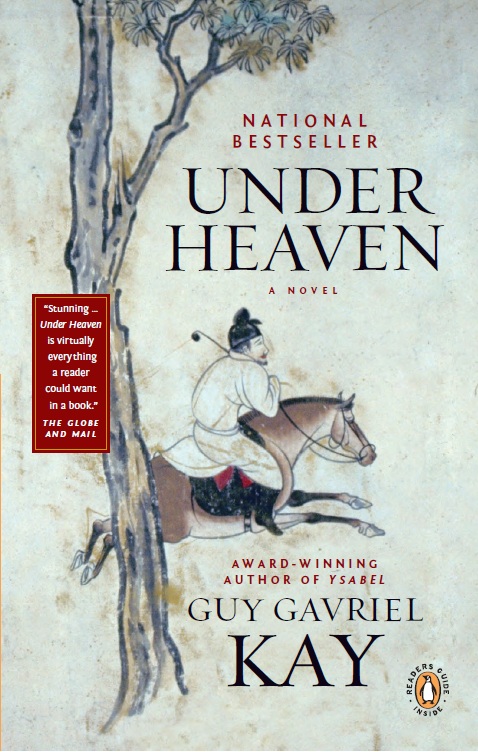
UNDER HEAVEN by Guy Gavriel KayIn a newly released video, Guy Gavriel Kay, celebrated author of Tigana, discusses his next novel, taking place in the same place as Under Heaven, only a few hundred years later, titled River of Stars. Under Heaven is one of my favourite novels in recent years, and I’m overjoyed that Kay is returning to that world with his next novel, River of Stars. Details in the video include the newly revealed title, as well as various plot points and descriptions. River of Stars takes place about 350-400 years after the events of Under Heaven. In the video, Kay says:

“The River of Stars” is one of the standard English translations for what the Chinese refer to as the Milky Way. It divides a mortal from his immortal beloved; it becomes a symbol, I suppose, for a division between ourselves and our dreams. It also is the way in which we all live out our lives underneath the “River of Stars.” It works for me as an overarching image, no pun intended, for what the book is dealing with. The novel takes place, it’s not a sequel to Under Heaven, it takes place about 350 to 400 years later, in one of the other great, profoundly inspirational dynasties in Chinese history and the setting, once more, was my starting point. I start with the setting and the ambience I want to evoke, and from there I go to the characters. I’m just about finished, I hope, and, if all goes well and I don’t screw up, which I try not to do, we should be seeing it published early next year.”

There’s not a lot there, but Kay always has such a wonderful way of thinking about his storytelling, of describing it lyrically, that I fall in love with his novels before they’re even published. I’m also a sucker for forbidden love and his description of the “River of Stars” as a force that “divides a mortal from his immortal beloved,” plays right into Kay’s strength with relationships, melancholy and the longing soul. There are few 2013 novels that I looked forward to as eagerly as River of Stars.
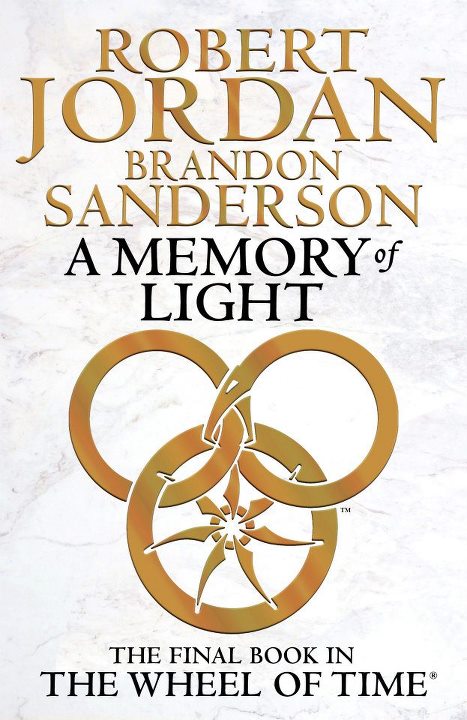
A Memory of Light by Robert Jordan and Brandon Sanderson

And it came to pass in those days, as it had come before and would come again, that the Dark lay heavy on the land and weighed down the hearts of men, and the green things failed, and hope died.’ From Charal Drianaan te Calamon, The Cycle of the Dragon.

In the Field of Merrilor the rulers of the nations gather to join behind Rand al’Thor, or to stop him from his plan to break the seals on the Dark One’s prison – which may be a sign of his madness, or the last hope of humankind. Egwene, the Amyrlin Seat, leans toward the former.

In Andor, the Trollocs seize Caemlyn.

In the wolf dream, Perrin Aybara battles Slayer.

Approaching Ebou Dar, Mat Cauthon plans to visit his wife Tuon, now Fortuona, Empress of the Seanchan.

All humanity is in peril – and the outcome will be decided in Shayol Ghul itself. The Wheel is turning, and the Age is coming to its end. The Last Battle will determine the fate of the world..

Can’t really comment on the synopsis, given that I’ve only read the first seven volumes of the series, but it was written by Harriet McDougal, Jordan’s widow and Wheel of Time overlady, and will appear on both the Tor and Orbit Books editions of A Memory of Light.

The cover itself is pretty, and fitting for the title of the novel, after all the previous volumes were black. It’s simple and classic, if predictable. Good enough for me.

Diablo III Review Round-up

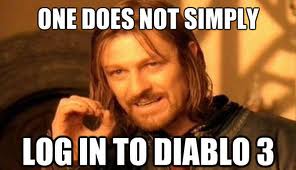
I was hoping to post some Diablo III impressions today. Instead, my entire experience with the game can be summed up with a simple meme. Actually, scratch that, I can log in, but my character (a monk) is booted from the server and unable to log back in. The 30 minutes I’ve spent with the game have come over 12-15 different sessions. Frustrating, and I’m not alone (but, unlike some trolls on the Internet, I have many other ways to occupy my time instead of stewing over a videogame.) So, in lieu of my own impressions, here’s a round-up of some of the review of Diablo III from around the web.

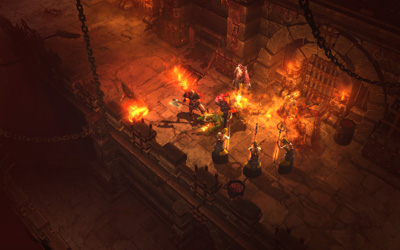
Diablo 3 screenshotMike Anderiesz, The Guardian:

Once in the game, it’s clear that the new 3D engine has been put to work on rendering a level of detail we haven’t seen in the series before. Superb lighting effects make even Act 1’s formulaic dungeons seem more atmospheric, but once you reach Act 2’s Caldeum and beyond, more spectacular locations and draw distances emerge. Enemies may have a tendency to swarm mindlessly towards you, but they come in large numbers and reasonable variety.

Not every improvement pays off, however; there’s far too little destructible scenery and context-sensitive traps – such as falling chandeliers or rolling logs – sound like a great idea on paper but require such careful lining up of enemies you won’t be troubling with them after the first few attempts.

There’s improvement as well as innovation, particularly with the UI. With a permanent Portal spell to take you back to nearby towns and a much smarter way of choosing and comparing items, you can now focus on the important task of killing things.

[…]

So the key question remains, was Diablo 3 worth the 12-year wait? That depends on how you play it – for single players, it’s an entertaining and gorgeous-looking dungeon hack but it’s a bit short, extremely linear and hardly pushing any boundaries. Playing online (and Blizzard isn’t really giving us a choice) makes it a better balanced and more compelling challenge, with all the potential to be the kind of lifestyle substitute that Diablo’s legion of hunter-gatherer fans should relish.

Read More »

Diablo for PC

So, last night, like millions of other cool, socially well-adjusted people nerds, I went out and eagerly purchased Diablo III. And then, like millions of other nerds cool, socially well-adjusted people, I also ran into immense frustration when my single-player experience was halted (in fact, never begun) because of various server issues. That’s a topic for another day, but I did run across a pretty cool bit of trivia while waiting for Diablo III to install. While the installation process was happening, eager gamers can read a short illustrated primer that details about the stories in Diablo and Diablo II. You remember this guy?

Warrior from Diablo

Of course you do. His name? Aidan. Yep, that’s right. The Warrior from Diablo, that game that stole hours-upon-hours-upon-hours of my teenage life, had the same name as me. Little did I know that when I created a new character a gave him my name, that I was only following the true canon of the series.

My hidden and tragic past, from the Diablo Wiki:

Aidan lived with his father as he grew up. The earliest information we have about him is that he served in his father’s army and was under the command of Lachdanan when he led the assault against Westmarch prior to the events of Diablo I. Upon returning to Tristram and seeing his father raised from the dead, his younger brother missing and Lazarus gone, he journeyed into the depths of the labyrinth under the Cathedral.

As he journeyed deeper and deeper into it he not only found and killed his own father as the Skeleton King, he also killed Lazarus and his own brother who was at the time possessed by Diablo.

The further down he’d gotten however, the larger Diablo’s influence over him had grown. The Lord of Terror recognized what a fine host Aidan would make, and so slowly crept into his mind. Once Diablo was slain, Aidan had become convinced that in order to contain Diablo he had to shove the soulstone into himself, and so Aidan became the Dark Wanderer.

Read More »

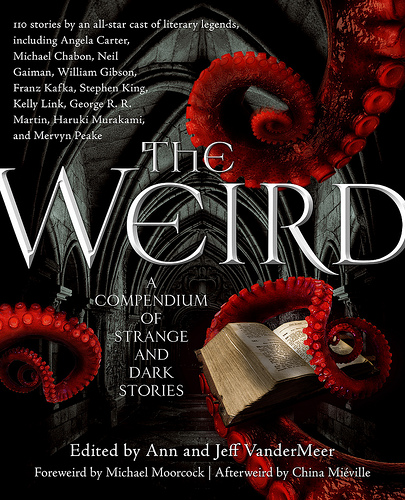
The Weird, edited by Ann and Jeff VandermeerThis week saw the publication in the U.S. of a massive (Amazon shipping weight for the hardcover: 3.1 pounds!) new anthology of fantastic literature: Ann and Jeff VanderMeer’s The Weird: A Compendium of Strange and Dark Stories. Initially published in the U.K. by Corvus last fall, this book contains 110 stories of fabulous, bizarre, sometimes esoteric weirdness. I read the whole thing at the end of last year, and it has produced a lot of fodder for contemplation. I found it difficult to write a brief, crisp review of it (although a review is in progress), but what really made this book significant to me is that I have been able to turn the stories over and over in my mind and find insights into reading, writing, story, genre, and some tenebrous insights into how I look at life and reality. Even better, some of the stories require you to struggle, to navigate your way through discomfort and perplexity, to really experience their value. I’ve written about it several times, and it has inspired a chapter in the book I’m currently working on. What’s great about The Weird is that you can find all kinds of odd, perplexing, sometimes horrible things in it, and once you take them in they start to worm themselves into your thoughts and ideas.

Well, they do for me at least.

And this is what I want to discuss in this blog post: the idea not just of weird fiction, but of how genre expectations — as reading frameworks — condition our engagement with fantastic literature. We all have our preferred categorizations for the stories we read: some people like SF, others speculative fiction or fantastic fiction. Some readers want to organize stories more precisely, right down to very specific sub-genres like paranormal romance or steampunk. Some people like micro-designations, while others like a big playing field. Myself, I was a rabid, obsessive parser of subgenres as a younger reader, but I found after some years that I was reading the same sort of stuff constantly, and I was getting, well, bored. I came to realize that my problem was with how I looked at genre, how I used genre and how my expectations and assumptions influenced my reading of a story. I have evolved into a big-tent sort of reader of fantastic fiction, to the point where I prefer to use the term fantastika, precisely because it opens doors into stories rather than closing them. It also incites discussions about genre and how we look at the stories we enjoy reading, and I like that. Read More »