Posts Tagged: Fantasy

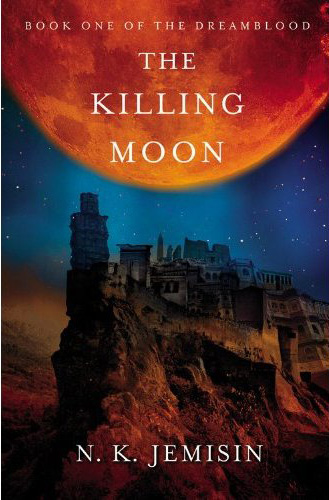
The Killing Moon by N.K. Jemisin

To anyone who’s read this blog, or is generally acquainted with the popular Fantasy fiction from the last several years, N.K. Jemisin needs no introduction. She’s been nominated for a serious number of awards (Locus, Hugo, Nebula), and, since the release of her first novel, The Hundred Thousand Kingdoms (REVIEW), has become something of a force in the Fantasy genre.

The synopsis for The Killing Moon is enough to get any jaded fan interested:

In the ancient city-state of Gujaareh, peace is the only law. Upon its rooftops and amongst the shadows of its cobbled streets wait the Gatherers – the keepers of this peace. Priests of the dream-goddess, their duty is to harvest the magic of the sleeping mind and use it to heal, soothe . . . and kill those judged corrupt.

But when a conspiracy blooms within Gujaareh’s great temple, Ehiru – the most famous of the city’s Gatherers – must question everything he knows. Someone, or something, is stalking its prey both in Gujaareh’s alleys and the realm of dreams. Ehiru must now protect the woman he was sent to kill – or watch the city be devoured by war and forbidden magic.

The Killing Moon is the first volume of her latest series, The Dreamblood Duology, and has received a number of positive reviews around the web. If, like me, you’re excited about Jemisin’s work, it looks like you won’t be let down. If you’re unaware of Jemisin, or haven’t tried her fiction, this is the perfect place to start.

And the reviews:

The Book Smugglers:

Gripping. Fascinating. Cool. All these mighty fine words that can be used to describe The Killing Moon. From lavish descriptions of Gujaareh and its temples and palaces to the detailed aspects of the social, political and religious structures, all of them intrinsically connected around the worship of the Goddess of Dreams, all is superbly well done. Although at points I did think there was a certain excess of exposition, I can’t deny that I gobbled it all up with pleasure. Although it is clear from early on who is behind the conspiracy that, I feel, is not the point of the story – the point is not only the HOW and the WHY but also the ways that said conspiracy and its motivation impact or will impact in the Modus Vivendi of not only the Gujaareh people but also of other peoples. Beyond that, even despite the originality of the setting, the idea behind the magic system being rooted in dream theory and the Dream-world as a PLACE reminded me a lot of Gaiman’s Sandman (not to mention that I thought of the Corinthian as well when the Reaper starts to make an appearance ) and this is a very positive thing in my book.

Also and I don’t think I can emphasise enough the level of coolness present in The Killing Moon but: NINJA PRIESTS. Yeah, baby.

[…]

What is so impressive about Gujaareh (and the other peoples we see in this book, particularly those of Kisua) is in its utterly fantastic holistic believability. We believe in this world and its characters because the culture is so well defined, the rules of magic so wholly conceived, the tensions between classes, between natives and foreigners, so utterly genuine. Reading a society like that of the Gujaareen makes it so glaringly apparent how lacking so many contemporary fantasy novels are in comparison – N.K. Jemisin’s worldbuilding is of the highest grade, and nigh unparalleled.

[…]

I loved this novel deeply, and I cannot wait for The Shadowed Sun. The Killing Moon, to put it simply, is the best book I have read in 2012 thus far.

Read More »

N.K. Jemisin, author of THE HUNDRED THOUSAND KINGDOMSN.K. Jemisin spilled the beans today about a new trilogy that she’s sold to Orbit Books, who published her previous two Fantasy series. Like those, this is also Epic Fantasy, but the setting is sure to capture your attention:

[T]his will be a postapocalyptic epic fantasy trilogy, set in a world of seismic magic users and enigmatic nonhumans called stone-eaters. I’m experimenting with writing the kind of trilogy that follows a single character through mutliple [sic] books.

Seismic magic? Post-apocalyptic Epic Fantasy? Enigmatic nonhumans? I constantly find myself envious of her imagination. Where do I sign up?

As always, I’ll pass along any news or details about Jemisin’s next (next?) series as I unearth it. Meanwhile, Jemisin is set to release her fourth novel, The Killing Moon, the first volume in The Dreamblood Duology, tomorrow, May 1st, 2012.

Suitup 3, Art by Nathan Twist: http://nathantwist.deviantart.com/art/Suitup-3-215636699

Recently, I read one of the most wonderful anecdotes I’d ever heard. Nichelle Nichols, who played Lt. Uhura on Star Trek, gave the keynote speech at Goddard’s 2012 Martin Luther King, Jr., and African-American History Month commemorative presentation. After Star Trek’s first season, she was set to leave. The stage was her first love and she wanted to pursue that instead of the television show. After confessing her feelings to Gene Roddenberry, he asked her to take the weekend to reconsider. That weekend she attended a NAACP fundraiser. During the event, she was asked if she would talk to a fan.

“I stood up and turned around, and looked into the beautiful face of Dr. Martin Luther King—my leader!” Nichols said. They discussed the cultural significance of Nichols’s role and her intent to depart television for the stage. She reflected on King’s response: “You cannot leave; you cannot abdicate,” he told her. “You don’t know what you mean to us. Every night that you’re on, we can look on and see what we’re fighting for.”

Her choice to remain created long-lasting ripples. Mae Jemison, a former NASA astronaut, cited Uhura as an inspiration for becoming an astronaut. Nichols’ work as a NASA recruiter also impacted the decisions of Sally Ride, Guion Bluford, Judith Resnik, and Ronald McNair. Whoopi Goldberg also points to Uhura as a turning point in her life, recalling that she ran through the house saying “I just saw a black woman on television; and she ain’t no maid!”

Without characters such as Uhura, we run into what Chimamanda Adichie calls “The Danger of One Story.” In her TED talk, the novelist discusses her childhood in Nigeria and recalls a number of instances where she or another found that their view of others was mistaken because they had only heard one story, one view of the others’ life. She starts with her experience reading foreign books as a young girl, how she came away with the belief that books had to have foreign characters and things she didn’t recognize from her own life. Until she discovered African literature, she did not realize that people like her could be characters in books.

Read More »

The Drink Tank #315, Handicapping the HugosIssue #315 of The Drink Tank, the Hugo Award-nominated fanzine edited by Christopher J. Garcia and James Bacon, just hit newstands efanzines.com and it’s dedicated entirely to examining this year’s Hugo ballot. It’s called “Handicapping the Hugos.”

Also included are thoughts on the awards from Charlie Jane Anders, Niall Harrison and some guy named “Aidan Mohr.” Despite the mispelling of my name, I’m absolutely thrilled to have been invited to take part in the analysis with several other Hugo-nominated fan writers (and Niall Harrison, who, damnit, should be a Hugo-nominated fan writer by this point,) all of whom have a strong online presence.

Also of interest are Garcia’s thoughts on the inclusion of SF Signal in the “Best Fanzine” category:

OK, there’s been a lot of folks in the blog community that were not happy with the Hugos last year.

They point out that much of fandom is blogs and podcasts and so on and they wanted to see them represented on the Hugo ballot. And there were others who didn’t like that and it went on and on. Aidan Mohr [sic] was one of the loudest folks decrying the lack of blogs and so on. There were others, but his were the most widely discussed among the folks I know. This nomination was probably not directly tied, though even I was a little surprised that it didn’t do better in the nominations last year . I expect it to destroy the rest of us completely. [W]hen it ended up somewhere around number 13 or so. It’s got a huge following, far bigger than any of the other nominees, or probably eFanzines.com in total!

So, go read “Handicapping the Hugos”, The Drink Tank #315. You’ll find insight into the ballot and also and interesting look at how another portion of the fan community views the awards and the nominated books/stories/writers/editors.

If you’re interested in learning more about The Drink Tank, its editors and the fanzine culture in general, check out Garcia’s “Ma Vie En Zines,” and article he recently wrote for A Dribble of Ink exploring fanzine history and culture.

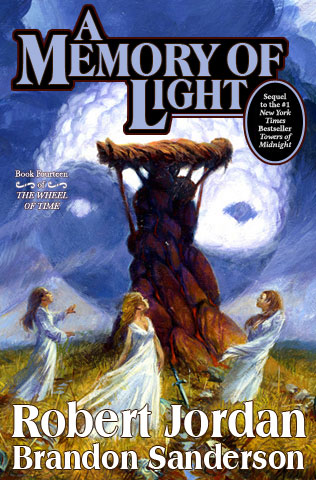
Cover Art for A MEMORY OF LIGHT by Robert Jordan and Brandon Sanderson, mocked up by Aidan Moher

Bayrd pressed the coin between his thumb and forefinger. It was thoroughly unnerving to feel the metal squish.

He removed his thumb. The hard copper now clearly bore its print, reflecting the uncertain torchlight. He felt chilled, as if he’d spent an entire night in a cold cellar.

His stomach growled. Again.

The north wind picked up, making torches sputter. Bayrd sat with his back to a large rock near the center of the warcamp. Hungry men muttered as they warmed their hands around fire pits; the rations had spoiled long ago. Other soldiers nearby began laying out all of their metal—swords, armor clasps, mail—on the ground, like linen to be dried. Perhaps they hoped that when the sun rose, it would change the material back to normal.

Bayrd rolled the once-coin into a ball between his fingers. Light preserve us, he thought. Light… He dropped the ball to the grass, then reached over and picked up the stones he’d been working with.

“I want to know what happened here, Karam,” Lord Jarid snapped at his advisor. Jarid stood nearby, in front of a table draped with maps. “I want to know where they are and how they drew so close, and I want that bloody, Darkfriend Aes Sedai queen’s head!” Jarid slammed his fist down on the table. Once, his eyes hadn’t displayed such a crazed fervor. The pressure of it all—the lost rations, the strange things in the nights—was changing him.

I didn’t expect Tor to release an excerpt from A Memory of Light, given its importances and the frothing demand for its release in early 2013, but, well, here it is. Remember when they used to charge fans $2.99 to read the prologue? This is the same excerpt read by Harriet McDougal, Jordan’s widow, at JordanCon. It’s and excerpt from the prologue, and not told through eyes of one of the main characters, though I’m sure no Wheel of Time fans are surprised by that.

What did you think of the excerpt?