Posts Tagged: Tor

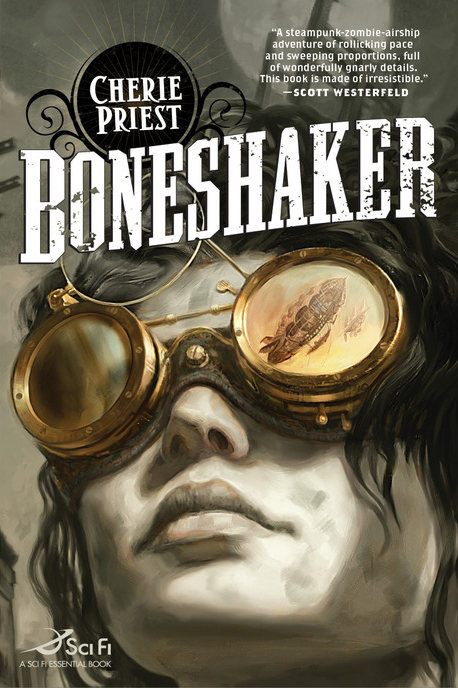
Boneshaker by Cherie PriestVia Variety:

Cherie Priest’s steampunk sci-fi novel “Boneshaker” is coming to the bigscreen with Cross Creek Pictures, Exclusive Media Group and Hammer Films onboard.

The companies said Wednesday that Hammer has acquired the rights to the novel. Project will be co-produced by Hammer and Cross Creek Pictures and co-financed by Exclusive and Cross Creek.

John Hilary Shepherd (“Nurse Jackie”) is writing the screenplay. Hammer head of production Tobin Armbrust is overseeing.

Priest’s novel is set in an alternate version of 1880s Seattle, where the city has been walled in and a toxic gas has turned many of its remaining residents into “Rotters,” more commonly known as zombies. A young widow hunts for her teen son in the Seattle underworld while dealing with airship pirates, a criminal overlord and heavily armed refugees.

The novel, published in 2009 by Tor Books, is the first in a series set in the period, which has Priest has dubbed the Clockwork Century. Second novel “Dreadnought” was published in 2010, and the third, “Ganymede,” was recently released.

Tor Books is releasing the fourth in the series, “Inexplicables,” in 2012, and last week announced a deal with Priest for her to write a fifth. That book will be called “Fiddlehead.”

“It’s like Jules Verne meets ‘Resident Evil,’ and we’re thrilled to have such a fun, commercial potential franchise in Boneshaker,” said Cross Creek’s Brian Oliver.

Cherie’s an absolute sweeheart and this couldn’t happen to a better person. Though I haven’t read Boneshaker, my impression of it indicates that Priest’s Zombie-filled, alternate history version of Seattle will traslate wonderfully to the screen. As always, take the news with salt; it’s Hollywood, afterall.

Songs of the Earth by Elspeth CooperI was in hospital recently (my gallbladder and I were in the middle of an acrimonious break-up) and as you do, I got chatting with my fellow inmates.

‘So, what do you do?’ asked the woman in the opposite bed, in the pink bunny slippers.

‘I’m a writer.’

‘Oh!’ Her eyes lit up. ‘Romance, is it?’

‘Er, no.’

‘Crime?’

I wouldn’t mind Val McDermid’s sales, I thought. ‘Actually, I write fantasy.’ I held up my copy of The Name of the Wind. ‘Like this.’

My interlocutor peered at the cover, but obviously didn’t recognise the name. ‘Is that like that Twilight, then? All vampires and werewolves and stuff?’

‘Not really. It’s more sword and sorcery.’ In the face of her blank expression, I fumbled for the one name I was sure she would have heard of. ‘Lord of the Rings.’

The shutters of indifference came down with a near-audible clang. ‘Oh. Stories for boys.’

I did try to explain, but apparently because I didn’t write about oversexed earls in pursuit of fluttering virgins, or ghastly Yakuza executions in grim grey cities, I was now off the lady’s literary radar. What she would have made of the longsword hanging up in my office I do not know.

The doctor who came to draw some blood asked me the same question, in a hearty, take-your-mind-off-what-I’m-doing-with-this-needle voice, whilst prodding my inner elbow for a vein.

‘So, what do you do?’

‘I’m a writer.’

‘Historicals?’

‘No, fantasy. Ow.’

‘My son’s into all that whatchamacallit, Assassins’ Creed, on his X-Box. I’ll get some gauze to wipe that up.’

A year previously, I’d had a similar conversation with my publisher. She’d just had a meeting with the fiction buyer from Waterstones, and the author gender vs target readership issue had reared its ugly head: boys won’t buy books written by girls, and it can affect sales by as much as ten percent – the horror! My publisher and I even went so far as to toss around some gender-neutral pen names like Alex Cooper before she decided that female was the new black for fantasy writers, and that was that.

Clearly, the publishing industry is well ahead of the curve here; for the rest of the population, fantasy is just not something that girls do. It is still perceived as a very male-dominated genre, the province of geeks and gamers and lank-haired Lurches in Slipknot hoodies. The likes of Jemisin, Downum, and Cashore have not yet penetrated the wider public consciousness. Meyer has, Charlaine Harris has, but we can’t all have big-budget TV shows and movies and enough with the damn vampires already! You’re giving us girls a bad name.

I was rather hoping that the Game of Thrones mini-series would start a few more cracks in the genre glass ceiling; if anything it seems to be reinforcing it, but that’s another issue, being debated elsewhere by minds more articulate than mine.

So, a question for the floor: if a woman tells you she’s a writer, do you assume that because she’s a woman, she won’t be writing about sharp edges, harsh realities? Does the gender of the author alter your perceptions of a book as you’re browsing in the store, and make you more likely to pick it up, or less?

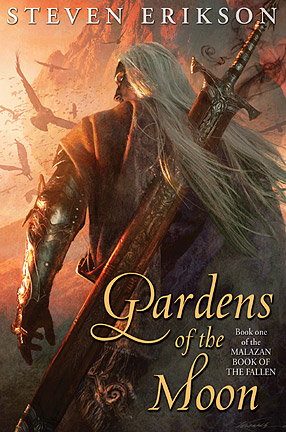
Gardens of the Moon by Steven EriksonThough he has no website of his own, Steven Erikson is in the midst of blogging over at Life as a Human. In the latest in his series of articles title Notes on a Crisis, Erikson digs deep into his craft.

What’s neat is that he does so by taking an excerpt from his upcoming novel, The Crippled God, the final volume of the Malazan Book of the Fallen series, and breaks down what one short scene can reveal about the structure and thought process necessary to build a much (much, much, much) longer piece of fiction.

In a general sense, I write elliptically. By that I mean I open sections with some detail I want to resonate throughout the entire section, and through the course of writing that section you can imagine me tapping that bell again and again. Until with the final few lines, I ring it one last time – sometimes hard, sometimes soft, depending on the effect I want, or feel is warranted. It’s become such a habit now that I often do it without conscious thought.

On a most basic level it shows up in paragraphs (and no, there’s nothing unique to me in any of this). Look two paragraphs upward on this screen. The opening line talks about multiple points of view; the last line describes the many ways of seeing the world. But that last line isn’t just reiterating the first one. Something is added (in this case, a personal comment on my desire to experience every one of them). It’s probably the only structural lesson I learned in school that I still use on occasion – the whole introductory and concluding sentences to frame a paragraph.

Anyway, extrapolating this pattern is how I write — within a scene, from section to section, from chapter to chapter, from novel to novel. While the narrative infers something linear, as in the advancement of time and a sequence of events, in fact the narrative loops back on itself again and again. And each time it returns, the timbre of that resonance has changed, sometimes subtly, sometimes fundamentally.

I read somewhere that Scott Bakker has recently complained that I’m repeating myself in my series, but he’s missing the point. It’s more that I return again and again to particular themes, from as many perspectives as I can. Maybe it still rates as a flaw in my writing, but it’s also my whole point in writing. Forget the conceit of hunting for the right answers – let’s start with trying to find the right questions. Personally, I doubt I will ever get past that stage; for me, the more ways I discover of looking at something, the more humbling the whole exercise becomes (Think you got the answers? Sorry, don’t believe you. Never will).

Elliptical. Looping back. It can be an image, a detail of setting, a mood or flavour, a particular action, or an idea. There’s countless ways of coming round back to where you started, and I admit I like the sly ones, though sometimes it pays to be more obvious.

Erikson’s comments on Bakker’s observations are interesting (in no small part due to the fact that Erikson was a large influence on Bakker first being published), and reveal a little bit about why his series encompasses ten massive volumes. As he says, some readers consider this repetition to be a flaw in his writing (which is somewhat my issue with the Malazan books, though I’ve only read two); but if it’s the point he’s trying to make, then how does one judge whether the Malazan books are a success? Do you care if he achieves his personal goals of recursive reflection if it gets in the way of proper storytelling? Do you like his novels because of the themes and the similarities in the characters’ internal battles? Or do you like it because even the weakest of his characters could rend the world in half on a cranky day?

Whatever the case, Erikson goes into a fairly in-depth analysis of the excerpt, picking apart the structure and language he uses and gives rather lucid and insightful consideration to the nitty-gritty decisions made by writers almost every day. Will it be useful to everybody? Maybe not, Erikson has a very defined style. But it’s certainly a revealing look at the process behind one of the most complex, convoluted and, well… huge fantasy series on the market today.

You can read the whole article, and the excerpt, HERE.

Terry Goodkind, asshole.

I generally stay away from taking jabs at people in ill-faith (okay, that’s a bit of a white lie, but still…), but this quote, from an old USA Today interview (via Ansible) with Terry Goodkind, author of such bastions of literature as Wizard’s First Rule, Naked Empire and Chainfire, just screamed for some attention. One can only assume that the dude’s still an asshole.

‘First of all, I don’t write fantasy. I write stories that have important human themes. They have elements of romance, history, adventure, mystery and philosophy. Most fantasy is one-dimensional. It’s either about magic or a world-building. I don’t do either.’

No. No he does not. But, hey, at least he’s aware of his shortcomings!

I suppose the real problem, though, is that we’re all too ignorant to see past the Dragons, roiling balls of liquid fire, sword fights, Wizards, alternate realities, prophecies, Evil Dark Lords, princesses, and massive army battles to understand that he writes not Fantasy, but philosophical explorations of what it means to be a human being.

Another gem includes:

Weymouth, MA: In your opinion who is the most must-read, cutting edge writer publishing today?

Terry Goodkind: Ayn Rand.

Who wants to be the one to break news of Ayn Rand’s death to Goodkind?

Steve Erikson and IRobert, over at Fantasy Book Critic, just posted an interesting interview with Steven Erikson, author of the mighty Malazan Book of the Fallen. Among general questions about the series and tidbits about the upcoming novel, Toll the Hounds, Robert asks Erikson about what’s coming after he’s done with the ten volume Malazan series. Here’s what he had to say:

Release dates remain unknown. I am into the ninth chapter of Dust of Dreams/strong> right now and things proceed apace. I anticipate completing the manuscript some time in the autumn of this year. I normally roll straight into the next novel with not much of a breather between the two, then get slowed up doing the edited version (of the previous one) that comes back from the publisher. With a novella or two thrown in as well.

I don’t think it’s a secret any more that I’ve signed with Bantam UK for six more fantasy novels. Two trilogies, in fact. But not one a year – that pace (with novellas thrown in) is wearing me out. I won’t get into any details on the books, or whatever stand-alone works I may squeeze in here and there. Not yet. Too early.

Hmm… two trilogies? Could one of those be an exploration of the Ascendants’ pasts that I hinted about a few months ago?