According to The Verge, Disney is planning to release a new Star Wars film every summer for five years. This schedule will begin with Episode VII in 2015, VIII in 2017, and IX in 2019. Sandwiched between these releases will be standalone films, presumably starring some of the series’ more popular characters (Yoda, Han Solo and Boba Fett have all been rumoured.
Thoughts?
Publisher: Jo Fletcher Books UK -
Pages: 704 -
Buy: Book/eBook
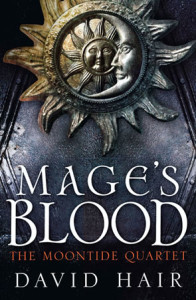
In a fantasy marketplace that has only recently seen a conclusion to Robert Jordan’s iconic Wheel of Time, and long suffering delays to George R.R Martin’s A Song of Ice and Fire, I’ve compiled a list of authors and series I can recommend in their place, which includes: Peter Brett’s Demon Cycle, Elizabeth Bear’s The Eternal Sky, Daniel Abraham’s The Dagger and the Coin, and Brent Weeks’s Lightbringer. That established, David Hair’s first adult novel, Mage’s Blood is one of the better epic fantasy series first instalments I’ve read in recent years.
It should be noted that when I refer to the term epic fantasy, I really mean it. Sweeping conflicts, clashes of cultures, political and personal entanglements, rich and in-depth magic, and mighty warriors dot the landscape. There’s even lavish descriptions of food,
…they ate a cold meal of dried meat and breads, washed down with a small flask of arak and some water, all from the wagon’s spoils. Tanuva Ankesharan’s best cooking could not match so wondrous a feast as this scavenged meal.
Written in limited third person from multiple points of views, Mage’s Blood does maintain some notion of good and evil. It walks a fine line though, often refusing to color individuals entirely one or the other. In that sense it’s quintessential modern epic fantasy, but couched in a very expected setting. Read More »
The birth was messy. Sweat, blood, tears, and cerebrospinal fluid slicked the white tile. Dirty forceps, scalpels, and fountain pens were strewn haphazardly. In a pail of ink, a half-formed idea wailed. The thought-doctors could only guess if it would make it.
–From Skull Born, the very first (and thankfully unpublished) Lacuna story
Metafiction, at its most basic, is fiction about fiction. This can take a variety of forms. Everything from John Barth’s Lost in the Funhouse to Carlos Ruiz Zafon’s Shadow of the Wind, can be considered metafiction.
Stories about storytelling have always interested me. An early influence on my writing were Walter Moers’ Zamonia books, specifically The City of Dreaming Books. In it, he imagined a decadent, surreal wonderland of writers, publishers, and booklovers. Books and stories literally came alive and posed serious dangers to the citizens of Bookholm.
The first Lacuna story was more-or-less Bookholmian fan fiction as seen through the eyes of China Mieville. It was very metafictional, with book ideas being torn from the skulls of writers in a bizarre send-off of a birthing ritual. These idea-babies were fed books, poems, emotions; anything to make them more robust. Literary devices manifested as physical deformities on the idea-husk. They would develop into golemic mandrake roots of pulp and story. Once they became large enough, the authors would consume the idea, go into a trance-like state, and write an entire manuscript in one sitting. Read More »
Publisher: Tor Books -
Pages: 800 -
Buy: Book/eBook
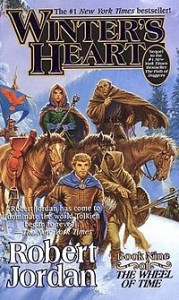
I have spent the past eight commentaries talking about where I was as a reader in my early-to-mid 20’s when I first read (and then re-read, in some cases more than twice) the first eight volumes of The Wheel of Time. For the first seven, I read them all within a two-week stretch in-between and just after my MA exams in November 1997. The eighth volume, The Path of Daggers, I bought on its release date and re-read either once or twice (memory is faint) before November 7, 2000, when the ninth Wheel of Time novel, Winter’s Heart, came out in the US.
The astute readers probably have realized by now that if I am talking about books last read around 10 years ago, then it must have been Winter’s Heart that gave me a long pause in my reading. That is indeed true, as not only was there a shade over two years to wait until the tenth volume, Crossroads of Twilight, but I never re-read any of the first nine in the interim, nor did I read that volume until 2006 on a lark. What happened in this reading that finally caused me to do the metaphorical throwing up of hands in surrender? Read More »
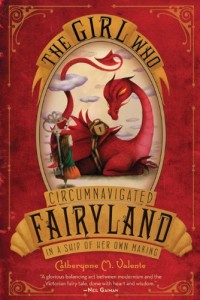
It’s difficult for me, personally, to read portal Fantasy without comparing it against Neil Gaiman’s Stardust, especially those with a fairy tale lilt to its voice. It’s hardly fair to hold one novel against a work of fiction that still, just by evoking its name, transports me, like its protagonist, to another time, another place: a rainy December afternoon, just after Christmas, when I first discovered the beauty of Gaiman’s whimsical imagination. The Girl Who Circumnavigated the World in a Ship of Her Own Making (furthermore, The Girl Who…) has such soul, such a wonderfully commanding and joyous relationship with language, myth and fairy tale, however, that soon after its opening scene, I stopped comparing it against other works, and, in a critic-proof manner that makes this review difficult to write, began to read the work without thought. I fell into its pages, and only crawled out again alongside September, a girl who loses and finds herself in Fairyland.
September read often, and liked it best when words did not pretend to be simple, but put on their full armor and rode out with colors flying.
Though September’s tale is familiar, the telling of it is extraordinary. She is an intelligent girl, though her intellect is often lost behind the naivety of her youth and gets her into as much trouble as it solves. Much of what a reader needs to know about September is summed up in a particular passage that caught my attention:
One ought not to judge her: all children are Heartless. They have not grown a heart yet, which is why they can climb high trees and say shocking things and leap so very high grown-up hearts flutter in terror. Hearts weigh quite a lot. That is why it takes so long to grow one. But, as in their reading and arithmetic and drawing, different children proceed at different speeds. (It is well known that reading quickens the growth of a heart like nothing else.) Some small ones are terrible and fey, Utterly Heartless. Some are dear and sweet and Hardly Heartless At All. September stood very generally in the middle on the day the Green Wind took her, Somewhat Heartless, and Somewhat Grown.
p. 4
Read More »