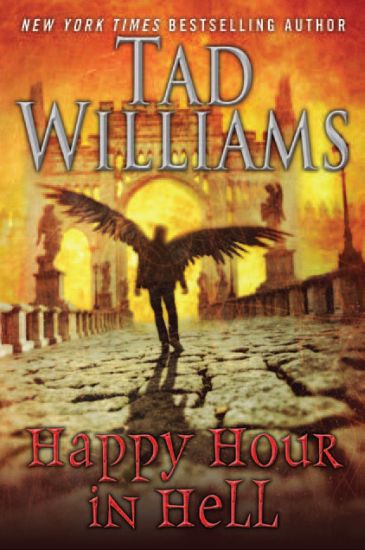
It’s, um… orange. And fiery. To be honest, even six month after reading the predecessor volume to Happy Hour in Hell, The Dirty Streets of Heaven, I’m still unsure what I think of this direction for Williams. Equally, I’m unsure what I think of this cover. Apologies for the poor quality.
Publisher: Tor Books -
Pages: 896 -
Buy: Book/eBook
As I believed I mentioned somewhere earlier in one of my commentaries, A Crown of Swords was actually the first WoT book that I read. I was in the midst of my MA exams (I want to say I purchased the book during the week between my MA writtens and my MA orals) and I wanted something light to read. I was doing my usual late-night grocery shopping when I thumbed through the books in the display. One of them looked somewhat promising. Said it was one of several books by this author (I should note that this was the alternate paperback cover that didn’t feature any of Darrell Sweet’s artwork, or else I might not have ever picked up the book in the first place), but no indication if this series was a bunch of stand-alones or part of an ongoing serial. Since it was only $7 or so and I was bored, I picked it up and read it the next day/night or two between my readings on the Second International. Read More »
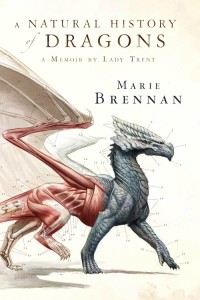
“Be warned, then: the collected volumes of this series will contain frozen mountains, foetid swamps, hostile foreigners, hostile fellow countrymen, the occasional hostile family member, bad decisions, misadventures in orienteering, diseases of an unromantic sort, and a plentitude of mud. You continue at your own risk. It is not for the faint of heart – no more so than the study of dragons itself.”
So states the preface of Marie Brennan’s A Natural History of Dragons: A Memoir by Lady Trent, the first volume in a projected series recording the life and times of the eponymous heroine, a self-taught dragon naturalist living in Scirland, which is more or less an analogue for Victorian England. This first book constitutes an accounting of Isabella’s childhood and adolescence, her marriage to Jacob Camherst, an academic, and their expedition to the mountains of Vystrana (which is more or less an analogue for Romania) to learn about dragons, which ends up being complicated by both the local religion and political intrigues.
A Natural History of Dragons is thematically much less concerned with dragons than the sexist social attitudes which attempt to curtail Isabella’s interest in them.
In hindsight, the dissonance between my expectations for this book and what it actually turned out to be is a contributing factor in my ambivalence towards it. Having been seduced by the undeniably beautiful cover art, I envisaged a story with a strong, primary focus on dragons – their physiognomy, habits, breeds and other peculiarities – set against a backdrop of detailed magic-scientific worldbuilding; something like an adult, novelised version of Graeme Base’s classic The Discovery of Dragons, perhaps. In my defence, I suspect this is an impression that the cover, title and preface all strive to convey to some extent, and it may well be that this constitutes an accurate assessment of the series as a whole. This first book, however, is thematically much less concerned with dragons than the sexist social attitudes which attempt to curtail Isabella’s interest in them, and as such functions more as a protracted justification as to how and why a Scirling lady ended up as a scholar and explorer than as a natural history. Obviously, dragons still make an appearance, but having anticipated a story that was primarily an adventure, it came as something of a let-down to find myself reading one that was much more internal and domestic. Read More »
It’s social science fiction, experimenting with questions of power, compromise, dependence and independence, identity and self-determination.
When I started thinking about how to describe The Best of All Possible Worlds, I decided not to call it a romance for two reasons. First, I didn’t think it was a romance. I have a certain admiration for romance writers because they possess a skill set that I don’t have, not yet. I knew that what I’d written lacked the tension and angst and passion I associate with the traditional romance template. Calling it a romance, then doing a bait and switch into Science Fiction, felt dishonest. Second, I couldn’t guarantee there would be any romantic subplots in the sequel (though I also can’t guarantee there won’t be).
Don’t think I’m being polite when I say I admire romance writers. Remember that Sturgeon’s Law applies to all genres. A good, well-written romance is as beautiful and rare as a good, well-written science fiction novel. Even better than both is a blend of genre, a book that can give you a little bit of this and a little bit of that and somehow bring it all together in a very satisfactory, holistic and human way. People fall in love in the future, they encounter mysteries both mundane and uncanny, have adventures, make bad career decisions, experience personal crises and grow – sometimes all at the same time. I don’t mean to suggest this should be all packed in haphazardly like a soap opera, drama piled upon drama for no good reason. There must be order: minor subplots tweaked to reinforce the main plot, characters and situations juxtaposed in ways that create resonance, themes and motifs orchestrated to please and satisfy the subconscious. Read More »
Publisher: Tor Books -
Pages: 320 -
Buy: Book/eBook
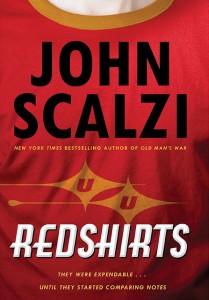
Like many twenty-something Science Fiction fans, I grew up with a love of Star Trek and Star Wars (yeah, both of ’em. Come at me!) gifted to me by a family member. Star Trek, in particular, was a shared interest between me and my mom. I couldn’t match her, who read every novel published, and watched every episode of every series, in her enthusiasm, but I hold a fond spot in my heart for Geordi La Forge, Data and Quark, and even before-my-time Sulu and Kirk. That love in mind, Redshirts was of particular interest to me in its attempt to deconstruct the lazy narrative ambitions of network television and the Science Fiction genre as a whole.
The main narrative in Redshirts is told through a tight third-person voice, following Ensign Dahl, who, in very un-Scalzi-like fashion, is plain. Yeah, he’s also likable, like all of Scalzi’s other protagonists, but lacks the acidic tongue and wit that usually marks Scalzi’s other stars. This plain personality is even discussed at one point, when two characters examine his place in the overall narrative. They eventually peg as the everyman protagonist — which, of course, he is. The rest of the cast, however, more than makes up for this plainness, and Scalzi’s trademark humour and mile-a-minute dialogue hums along as expected. Read More »