Speculative Fiction 2012, The Years Best Online Reviews, Essays and Commentary, edited by Landon and ShurinLazy cut & paste job here, since I clearly have nothing else to prove to the online SFF writing/fandom circle.

Speculative Fiction 2012: The Best Online Reviews, Essays and Commentary announced its lineup of contributors, Wednesday. Edited by bloggers Justin Landon (Staffer’s Book Review- US) and Jared Shurin (Pornokitsch – UK), SpecFic ’12 collects over fifty pieces from science fiction and fantasy’s top authors, bloggers and critics.

Author and podcasting sensation Mur Lafferty, whose newest novel The Shambling Guide to New York City is due out from Orbit Books this Spring, has agreed to write the foreword. “Lafferty’s writing career germinated online. She’s been a pioneer in the space and understands why the work in this book is so important. She’s the perfect person to put it into context,” said Landon.

Landon and Shurin also announced that they will pass the torch in 2013, establishing a precedent of rotating editors every year. The 2013 volume will be edited by Thea James and Ana Grilo of The Book Smugglers. Shurin commented, “We’re excited to see this move forward with Thea and Ana. They have a great perspective on the genre community that’s also very different from our own. 2013 couldn’t be in better hands. I’m really looking forward to working with them as Jurassic London continues to publish the series.”
Read More »

Lord of Chaos by Robert Jordan

Publisher: Tor Books - Pages: 720 - Buy: Book/eBook

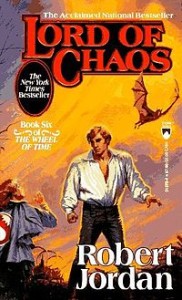
I’ve reached the halfway point at least in this series to date. Death is like a feather, duty like a mountain, and around 5000 pages of WoT is like carrying a 400 lb. woman wearing spandex and a tube top on your shoulders as you run up that mountain. Not the most pleasant of images, true, but this book was much more of a slog than the previous book, The Fires of Heaven, had proven to be.

When I first read Lord of Chaos back in November 1997, I even then found it to be the most difficult of the seven books to date to enjoy. Back then, used as I was to reading cultural and religious histories in English and German, it wasn’t the size of the novel that daunted me but rather how disjointed it felt. Nearly 13 years later, that sense of disjointedness was even more pronounced. It was a struggle at times to pay attention to what was transpiring, which might explain in a perverse fit of reasoning why I am reviewing it so soon after completing it (I finished it about an hour before I began writing this post), when I typically wait 1-2 days. Between the often-interchangeable character types (Aes Sedai, Cairhein, Aiel, Forsaken, Tairens, etc.) and the over-explanations of things that I first read about several books ago, I fear my own complaints may become just as repetitive if I don’t spice them up with some actual observations. Read More »

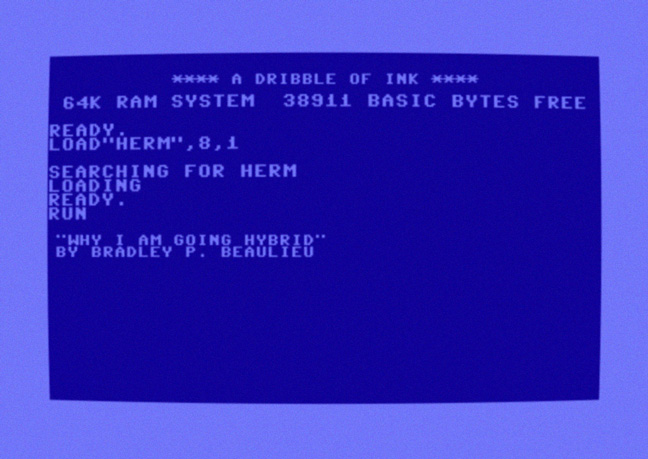
why-i-am-going-hybrid-by-brad-beaulieu

I shuddered at the thought of switching editors mid-stream, as many of my colleagues have been forced to do.

Editor’s Note: When news came that Bradley P. Beaulieu was leaving his publisher, Night Shade Books, and making the change to self-publishing, I was puzzled and intrigued. I’ve invited him here to talk about his experience, his decision and the changing landscape of publishing. If you’d like to support Beaulieu, he is currently running a Kickstarter to support the relaunch of his trilogy, The Lays of Anuskaya.

Several months back, I learned that my editor, Ross Lockhart, was let go from Night Shade Books. It had been very good to work with Ross up to that point. He was enthusiastic about the series, he kept the wheels of publishing (at least for my books) oiled and running smoothly, and he gave me some great advice on the series. I’m grateful he was there to help for all three of the books in The Lays of Anuskaya trilogy, and I shuddered at the thought of switching editors mid-stream, as many of my colleagues have been forced to do. Such a change can end up well in the end, but it can just as easily cause serious and permanent damage to an author’s career.

So Ross’s departure was worrying news, indeed. It comes as no surprise to any who have cared to look that Night Shade has been a cash-strapped business for some time. This is bad enough, worrying about where your future with them was headed, but the loss of my editor made me doubly worried about how my books would now be handled. Taking a pragmatic look at the change, cutting back on staff is normal in business. It can help a business survive. But when it happens it means that fewer people will be doing a lot more things, at least in the short- to medium-term. None of this boded well for the release of my third book, which frankly I hadn’t heard much about from my publisher. Not having heard anything different, I had assumed it would be coming out in April of 2013, as the first two books had been released that same month. Everything else—the initial editing, copy edits, and artwork—were all in works already, so things seemed good for an April release, even if it would be a bit rushed. Read More »

Cover Art for THE HEROES by Joe Abercrombie

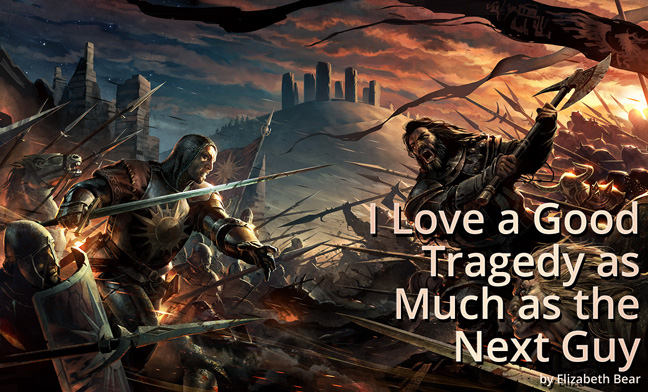
The conversation in the genre blogosphere lately has been leaning heavily to grittiness, grimdark, and whether they serve a purpose—and whether there’s any difference between the two. A lot of bloggers and commenters seem to be settling on the idea that “grimdark” is the pejorative, so perhaps that is how I will use it here.

Now, I love a good tragedy as much as the next guy. If the next guy is William Shakespeare.

I believe in fiction where actions have consequences, and sometimes terrible prices are paid, and sometimes good people meet fates you wouldn’t wish on Count Rugen. I would argue that darkness and uncertainty are a needful thing; that without them, there are no stakes, no emotional engagement. Read More »

Drakenfeld by Mark Charan Newton

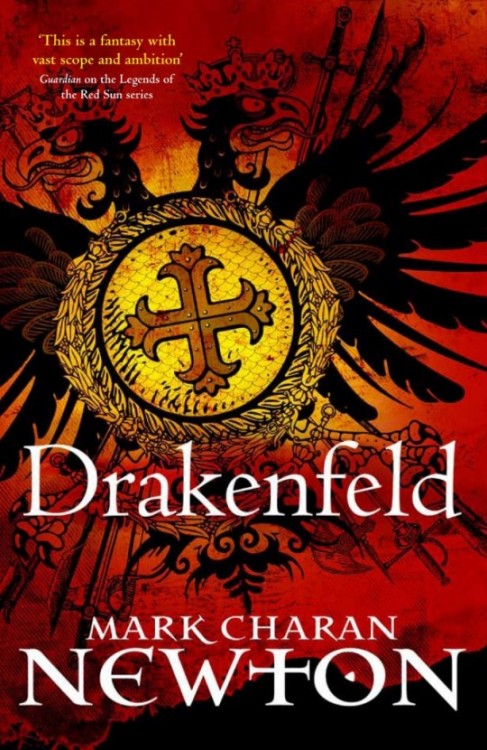
I’ve made something of a career out of ripping into the many covers for Mark Charan Newton’s novels. Sometimes it’s in good fun, sometimes I’m legitimately offended. He’s got so many covers at this point that I’ve lost track of them all. This time around, however, Pan Macmillan has crafted together a cover that, I, well… like. It’s impactful, maybe a little plain, but steps away from the more traditional ‘Epic Fantasy Hooded Figure/Badass/Brooding’ cover trao that a few of Newton’s other covers fell into. I wouldn’t be surprised to see this angled at a Historical Fiction audience.

Newton discusses the cover, and why he feels like it fits so well:

Of all my many covers, this is by far the best and most appropriate. It really sums up the book, because nations (or rather nationalism) are core to the series, and the idea with the covers is that each novel features a coloured banner representing the country in which the novel takes place. The one above is the banner of Detrata, with a double-headed falcon, various glaives and swords and a lovely icon. It also evokes the classical world, which was – as regular followers of the blog might have guessed – a major inspiration for the novel. I like to think that the main continent of Vispasia could sit just off the classical maps, as some forgotten corner of the world yet to be discovered by archeologists.

I’ve read a portion of an early draft of Drakenfeld and enjoyed it quite a bit. I think Newton is spot on in his description of the cover. The multi-coloured flag approach is interesting, and, should the publisher follow through with it, should provide a nice looking set of books when the series is done.