I was asked for this post to write about hope in fantasy. And that means I need to talk about grimdark.
I was asked for this post to write about hope in fantasy. And that means I need to talk about grimdark. (Definition from TV Tropes here, for those who need it.) And I need to say, before I start, that I am a practitioner of grimdark; the Doctrine of Labyrinths quartet (Melusine (2005), The Virtu (2006), The Mirador (2007), Corambis (2009)) can be nothing but. So I’m not speaking as someone who abhors grimdark, but as someone who loves it.
One of the things behind grimdark, I think–and it’s not just grimdark, either, but most of Anglophone literature since somewhere around World War I–is a conviction that being pessimistic, tragic, depressing, dark means that a text is more “realistic,” more “serious,” and therefore inherently “better” than it would be if it allowed optimism and hope. I’ll get into the issue of “realism” later, but I want to point out here that tragedy is not inherently “better” as a literary form than comedy and writing a tragedy does not demonstrate greater skill/talent/genius than writing a comedy. (Kind of the reverse, in fact. Comedy is hard.) Read More »
On Saturday, April 19th, the 2014 Hugo Award nominations were announced, and I’m proud to announce that A Dribble of Ink is represented in two categories: Best Fanzine and Best Related Work.
Best Fanzine
Alongside The Book Smugglers*, Elitist Book Review, Journey Planet and Pornokitsch*, A Dribble of Ink is in the running for Best Fanzine of 2013. If you’ve followed my writing for any time, you’ll know that I’ve long been critical of this category for dipping its pen into the same inkwell too often, so I’m thrilled to be included on a ballot that is guaranteed to see a new winner.
On that note, I expect to get crushed by Pornokitsch and/or The Book Smugglers, but it’ll be fun competition between these friends of mine regardless. Read More »
Via Tor.com, the list of nominees for the 2014 Hugo Award nominees (with added squee!):
2014 Hugo Award nominees
Best Novel (1595 ballots)
-
Ancillary Justice by Ann Leckie (Orbit)
-
Neptune’s Brood by Charles Stross (Ace / Orbit)
-
Parasite by Mira Grant (Orbit)
-
Warbound, Book III of the Grimnoir Chronicles by Larry Correia (Baen Books)
-
The Wheel of Time by Robert Jordan and Brandon Sanderson (Tor Books)
Read More »
If it wasn’t for unconventional publishing, that would have been the end of the road for Hollow World.
Publishing today is a complicated business full of many options and proponents on different sides vocalizing their path is “the right one” with full-throated conviction. For the record, I see the advantages (and disadvantages) of each. I also don’t think there is a “universal right choice,” just a choice that is going to best fit on an author by author basis.
Currently I’m a ‘hybrid author‘ because I have works available both through self-publishing and traditional routes. What’s more, my traditional routes include both big-five and small presses and there is a world of difference between them.
I think Hollow World, my latest novel, was probably produced in one of the most unconventional ways possible. First it was submitted to my publisher, Orbit. My editor loved the book, but the marketing department didn’t. They need to focus on what sells (and I don’t begrudge this mindset) and currently they think that means military science-fiction and space operas. A classic-style, social science fiction novel such as those written by Asimov or Wells just didn’t fit the bill.
If it wasn’t for unconventional publishing, that would have been the end of the road for Hollow World, and I know far too many authors who have shelved books because they couldn’t get them picked up (or were offered too little). But from past experience, I knew a closed door just means I should look around for an open window. Read More »
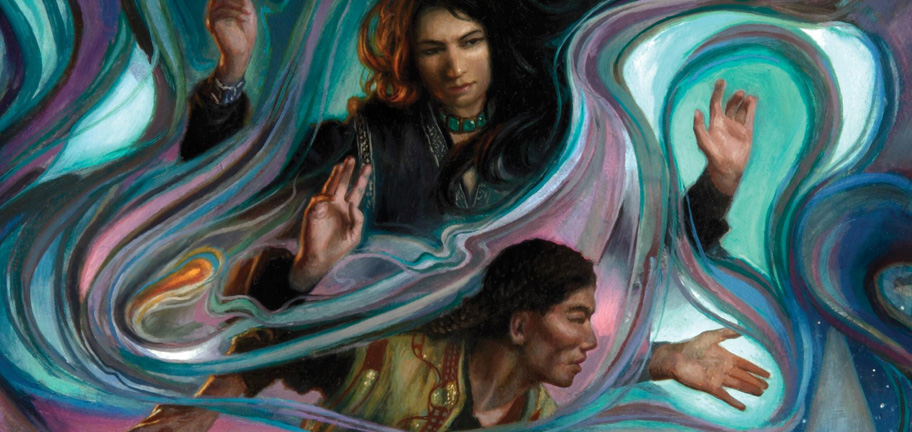
I’ve made no secret of my excitement for Elizabeth Bear’s The Eternal Sky trilogy. I recently sang my praise of the trilogy in a review of the final volume, Steles of the Sky, which was released yesterday:
Bear fills Steles of the Sky, and the entire trilogy, with a masterfully crafted meld of Asian and Middle Eastern mythology, legend and history with the wholly unique and deeply considered secondary world she has created. Shedding the tried and true landscapes and politics of faux-medieval western Europe, Bear introduces readers to a diverse world and political landscape that avoids feeling like the same ol’, same ol’, despite readers a story that uses many of the genre’s most recognizable tropes—ancient magic; an exiled youth of royal blood; a journey from one side of the map to the other; evil sorcerers; dragons; clashing armies.
So, it is with no small amount of enthusiasm that I pass along news that Bear has sold a sequel trilogy, The Lotus Kingdom, to Tor Books. “While Range of Ghosts, Shattered Pillars, and Steles of the Sky comprise a complete story arc in and of themselves,” said Bear, via The Big Idea on John Scalzi’s blog, “I can now reveal that Tor will be publishing at least three more books in this world.”
The Lotus Kingdoms, will follow the adventures of two mismatched mercenaries–a metal automaton and a masterless swordsman–who become embroiled in the deadly interkingdom and interfamilial politics in a sweltering tropical land.
The first volume of The Lotus Kingdom will be released in (*gasp*) 2017. Meanwhile, if you haven’t read The Eternal Sky trilogy, you should, starting with Range of Ghosts: Book/eBook.